

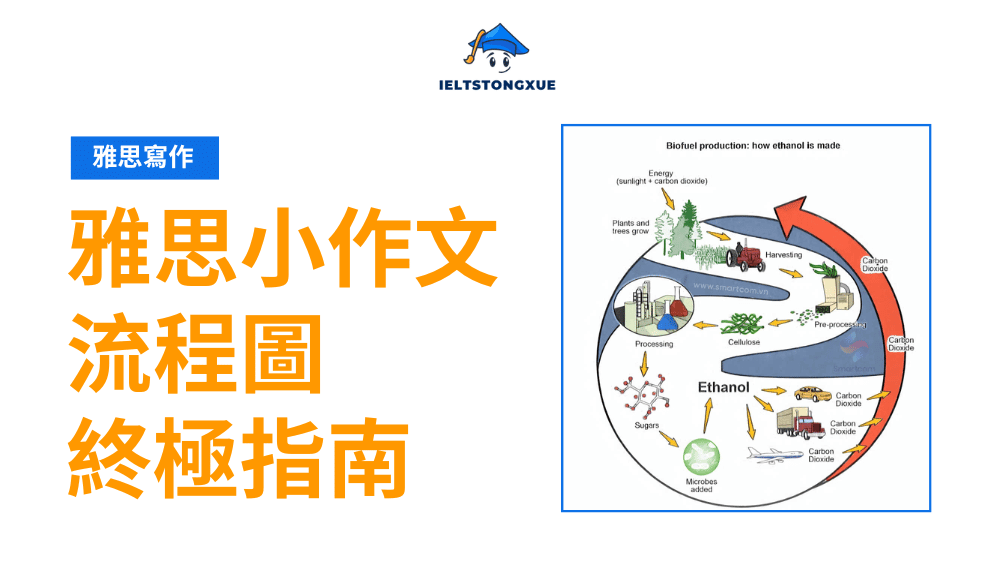
您是否曾在雅思考場上看到流程圖題目時感到手足無措,不知該從何下筆?雅思小作文流程圖確實是許多考生公認最具挑戰性的題型之一,因為它不僅要求您準確理解複雜的步驟順序,更需要運用專業的描述技巧與精準的被動語態來呈現整個過程。根據 IELTSTongXue 教學團隊多年的考場數據分析,超過 60% 的考生在首次遇到流程圖時會出現結構混亂、詞彙重複或遺漏關鍵步驟等問題,導致分數難以突破 6 分門檻。然而,好消息是,流程圖其實是最具「套路」可循的題型,只要掌握正確的分析方法與寫作藍圖,您完全可以將它轉化為穩定得分的優勢項目。
想像一下,當其他考生還在苦惱如何組織語言時,您已經能夠在三分鐘內完成審題規劃,用流暢的連接詞串連每個步驟,並自信地運用多樣化的動作動詞來展現語言能力。這正是本指南將為您實現的目標。
本文由 ieltstongxue.com 資深雅思導師團隊傾力打造,為您提供從基礎概念到進階技巧的完整學習路徑。您將學習到如何辨識流程圖的核心類型、掌握四步黃金寫作法則、建立豐富的詞彙與句型資源庫,並透過五篇 7.0 以上的考官級範文深度剖析,全面理解高分作文的寫作邏輯。無論您目前的英語程度如何,只要按照本指南的策略執行,達到 7 分以上的寫作表現將不再是遙不可及的夢想。
I. 解構雅思流程圖:高分寫作的第一步
工欲善其事,必先利其器。在學習具體的寫作技巧之前,您必須徹底理解 IELTS Writing Task 1 Process/ Diagram 題型本身的本質特徵與官方評分標準。這些基礎知識不僅能幫助您建立正確的寫作思維框架,更能讓您在審題時快速辨識關鍵資訊,為後續的高分表現奠定堅實基礎。
1. 認識流程圖的兩大核心類型與變體
雅思小作文流程圖主要分為兩個核心類型,每種類型在描述重點與寫作策略上都有顯著差異。
- 第一類是人造流程(Man-made Process), 典型例子包括水泥的製造過程、傢俱的生產流程,或是某種產品從原料到成品的加工步驟。這類流程通常涉及特定的設備、工序與技術操作,重點在於描述人為控制下的各個生產階段如何有序進行。
- 第二類是自然循環(Natural Cycle), 例如水循環系統、生物的生命週期,或是自然界中的能量轉換過程。這類題型強調的是自然界中週而復始的循環現象,描述時需要突出其連續性與循環特質。
在這兩大類型的基礎上,您還需要掌握一個關鍵的辨識技巧,那就是判斷流程屬於線性結構(Linear)還是循環結構(Cyclical)。
- 線性流程有明確的起點與終點,各步驟依序發生且不會回到起點,例如製造一把椅子的過程從原木開始,最終以完成品結束。
- 循環流程則沒有絕對的終點,最後一個步驟會自然連接回第一個步驟,形成封閉的循環,例如水從海洋蒸發、形成雲、降雨、流回海洋的完整週期。這個辨識步驟對您撰寫概述段(Overview)具有決定性影響,因為您需要在概述中明確指出流程的整體性質。
2. 流程圖的四項評分標準深度解析
理解官雅思方評分標準是達到高分的前提,因為這能讓您明白考官在評閱您的文章時究竟在尋找什麼。雅思小作文 Diagram 的評分同樣依據四個核心標準,但每個標準在流程圖中的具體要求與其他圖表類型存在微妙差異。
| 雅思寫作評分標準 | 在流程圖中的具體要求 |
| Task Achievement (TA) | 您必須準確識別流程的類型與階段總數,在概述段中清晰說明整體特徵。所有主要步驟都需要被描述,不能遺漏關鍵環節,同時要避免加入圖中未呈現的主觀推測或解釋。概述段的完整性與準確性是獲得 6 分以上的必要條件,因為它展現了您對整體資訊的理解與總結能力。 |
| Coherence and Cohesion (CC) | 您的文章需要展現清晰的邏輯流程,使用多樣化的連接詞來串連各個步驟,避免單調重複的 “then… then…”。每個段落應該有明確的主題,段落之間需要平滑過渡。合理的分段策略能夠幫助讀者輕鬆跟隨您的描述,理解整個流程的演進。 |
| Lexical Resource (LR) | 流程圖的描述核心在於動作,因此您需要展現豐富的動詞詞彙,特別是描述加工、轉換、運輸等動作的動詞。使用精準的技術名詞(直接引用圖中資訊)與多樣化的順序詞能顯著提升詞彙分數。避免過度重複相同的詞彙,善用同義詞替換能讓您的文章更具專業性。 |
| Grammatical Range and Accuracy (GRA) | 被動語態是描述流程圖的核心文法結構,因為焦點在於動作本身而非執行者。您需要熟練運用各種被動語態的變化形式,包括簡單現在式被動、完成式被動,以及帶有情態動詞的被動結構。此外,適當使用複雜句式(如 after/before/once 引導的時間子句)能展現您的文法掌控能力。 |
II. 滿分寫作藍圖:攻克雅思小作文流程圖的四步黃金法則
現在您已經理解了題型本質與評分標準,接下來要學習的是一套經過實戰驗證、極具實用性的寫作方法論。IELTSTongXue 教學團隊將整個寫作過程拆解為四個清晰可執行的步驟,每個步驟都對應特定的評分標準,確保您不會遺漏任何得分要點。只要嚴格按照這個藍圖執行,您將能夠有條不紊地完成一篇結構完整、內容充實的高分作文,徹底消除寫作的神秘感與恐懼感。
1. 步驟一:分析與規劃 – 決定成敗的關鍵3分鐘
許多考生急於下筆,卻忽略了寫作前的分析規劃,這往往導致文章結構混亂或遺漏重要資訊。投資 3 分鐘進行仔細的審題與規劃,遠比倉促寫作 12 分鐘更有效率。您需要完成以下三個關鍵動作:
- 首先是辨識流程的起點與終點。仔細觀察圖中的箭頭方向,找出流程開始的第一個步驟與結束的最後一個步驟,如果是循環流程,則需要辨識出最符合邏輯的起始點。
- 其次是為所有步驟編號,在草稿紙上快速標註 1、2、3…,這能幫助您在寫作時不會遺漏任何步驟,同時也能讓您更容易規劃如何將步驟分配到不同段落中。
- 最後是思考分段策略,根據流程的特點決定如何邏輯性地劃分主體段落。
分段策略參考:當流程在不同的地點或區域進行時,您可以按照地點轉移來分段,例如原料處理區與成品包裝區分別描述。如果流程涉及多個功能完全不同的大型設備或系統,則可以按照設備功能分段,例如加熱系統、混合系統與冷卻系統各自獨立成段。對於步驟較多的線性流程,您可以將前半部與後半部分開描述,確保每個段落的內容量適中且易於閱讀。
專家提示: 花三分鐘規劃遠比花二十分鐘修改更有價值。當您清楚知道要寫什麼、如何組織時,您的寫作速度會明顯加快,文章的邏輯性也會大幅提升。這三分鐘的投資能讓您避免寫到一半發現結構不對而需要重寫的窘境。
2. 步驟二:搭建高分結構
文章結構是您得分的基礎框架,一個清晰完整的結構能讓考官輕鬆理解您的內容,從而在 Task Achievement 與 Coherence and Cohesion 兩項標準上獲得較高分數。IELTS Writing Task 1 Process Practice 中最常見的結構包含三個核心部分。
引言段的主要任務是改寫題目,展現您的語言運用能力。您需要使用同義詞替換題目中的關鍵詞,並調整句式結構,避免機械式抄寫。例如,當題目使用 “The diagram shows” 時,您可以改寫為 “The provided illustration demonstrates” 或 “The given diagram depicts”。當題目提到 “how a product is manufactured” 時,您可以替換為 “the manufacturing process of a particular product” 或 “the production stages involved in making”。這種改寫不僅能展現詞彙能力,還能讓您的文章開頭更加專業自然。
概述段是決定您能否突破 6 分進入 7 分區間的關鍵段落。許多考生忽略這個部分,直接進入細節描述,這是導致分數停滯的主要原因之一。概述段的核心任務是用兩到三句話總結流程的整體特徵,包括流程的類型(線性或循環)、涉及的主要階段數量,以及起點與終點的簡要說明。您可以參考以下萬能句型模板。
- 第一種模板適用於線性流程:”Overall, the process consists of X distinct stages, beginning with [起始動作] and culminating in [最終結果].” 例如:”Overall, the manufacturing process consists of seven distinct stages, beginning with the collection of raw materials and culminating in the packaging of finished products.”
- 第二種模板適用於循環流程:”In general, this is a cyclical process comprising X main phases, with the final stage naturally leading back to the initial step.” 例如:”In general, this is a cyclical process comprising four main phases, with the final stage naturally leading back to the initial step of evaporation.”
- 第三種模板強調流程的複雜性:”It is evident that the entire process involves multiple stages of [動作類型], requiring both [設備/條件A] and [設備/條件B].” 例如:”It is evident that the entire process involves multiple stages of heating and mixing, requiring both specialized machinery and precise temperature control.”
3. 步驟三: 填充細節段落
完成了引言與概述的搭建後,您需要將規劃好的步驟有邏輯、有層次地串連成完整的主體段落。這個部分是展現您語言掌控能力的核心區域,直接影響 Lexical Resource 與 Grammatical Range 兩項評分。主體段落的寫作關鍵在於避免流水帳式的平鋪直敘,您需要使用多樣化的連接詞與句式來展現步驟之間的邏輯關係。低分段落往往充斥著單調重複的 “Then” 或 “Next”,這種寫法不僅缺乏變化,也無法準確表達步驟之間的因果、順序或條件關係。讓我們通過一個對比範例來理解差異。假設您要描述一個簡單的三步驟過程。
- 低分寫法(流水帳式): “First, the raw materials are collected. Then, they are transported to the factory. Then, they are processed by machines. Then, the final products are packaged.” → 這種寫法雖然描述了所有步驟,但完全缺乏變化與深度,無法展現語言能力,通常只能獲得 5-5.5 分。
- 高分寫法(銜接流暢): “The process commences with the collection of raw materials from designated sources. Once gathered, these materials are transported to the manufacturing facility via specialized vehicles. Upon arrival at the factory, the materials undergo a series of processing procedures using automated machinery, after which the finished products are carefully packaged for distribution.” → 這個版本使用了多樣化的連接方式(commences with, Once gathered, Upon arrival, after which),展現了複雜句式的運用能力,能夠獲得 7 分以上的評價。關鍵在於每個步驟之間都有清晰的邏輯連接,讀者能夠自然流暢地跟隨整個流程的演進。
4. 步驟四:檢查與優化 – 最後一分鐘的價值
寫作完成後的自我檢查往往被考生忽視,但這最後一分鐘的投資能夠幫助您避免許多不必要的失分。IELTSTongXue 建議您使用以下檢查清單進行快速而高效的自我修正,每一項都直接對應官方評分標準。
- 首先檢查 Task Achievement 相關要點。您是否撰寫了完整的概述段,並在其中說明了流程的整體特徵?所有圖中顯示的主要步驟是否都被描述,沒有遺漏關鍵環節?您是否避免了加入圖中未呈現的主觀推測或額外解釋?
- 其次檢查 Coherence and Cohesion 要點。您是否使用了至少五種不同的連接詞或連接短語,避免了單一詞彙的過度重複?每個段落是否有明確的主題,段落之間的過渡是否自然流暢?整篇文章的邏輯流程是否清晰易懂?
- 接著檢查 Lexical Resource 要點。您是否使用了多樣化的動詞來描述不同的動作,而非反覆使用 “do” 或 “make” 等基礎詞彙?是否適當使用了圖中提供的技術名詞,展現了詞彙的準確性?同義詞的替換是否自然恰當,沒有造成語意混淆?
- 最後檢查 Grammatical Range and Accuracy 要點。您是否正確使用了被動語態,避免了主被動混用的錯誤?動詞的時態是否統一,通常流程圖應該使用現在式?是否檢查了基本的文法錯誤,如主謂一致、冠詞使用、單複數形式等?
看更多文章:
III. 提升 IELTS Writing Task 1 Process/ Diagram 文章質感的語言武器庫
結構是文章的骨架,而語言則是賦予文章血肉的關鍵要素。即使您擁有清晰的邏輯框架,缺乏豐富多樣的詞彙與文法表達仍然會限制您的分數上限。本章節將為您提供寫作所需的核心語言資源,這些都是從真實高分範文中精煉出的實用表達,幫助您在考場上能夠快速調用,提升文章的專業度與流暢度。
1. 詞彙資源:從常用到7+級別的替換詞表
詞彙的多樣性是 Lexical Resource 評分的核心要素,但許多考生在寫作時往往被固定的表達方式所限制。以下兩個表格將為您提供系統化的 IELTS 詞彙升級方案,讓您能夠根據自己的目標分數選擇合適的表達。
順序連接詞替換表(按分數等級分類):
| 分數等級 | 常用表達 | 使用情境與注意事項 |
| IELTS Band 5 基礎級 | First
Second Then Next Finally |
這些是最基礎的順序詞,雖然能夠表達順序關係,但缺乏變化與深度。如果您的整篇文章只使用這些詞彙,很難突破 6 分。建議僅在開頭與結尾處使用一到兩次,其他位置需要升級表達。 |
| IELTS Band 6 良好級 | Initially
Subsequently Following this At this stage In the next phase |
這些表達展現了一定的詞彙掌控能力,能夠讓您的文章更加正式與流暢。適合用於中間步驟的描述,能夠有效提升文章的連貫性。注意不要在一個句子中使用過多這類詞彙,保持自然性。 |
| IELTS Band 7+ 高分級 | The process commences with
Upon completion of this step Once [動作完成] Prior to [某動作] Simultaneously Concurrently |
這些是高分範文中常見的進階表達,能夠精準描述步驟之間的時間關係、因果關係或同時發生的情況。”Upon completion” 表達完成後的動作,”Simultaneously” 展現同時進行的步驟,”Prior to” 描述前置條件,這些用法能顯著提升您的分數。 |
核心動作動詞庫(按功能分類):
| 動作類型 | 基礎動詞 | 進階同義詞 | 使用範例 |
| 加熱相關 | heat | warm
raise the temperature of subject to high temperatures |
The mixture is subjected to high temperatures of approximately 1,450 degrees Celsius. |
| 混合相關 | mix | combine
blend merge amalgamate |
Various ingredients are carefully blended together to form a homogeneous mixture. |
| 運輸相關 | move, transport | convey
transfer transmit dispatch |
The processed materials are conveyed to the next stage via a series of conveyor belts. |
| 轉化相關 | change, turn into | transform
convert undergo transformation evolve into |
The liquid gradually transforms into a solid state as the temperature decreases. |
| 分離相關 | separate | divide
segregate isolate extract |
Impurities are systematically extracted from the solution through a filtration process. |
| 塑形相關 | shape | mould
form fashion craft |
The heated material is carefully moulded into the desired shape using specialized equipment. |
| 處理相關 | process | treat
handle manipulate refine |
Raw materials are refined through multiple stages before becoming usable products. |
2. 文法準確性:被動語態的精準運用與變化
流程圖描述的核心對象是動作本身與物件的變化,而非執行動作的人或機器,因此被動語態成為這類題型的主要文法結構。理解為何使用被動語態能幫助您更自然地掌握這一文法工具。
考慮這個例子,如果使用主動語態描述,您可能會寫 “Workers collect the raw materials and workers transport them to the factory.” 這種表達不僅重複累贅,更重要的是它將焦點錯誤地放在執行者(workers)身上。但在流程圖中,我們真正關注的是原料被收集這個動作以及它被運輸的過程,執行者是誰並不重要。因此,使用被動語態 “The raw materials are collected and transported to the factory” 更加精準且符合題型要求。
除了最基礎的 “be + V3” 結構,您還應該掌握更多樣化的被動語態變化形式,這能大幅提升您的文法分數。
進階被動語態句型展示:
- 使用分詞結構展現步驟的先後關係:”After being processed in the initial stage, the materials are transferred to a cooling chamber for temperature reduction.” 這個句型中 “After being processed” 清晰展現了時間順序。
- 使用完成式被動展現動作的完成狀態:”Once the mixture has been heated to the required temperature, it can be poured into moulds for shaping.” 這裡 “has been heated” 強調加熱動作已經完成,是下一步的前提條件。
- 使用情態動詞被動展現可能性或必要性:”The final products must be inspected thoroughly before they can be released for distribution.” 這個結構展現了品質檢查的必要性。
- 結合時間子句的被動結構:”While the initial components are being assembled, other materials undergo separate preparation procedures simultaneously.” 這個句型能夠描述同時發生的多個步驟,展現複雜的文法掌控能力。
IV. 雅思小作文流程圖的7.0+分範文深度剖析
理論知識的學習必須結合實際範文的分析才能真正內化為您的寫作能力。本章節將為您提供五篇針對不同流程圖類型的高分範文,每篇都經過 IELTSTongXue 教學團隊的精心挑選與批註。透過這些範文,您不僅能夠看到前面所學的技巧如何在實戰中應用,更能夠建立對高分作文的直觀認知,為您自己的寫作提供可靠的參照標準。
1. 雅思小作文流程圖: How steel rods are manufactured in the furniture industry
題目: The diagram below shows the process of manufacturing steel rods used in the furniture industry. Summarise the information by selecting and reporting the main features, and make comparisons where relevant.
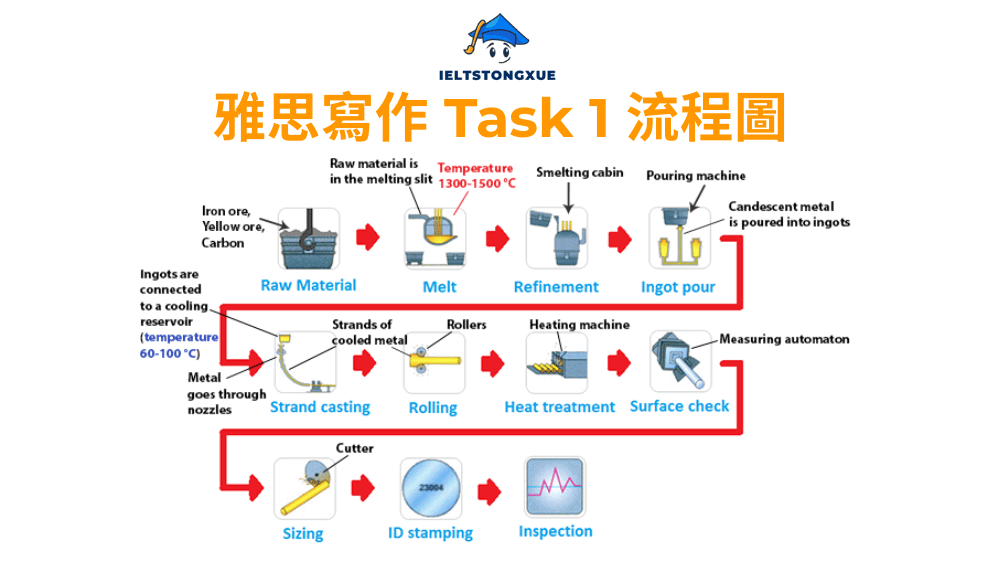
雅思小作文流程圖範文 (IELTS 7.5 分):
The provided diagram illustrates the manufacturing process of steel rods specifically designed for furniture production. Overall, this is a linear process consisting of eleven distinct stages, beginning with the melting of raw materials and culminating in the storage of finished products ready for distribution.
The process commences with the collection of iron ore, recycled steel, and various other materials, which are subsequently loaded into an electric arc furnace. Once inside the furnace, these materials are subjected to extremely high temperatures, causing them to melt into a liquid state. Following this melting phase, the molten steel undergoes a refining procedure to remove any impurities that might compromise the quality of the final product.
After the refining stage has been completed, the purified molten steel is transferred to a continuous casting machine, where it is carefully shaped into semi-finished billets with rectangular cross-sections. These billets are then conveyed to a reheating furnace to ensure they maintain the optimal temperature for subsequent processing. Upon reaching the required temperature, the heated billets are passed through a series of rolling mills, where they undergo multiple stages of compression and elongation, gradually transforming into thinner and longer steel rods.
Once the rolling process is finished, the steel rods are allowed to cool naturally to room temperature on a cooling bed. The cooled rods are subsequently transferred to a straightening machine, which eliminates any bending or warping that may have occurred during the cooling phase. Following straightening, the rods are cut into standardized lengths according to industry specifications. Finally, the finished steel rods are carefully inspected for quality assurance before being bundled together and stored in a warehouse, ready for shipment to furniture manufacturers.
2. 雅思小作文流程圖: How leather goods are manufactured
題目: The diagram illustrates the process of producing leather goods from animal hides. Summarise the information by selecting and reporting the main features.
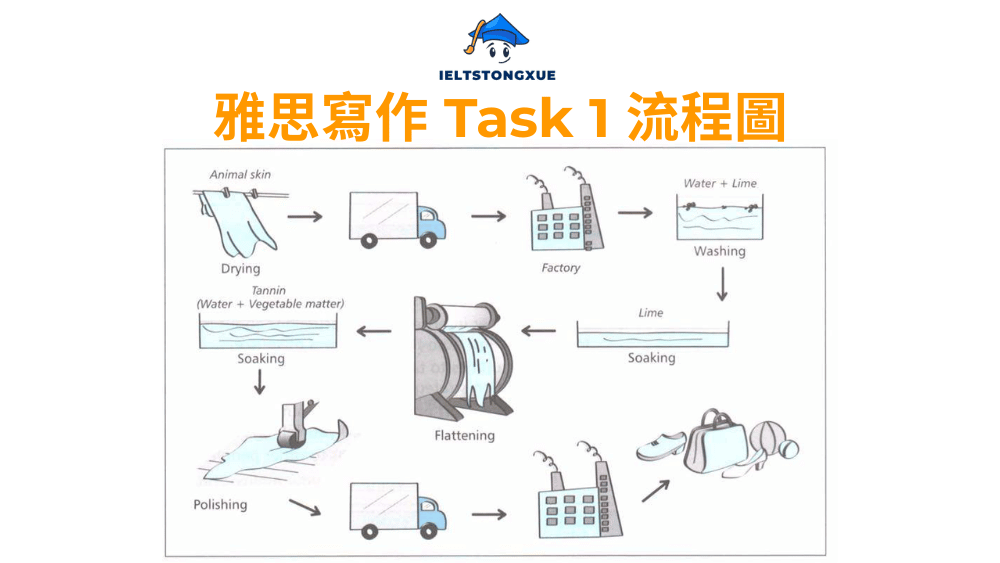
雅思小作文流程圖範文 (IELTS 7.0 分):
The given diagram depicts the comprehensive manufacturing process involved in transforming raw animal hides into finished leather products. In general, the entire procedure comprises approximately eleven stages, commencing with the initial drying of hides and concluding with the creation of various leather goods.
The process begins when animal hides are thoroughly dried under controlled conditions to remove excess moisture. Once sufficiently dried, these hides are immersed in a mixture of water and lime for an extended soaking period, which serves to loosen and remove any remaining hair or unwanted organic matter attached to the surface. Following the soaking phase, the hides are transferred to a large rotating drum filled with a tannin solution, where they undergo a crucial chemical treatment process known as tanning.
During the tanning stage, the hides remain in the drum for several days while the tannin solution penetrates deep into the material, fundamentally altering its molecular structure and preventing decomposition. After tanning has been completed, the treated hides are carefully removed from the drum and subjected to a mechanical flattening process using industrial rollers. This flattening procedure ensures uniform thickness throughout the material and eliminates any surface irregularities that might have developed during previous stages.
Subsequently, the flattened leather is transported to specialized polishing machines, where its surface is buffed and refined to achieve the desired smoothness and sheen. Once the polishing stage is finished, various dyes and coloring agents are systematically applied to the leather surface, allowing manufacturers to produce materials in a wide range of colors and finishes. The dyed leather is then permitted to dry thoroughly in temperature-controlled environments. Finally, skilled craftspeople cut the finished leather into specific shapes and assemble these pieces into various products such as bags, shoes, belts, and jackets, which are subsequently packaged and prepared for retail distribution.
3. 雅思小作文流程圖: The life cycle of the honey bee
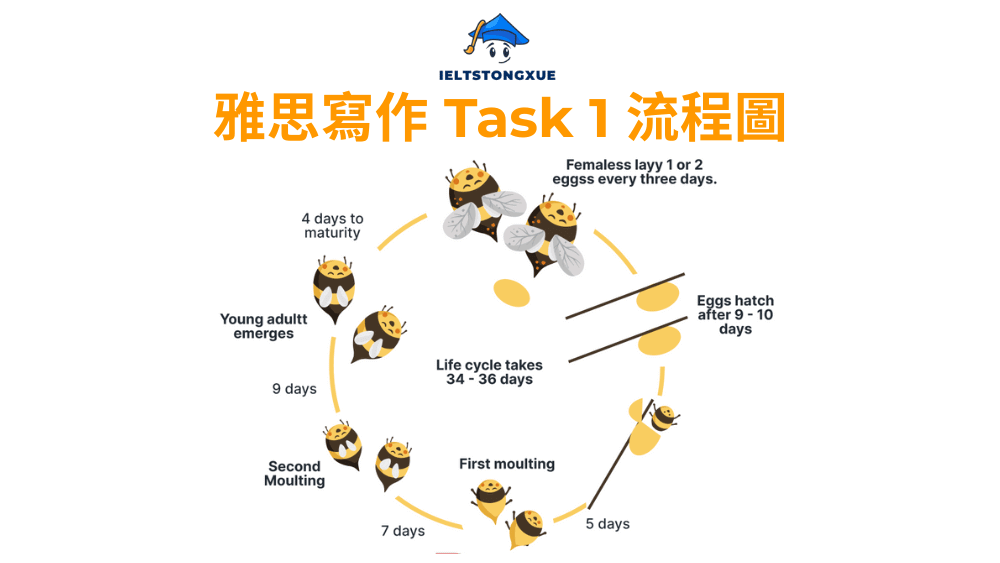
題目: The diagram shows the life cycle of the honey bee. Summarise the information by selecting and reporting the main features.
雅思小作文流程圖範文 (IELTS 7.5 分):
The presented diagram illustrates the complete life cycle of a honey bee, from the initial egg stage through to full maturity. Overall, this is a cyclical biological process spanning approximately 34 to 36 days, during which the bee undergoes five distinct developmental stages characterized by dramatic physical transformations.
The cycle commences when the queen bee lays individual eggs in hexagonal cells within the honeycomb structure. These tiny oval-shaped eggs remain in their cells for a period of between one and three days before hatching. Once hatching occurs, the eggs transform into larvae, which are small, white, worm-like creatures. During this larval stage, which lasts for an additional five days, young worker bees continuously feed the developing larvae with nutrient-rich royal jelly and pollen, enabling rapid growth.
Approximately nine to ten days after the initial egg was laid, each larva enters the pupal stage, during which it begins to develop the characteristic features of an adult bee. Throughout this critical transformation period, the developing pupa remains enclosed within its cell, which worker bees seal with a protective wax capping. The pupal stage represents the longest phase of development, continuing for seven days in the case of future queens, nine days for worker bees, and up to fourteen and a half days for male drones.
Following the completion of the pupal stage, a fully formed adult bee emerges from its sealed cell by breaking through the wax covering. At this point, the young adult possesses all the physical characteristics necessary for its designated role within the colony. The newly emerged bee then joins the established colony, where it will eventually reach sexual maturity after approximately four additional days. Upon achieving full maturity, if the bee is a queen, it will begin the cycle anew by laying eggs, thus perpetuating the continuous regeneration of the colony.
4. 雅思小作文流程圖: The process of growing and preparing pineapples and pineapple products
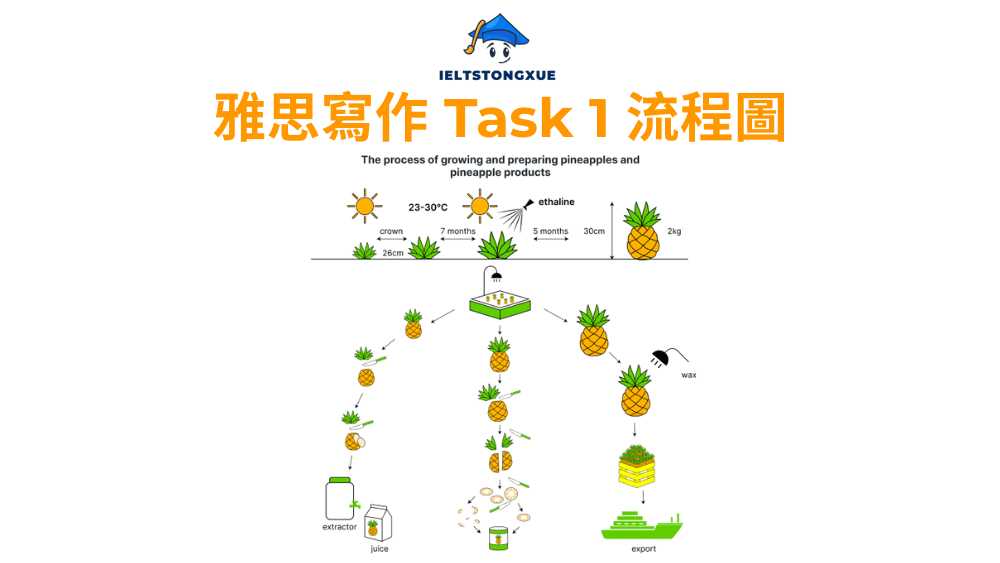
題目: The diagram below shows how pineapples are grown and processed into different products. Summarise the information by selecting and reporting the main features.
雅思小作文流程圖範文 (IELTS 7.0 分):
The provided diagram illustrates the comprehensive process of cultivating pineapples and transforming them into various commercial products. Overall, the entire operation can be divided into two major phases: the agricultural growing stage and the industrial processing stage, with the latter branching into multiple product lines.
The cultivation process begins when farmers plant pineapple crowns in well-prepared soil with appropriate spacing to ensure optimal growth conditions. These planted crowns require consistent care, including regular watering and the application of fertilizers to promote healthy development. Over the course of approximately twelve to eighteen months, the plants gradually mature and begin producing fruit. Once the pineapples have reached the appropriate size and ripeness, indicated by their golden-yellow coloration, they are carefully harvested by workers who cut the fruit from the plant using sharp tools.
Following harvesting, the fresh pineapples are transported to processing facilities where they undergo initial sorting and quality assessment. At this critical junction, the fruits are divided into different categories based on their size, quality, and intended final use. Some premium-quality pineapples are selected for direct sale as fresh fruit and are simply washed, inspected for defects, and packaged in protective materials before being distributed to retail markets.
The remaining pineapples enter various processing lines depending on the desired end product. One significant portion is directed to juice production facilities, where the fruits are first peeled and cored before being crushed and pressed to extract their liquid content. The extracted juice is subsequently filtered to remove any remaining pulp or fibrous material, pasteurized to ensure safety and extended shelf life, and finally packaged into bottles or cartons for consumer purchase. Another substantial quantity of pineapples is processed into canned fruit segments. These pineapples undergo mechanical peeling and cutting procedures that transform them into uniform ring-shaped or chunk-shaped pieces. These prepared pieces are then placed into metal cans, covered with sugar syrup or natural juice, sealed hermetically, and heat-treated to preserve freshness before being labeled and shipped to distribution centers.
5. 雅思小作文流程圖: How a hot air balloon works
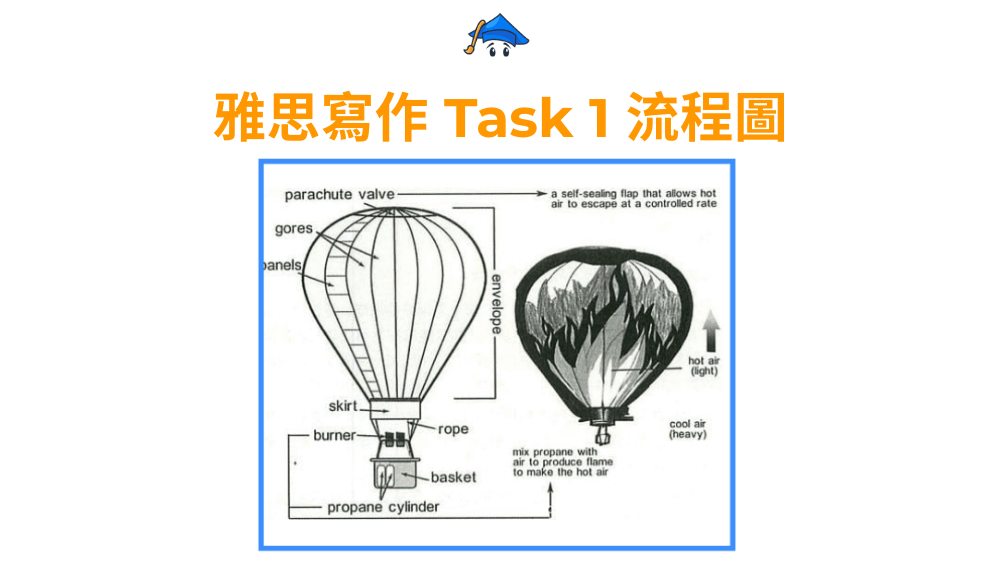
題目: The diagram shows how a hot air balloon operates. Summarise the information by selecting and reporting the main features.
雅思小作文流程圖範文 (IELTS 7.5 分):
The presented diagram illustrates the operational mechanism of a hot air balloon, demonstrating the scientific principles that enable this aircraft to ascend, maintain altitude, and descend safely. Overall, the functioning of a hot air balloon relies fundamentally on the manipulation of air temperature within the envelope, which directly affects the density of the air and consequently determines the balloon’s vertical movement.
The ascending phase commences when the pilot activates the burner system located directly beneath the balloon’s opening. This burner, typically fueled by propane gas, generates intense flames that heat the air inside the balloon’s envelope, which is the large fabric chamber that provides the balloon’s lifting capacity. As the air molecules within the envelope absorb thermal energy, they begin moving more rapidly and spreading further apart from one another, resulting in a significant decrease in air density. According to fundamental physical principles, this heated air becomes notably lighter than the cooler surrounding atmospheric air at the same altitude.
Once the internal air temperature reaches a sufficiently high level and the density differential becomes adequate, the buoyancy force acting upward on the balloon exceeds the combined downward forces of the balloon’s total weight and gravitational pull. At this critical point, the balloon naturally begins to rise through the atmosphere. The rate of ascent can be controlled by the pilot through precise adjustments to the burner’s intensity, with more intense heating producing faster upward movement.
To maintain a stable altitude without continuing to rise, the pilot must carefully balance the heating process, allowing the burner to operate intermittently rather than continuously. This periodic heating compensates for the natural cooling that occurs as the hot air gradually loses thermal energy to the surrounding cooler environment. When the pilot wishes to descend, the burner is deactivated entirely, permitting the air within the envelope to cool progressively. As cooling occurs, the air molecules slow down and move closer together, causing the air density to increase and approach that of the external atmosphere. Consequently, the buoyancy force diminishes until it no longer exceeds the balloon’s weight, and the aircraft begins a controlled descent. For more rapid descent when necessary, many balloons are equipped with a parachute valve at the top of the envelope, which can be opened to release the hot air more quickly, thus accelerating the cooling process and increasing the descent rate.
到目前為止,您已經系統性地學習了雅思小作文流程圖的所有核心寫作技巧,從題型理解到寫作策略,從語言資源到高分範文分析。這些內容為您提供了從零基礎到高分水平的完整學習路徑。然而,在真正的學習過程中,您可能還會遇到一些細微卻關鍵的疑問,這些問題往往不會在常規教材中詳細解答,卻對您的實際寫作表現有著重要影響。接下來的補充內容部分, IELTSTongXue 將為您解答這些進階問題,幫助您掃除學習中的所有盲點,確保您在考場上能夠自信從容地應對任何可能出現的狀況。這些深入的探討將幫助您從「知道如何寫」提升到「精通如何寫得更好」的層次。
V. 雅思小作文 Diagram 的FAQ
1. 流程圖中的「階段 (Stage)」與「步驟 (Step)」在寫作描述時,究竟有何本質區別?
理解 Stage 與 Step 的區別能幫助您在寫作時使用更精準的語言,這對於提升 Lexical Resource 分數有直接幫助。Stage 通常指一個較大的功能區塊或處理階段,它可能包含多個連續的步驟。例如,在水泥製造過程中,「原料準備階段」(Raw Material Preparation Stage)可能包含收集石灰石、開採黏土、運輸原料等多個步驟。每個 Stage 都有其明確的功能目的,代表流程中的一個重要里程碑。
相比之下,Step 是最小的單一動作單元,它描述的是一個具體的、不可再細分的操作。在同一個「原料準備階段」中,「將石灰石裝載到卡車上」就是一個具體的步驟。當您在概述段中描述整體流程時,使用 “The process consists of X stages” 更為恰當,因為這展現了您對流程的宏觀理解。而在主體段落描述細節時,使用 “In the first step” 或 “The subsequent step involves” 則更加精確。
掌握這一區別後,您可以在寫作中靈活運用兩者。例如:”Overall, the manufacturing process comprises three main stages: preparation, processing, and finishing. The first stage begins with several preparatory steps, including the collection and transportation of raw materials.” 這種表達方式展現了您對流程層次結構的清晰認知。
2. 哪些特徵的流程圖最適合被劃分為兩個主體段落,而哪些又更適合三個?
分段策略是影響 Coherence and Cohesion 分數的關鍵因素,但許多考生在決定段落劃分時感到困惑。IELTSTongXue 建議您根據流程的內在邏輯特徵來判斷最佳分段方式。
- 適合劃分為兩個主體段落的情況: 當流程明確分為前後兩個大的階段,且每個階段的步驟數量相當時,兩段式結構最為合適。例如,產品製造流程中的「生產階段」與「包裝階段」,或是自然循環中的「白天過程」與「夜間過程」。如果流程涉及地點的明顯轉移,例如從「戶外種植」到「工廠加工」,這種自然的地理分界也是理想的兩段分割點。總體原則是,當流程能夠清晰地一分為二,且兩部分在功能或性質上有明顯區別時,採用兩個主體段落能讓結構更加清晰。
- 適合劃分為三個主體段落的情況: 當流程包含明顯的「前期-中期-後期」三個階段,且每個階段都包含足夠多的步驟時,三段式結構更為理想。例如,某些複雜的生產流程可能包括「原料準備與初步處理」、「主要加工與轉化」、「品質控制與包裝」三個清晰的階段。如果流程涉及多個不同的大型設備或系統,每個設備都有其獨特的處理功能,那麼為每個設備單獨設段能讓描述更有條理。另一個需要三段的情況是當流程在某個節點出現明顯分支,產生兩種或多種不同的產品路徑時,您可以用一段描述分支前的共同步驟,然後用兩段分別描述不同的分支路徑。
- 判斷的核心原則是: 每個段落應該包含足夠的內容(理想狀態是60-80字),且每個段落都應該有明確的主題與內在邏輯。避免為了湊段落數而人為切割邏輯完整的步驟序列。
3. 如果圖中出現我不認識的專業名詞(如某化學物質),我是否應該直接跳過不寫?
答案是明確的「否」,但您需要掌握正確的處理策略。遇到不認識的專業術語時,很多考生會因為恐懼而選擇迴避,但這種做法可能導致 Task Achievement 失分,因為您遺漏了圖中明確呈現的資訊。
正確的處理方式:
- 直接照抄該專業名詞,完全不需要修改或嘗試解釋它是什麼。考官評估的是您描述流程的能力,而非您對專業知識的理解。例如,如果圖中提到某種化學物質叫 “sodium hydroxide”,您只需要在文章中寫 “sodium hydroxide is added to the mixture”,無需解釋這是什麼物質或它的化學性質。
- 將寫作重點放在描述該物質的「功能」與「變化」上,而非解釋其本質。例如:”The addition of calcium carbonate serves to neutralize the acidity of the solution” 這句話的重點是描述碳酸鈣的功能(中和酸性),而不是解釋碳酸鈣是什麼。再例如:”After being mixed with potassium chloride, the substance undergoes a color transformation from clear to milky white” 這裡重點描述的是混合後的變化,而非氯化鉀的性質。
- 使用正確的連接方式將專業名詞融入句子。例如:”Subsequently, a chemical known as ferrous sulfate is introduced into the tank” 或 “The process requires the use of a specialized compound called polyethylene glycol” 這類表達方式能讓專業術語自然地融入您的描述中。
這種處理方式不僅能確保您不會遺漏資訊,還能展現您在面對陌生詞彙時的應對能力,這本身就是語言能力的一部分。
4. 與雅思地圖題 (Map) 相比,流程圖在時態運用和描述焦點上有何根本性的不同?
理解不同題型之間的差異能幫助您在考場上快速切換正確的寫作模式,避免將不同題型的寫作方式混淆。地圖題與流程圖雖然都屬於 IELTS Writing Task 1, 但它們在核心特徵上存在根本性差異。
時態運用的差異:
- 流程圖的描述幾乎恆定使用現在式(Simple Present Tense),因為它描述的是一個標準化的、可重複發生的過程或自然規律。無論是產品製造流程還是自然循環,這些過程在任何時候執行都是相同的,因此使用現在式最為恰當。例如: “The raw materials are collected and transported to the factory” 而非 “were collected”。
- 地圖題則常常需要使用過去式與將來式,因為它通常描述的是某個地區在不同時間點的變化。當比較過去與現在的地圖時,您需要使用過去式描述舊地圖的狀態(“There was a small park in the northern area in 1990”),使用現在式描述當前狀態。當涉及未來規劃時,則需要使用將來式或計劃性結構(“A new shopping center will be constructed” 或 “is planned to be built”)。
描述焦點的根本不同:
- 流程圖的核心焦點是「順序」與「轉化」。您需要清晰地展現各個步驟如何依序發生,物質或物件如何從一個狀態轉變為另一個狀態。關鍵詞包括 “then”, “subsequently”, “transforms into”, “undergoes” 等表達順序與變化的詞彙。
- 地圖題的核心焦點則是「變化」與「空間位置」。您需要突出某個區域經歷了什麼樣的改變,新增了什麼設施,移除了什麼建築,或是擴建了哪些區域。關鍵詞包括 “replaced”, “demolished”, “extended”, “relocated”, “in the north/south of” 等表達變化與位置的詞彙。
句式結構的差異:
- 流程圖中常用的句式包括:”After being processed, the material is transferred to…” 或 “Once the heating stage has been completed, the mixture undergoes…”這些句式強調步驟之間的時間與因果關係。
- 地圖題中則更常使用:”The factory which was located in the east has been replaced by a residential area” 或 “A considerable number of trees have been cut down to make way for a new road” 這類句式強調位置與變化的對比。
觸類旁通地理解這些差異,能讓您在面對不同題型時迅速調整寫作策略,確保每種題型都能獲得理想分數。
總結
掌握本指南的系統化策略後,雅思寫作 Task 1 流程圖將成為您穩定得分的優勢項目。成功的關鍵在於四個核心要素:徹底理解題型特徵與評分標準、遵循四步黃金寫作法則、建立豐富的詞彙與文法資源庫,以及透過高分範文分析將理論轉化為實戰能力。為了真正內化這些技巧,IELTSTongXue 建議您採取以下行動方案。每週完成兩篇限時二十分鐘的完整練習,模擬真實考試環境。將文中的詞彙句型製作成個人筆記,每次練習前複習並有意識地應用。完成作文後對照評分標準自我評估,找出弱項針對性改進。同時摘錄範文中的優秀表達,分析使用情境並嘗試模仿運用。
寫作能力的提升需要持續練習與反思。只要堅持按照本指南進行系統化訓練,流程圖將從絆腳石轉變為助您邁向 7 分以上的得分跳板。IELTSTongXue 相信,您在雅思寫作的征途上必能取得理想成績!

