



雅思大作文 Agree or Disagree 題型應該如何準備?如何在 40 分鐘內寫出 Band 7 以上的高分作文?這是每位雅思考生最關心的核心問題。雅思大作文 Agree or Disagree 是 IELTS Writing Task 2 中出現頻率最高的題型之一,要求考生針對特定陳述明確表達立場,並提供充分且具說服力的論證。掌握這個題型的關鍵不在於背誦模板或華麗詞彙,而在於理解考官的評分邏輯、選擇適合的立場策略,以及運用系統化的段落展開技巧。
許多考生在面對這類題目時常常陷入困境:不知道該完全同意還是部分同意、擔心立場不夠明確會失分、或是寫出的內容缺乏深度和說服力。事實上,無論您選擇哪種立場,都有相應的寫作策略可以幫助您獲得高分。從「一邊倒」的堅定立場到「平衡觀點」的批判思維,每種策略都有其適用場景和具體操作方法。本指南由 IELTSTongXue 專業教學團隊根據 2026 年最新考試趨勢精心編撰,將帶領您深入理解四大官方評分標準,掌握三種核心立場策略,學習 PEEL 段落展開法則,並透過五篇 Band 7.0+ 真實範文分析,幫助您在最短時間內實現從基礎到高分的突破。
I. 雅思大作文 Agree or Disagree 是什麼?
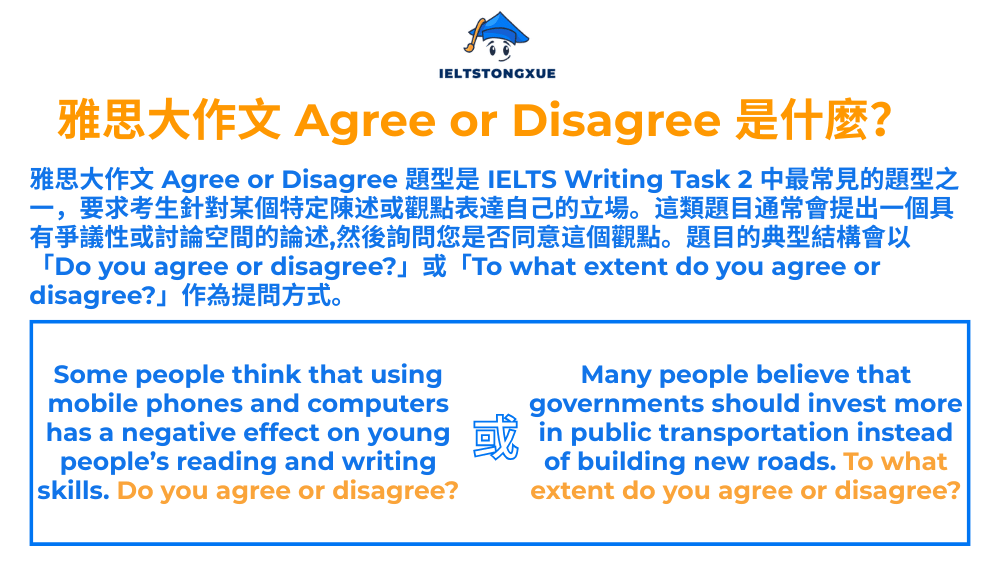
雅思大作文 Agree or Disagree 題型是 IELTS Writing Task 2 中最常見的題型之一,要求考生針對某個特定陳述或觀點表達自己的立場。這類題目通常會提出一個具有爭議性或討論空間的論述,然後詢問您是否同意這個觀點。題目的典型結構會以「Do you agree or disagree?」或「To what extent do you agree or disagree?」作為提問方式。例如:
- Some people think that using mobile phones and computers has a negative effect on young people’s reading and writing skills. Do you agree or disagree?
- Many people believe that governments should invest more in public transportation instead of building new roads. To what extent do you agree or disagree?
這個題型的核心在於評估您的批判性思維能力和論證技巧。考官希望看到您能夠選擇一個明確的立場, 並運用邏輯推理、具體例證和清晰的語言來支持您的觀點。與其他題型不同, Agree or Disagree 題型給予您較大的靈活度, 您可以選擇完全同意、完全不同意, 或是採取較為平衡的立場, 認為該陳述在某些情況下成立。
值得注意的是, 這個題型並非測試您的知識廣度或您對某個議題的「正確」見解。相反地, 考官關注的是您如何建構論證、如何組織想法, 以及您的語言表達能力。即使您的觀點與主流意見不同, 只要您能提供合理且充分的論證, 依然能獲得高分。這正是 IELTS Writing task 2 Agree or Disagree 題型的魅力所在——它考驗的是您的思維能力, 而非單純的知識記憶。
理解這個題型的本質後, 下一步是掌握考官如何評估您的作文。只有深入了解評分標準, 您才能有針對性地提升寫作技巧, 避免在錯誤的方向上浪費努力。
II. 雅思大作文 Agree or Disagree 考試評分標準
許多考生誤以為雅思寫作高分的秘訣在於背誦華麗的詞彙或複雜的句型模板。然而,無論是一般題型還是雅思大作文 Agree or Disagree,真正決定您分數的是四個核心評分標準的綜合表現。理解這些標準不僅能幫助您明白考官的期待,更能讓您在練習時有明確的改進方向。
雅思作文官方評分標準包括任務回應、連貫與銜接、詞彙豐富度與準確性,以及文法多樣性與準確性。這四個維度各佔 25% 的權重,共同決定您的最終分數。重要的是,這些標準之間存在密切關聯,一個方面的弱點可能會影響其他方面的表現。

1. 任務回應(Task Response)
任務回應評估的是您是否完整且恰當地回答了題目的要求。在雅思大作文 Agree or Disagree 題型中,這意味著您必須明確表達自己的立場,並提供充分的論證支持。許多考生在這個標準上失分,原因往往不是缺乏想法,而是立場表達不清或論證不足。高分考生與低分考生在任務回應上的差異可以透過以下比較清楚呈現:
| 分數段 | 立場表達 | 論證深度 | 論點發展 | 具體表現 |
| Band 5 IELTS | 立場模糊或搖擺不定 | 論證表面,缺乏深度 | 論點重複,缺乏展開 | 可能在文中改變立場,或使用「I sometimes agree and sometimes disagree (我有時同意,有時不同意)」這類模稜兩可的表述 |
| Band 6 IELTS | 立場基本明確 | 論證存在但不夠深入 | 論點相關但發展不充分 | 能明確表態同意或不同意,但支持論點的例證或解釋不夠具體或說服力不足 |
| Band 7+ IELTS | 立場清晰一貫 | 論證充分且具說服力 | 論點充分展開且相互呼應 | 從開頭到結尾立場保持一致,每個論點都有具體例證或深入解釋,文章整體邏輯嚴密 |
要達到 Band 7 以上的標準,您需要在文章開頭就明確表明立場,在主體段落中提供具體且相關的論證,並在結論中再次強化您的觀點。避免使用「This question is very complicated and difficult to answer. (這個問題很複雜, 很難說。)」這類迴避性表述,因為這會讓考官認為您缺乏明確的思考方向。
2. 語篇連貫與連貫性(Coherence and Cohesion)
這個標準評估您的文章是否具有清晰的邏輯結構,以及各個部分之間的連接是否自然流暢。許多考生在練習雅思大作文 Agree or Disagree時對這個標準存在誤解,認為只要大量使用連接詞如「moreover」、「furthermore」、「in addition」就能獲得高分。實際上,過度或不當使用連接詞反而會讓文章顯得僵硬不自然。有效使用連接詞並確保文章具備真正的連貫性,需要遵循三個核心原則:
- 第一,準確性優先於花俏。選擇最能精確表達您想法之間關係的連接詞,而非單純追求雅思詞彙的「高級」程度。例如,如果兩個論點是遞進關係,使用「furthermore」是恰當的;但如果是因果關係,「therefore」或「consequently」會更準確。
- 第二,追求多樣性但避免刻意堆砌。在整篇文章中,嘗試運用不同類型的連接方式,包括連接詞、代詞指代、同義替換等。這能展現您對語言的掌控能力,同時讓文章讀起來更自然。然而,不要為了展示多樣性而在每個句子開頭都使用不同的連接詞,這會讓文章失去自然的節奏。
- 第三,適度使用而非過度依賴。高分文章的連貫性更多來自於邏輯清晰的思路和合理的段落安排,而非連接詞的數量。有時候,一個精心設計的主題句比三個連接詞更能體現文章的連貫性。您應該先確保文章的邏輯架構清晰,再運用連接詞來增強這種連貫性。
3. 詞彙豐富程度與準確性(Lexical Resource)
詞彙豐富度評估的不僅是您認識多少「高級」單詞,更重要的是您能否準確且靈活地運用詞彙來表達想法。在雅思大作文 Agree or Disagree 寫作中,「用對詞」永遠比「用大詞」更重要。許多考生會背誦大量學術詞彙,試圖在考試中展現自己的詞彙量。然而,如果這些詞彙使用不當或不符合語境,反而會降低分數。考官更看重的是您能否運用準確的詞彙來表達特定的意思,以及您是否能透過同義替換、詞性轉換等方式來避免重複。
舉例來說,如果您想表達「很重要」,Band 5-6 的考生可能會重複使用「important」,而 Band 7+ 的考生則會根據語境選擇「crucial」、「vital」、「significant」或「essential」等不同表達。更高明的做法是運用不同的句式結構來傳達相同的概念,例如「plays a pivotal role in」或「serves as a cornerstone of」。
此外,拼寫準確性也是這個標準的重要組成部分。頻繁的拼寫錯誤會嚴重影響您的分數,即使您使用的是相對簡單的詞彙。建議您在平時練習時就養成仔細檢查拼寫的習慣,特別是那些常用但容易拼錯的詞彙。
4. 語法多樣性與準確性(Grammatical Range and Accuracy)
語法評分標準關注兩個維度:您能否運用多種句型結構來表達想法(多樣性),以及這些句子在語法上是否正確(準確性)。這兩者同樣重要,缺一不可。針對雅思大作文 Agree or Disagree這類論證型題型,句型變換是展現英文文法廣度的關鍵方式之一。高分文章會靈活運用主動語態與被動語態、簡單句與複合句、定語從句與分詞短語等不同結構。例如,與其重複使用「People think that…」的結構,您可以變換為「It is widely believed that…」或「There is a growing consensus that…」。這種變化不僅展現您的語法能力,也讓文章讀起來更有節奏感。
然而,多樣性必須建立在準確性的基礎上。一篇充滿複雜句型但錯誤百出的文章,其分數往往低於一篇句型相對簡單但語法準確的文章。考官能夠區分「偶發性錯誤」和「系統性錯誤」。偶發性錯誤是指在高壓環境下偶爾出現的小失誤,這些錯誤在 Band 7+ 的文章中是可以接受的。但如果您反覆出現同樣的語法錯誤,這表明您對該語法點的掌握不足,會嚴重影響雅思分數。
在準備階段,建議您先確保基本語法結構的準確性,再逐步增加句型的多樣性。一個實用的練習方法是:寫完雅思大作文 Agree or Disagree草稿後,檢查是否存在連續三句使用相同句型結構的情況。如果有,嘗試將其中一兩句改寫為不同的結構,這能有效提升您的語法多樣性得分。理解了這四個評分標準後,您已經掌握了雅思寫作高分的理論基礎。接下來,我們將進入實戰階段,學習如何將這些標準轉化為具體的寫作策略和技巧。
III. 雅思大作文 Agree or Disagree 的如何撰寫
掌握評分標準後,下一個關鍵問題是:如何將這些理論轉化為實際的文章架構?雅思大作文 Agree or Disagree 題型的寫作策略並非一成不變,您需要根據題目的具體內容、自己對議題的理解,以及考試當下的思路來選擇最適合的立場和架構。
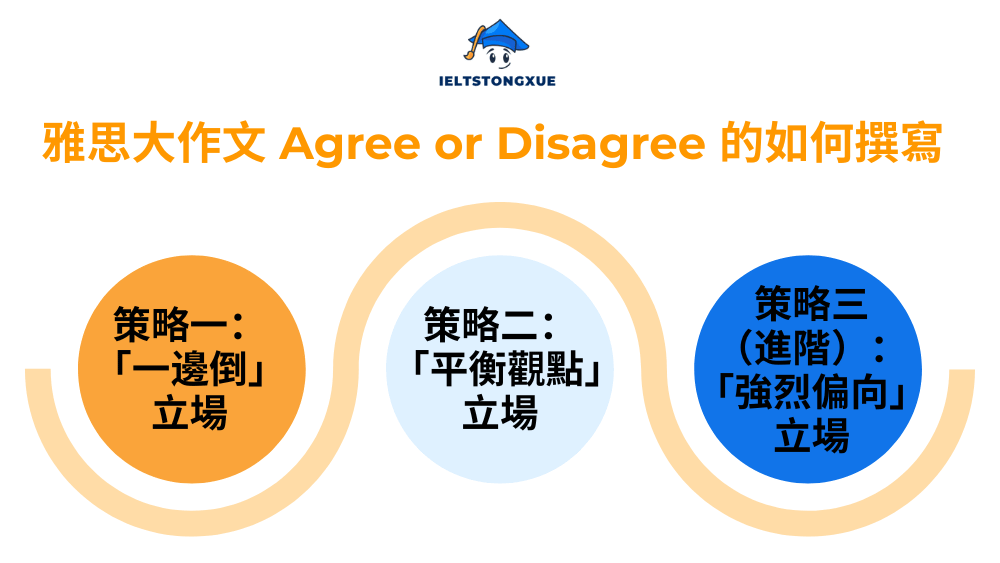
無論您選擇哪種立場,所有高分文章都遵循一個基本原則:四段式架構。這個架構包括引言段、兩個主體段落,以及結論段。這種結構清晰明瞭,既能滿足字數要求(至少 250 字),又能讓您有足夠的篇幅充分展開論證。在這個基礎架構上,您可以根據不同的立場策略進行靈活調整。
1. 策略一:「一邊倒」立場
「一邊倒」立場是指您完全同意或完全不同意題目中的陳述,並在整篇雅思大作文 Agree or Disagree文章中堅定地支持這個立場。這種策略適用於您對某個議題有強烈且明確的看法,能夠想出兩個以上充分的理由來支持您的立場。
這種策略的優勢在於立場明確,論證集中,不容易出現邏輯混亂的情況。然而,它也要求您能夠提供足夠強有力的論據,否則文章會顯得單薄或偏頗。如果題目本身就傾向某一方(例如「吸菸有害健康」這類幾乎沒有爭議的陳述),採用一邊倒立場是在雅思大作文 Agree or Disagree中最自然的選擇。
採用這種策略時,您的文章結構如下:
- 引言段需要改寫題目背景,明確表明您完全同意或完全不同意的立場,並簡要提及您將在主體段中討論的兩個主要理由。
- 主體段一詳細闡述您的第一個支持理由,包括解釋、例證和論證,確保這個理由與您的立場直接相關且具說服力。
- 主體段二展開您的第二個支持理由,採用與主體段一相似的論證方式,但角度應與第一個理由互補而非重複。
- 結論段總結您的主要論點,重申您的立場,並可以加入一個前瞻性的結語,讓文章更有深度。
舉例來說,如果題目是:“The government should ban all forms of advertising because it encourages people to buy unnecessary goods. Do you agree or disagree?”
而您選擇完全不同意,那麼您的兩個主體段可以這樣設計:
- 廣告提供重要的產品資訊,幫助消費者做出明智選擇;
- 廣告是現代商業經濟的重要組成部分,支持就業和創新。
2. 策略二:「平衡觀點」立場
「平衡觀點」立場是指您認為題目中的陳述部分正確,但同時也存在另一面的考量。這種策略在雅思大作文 Agree or Disagree題型中能夠展現您的批判性思維能力,顯示您能夠從多個角度分析問題。然而,它也容易被誤用,導致文章立場不清,或讓人覺得像「牆頭草」一樣搖擺不定。
成功運用平衡觀點的關鍵在於:雖然您承認雙方都有道理,但您最終必須明確表達自己更傾向哪一方,或指出在什麼條件下哪一方的觀點更具說服力。這種策略特別適合那些確實存在雙面性的議題,例如科技對社會的影響、教育方法的優劣等,都是常見的雅思大作文 Agree or Disagree題目範疇。
採用這種策略時,文章結構需要特別注意邏輯連貫性與說服策略的層次安排:
- 引言段:改寫題目內容,承認議題的複雜性,並明確表示您認為需要多角度看待,同時輕微暗示您的最終立場。
- 主體段一(讓步段):誠實討論您「部分同意」的一方,例如題目的立場,承認其合理性,但要為接下來的主張鋪墊空間。
- 主體段二(立場段):轉換立場、清楚表明您更堅定支持的觀點,並給出更強而有力的論據進行論證(通常這段較長、內容更充分),以展現您的判斷與說服力。
- 結論段:平衡而有個性的總結,重申立場,點出問題的多面性是現實的一部分,但強調為何您仍選擇某一方作為整體觀點。
舉例說明:對於題目 “Technology has made our lives more complicated, not simpler. Do you agree or disagree?”,您可以這樣切入平衡觀點結構:
- 讓步段:承認某些科技(如社群媒體、智能設備)在初期使用上確實會帶來學習曲線與隱私焦慮;
- 立場段:強調科技整體上提升了效率、提供便利的通訊方式,並已深度融入工作與生活,令生活變得更簡單;
- 結論:表達您不同意該陳述(科技使生活變複雜),並指出關鍵在於如何恰當使用科技。
3. 策略三(進階):「強烈偏向」立場
「強烈偏向」立場是雅思大作文 Agree or Disagree中「平衡觀點」的進階版本,適合那些希望展現更成熟思維與語用控制力的考生。這種策略與平衡觀點的主要區別在於,您對某一方的支持更加明顯和堅定,讓步的部分僅是為了顯示您考慮過其他觀點,而非真正認為兩方具有同等重要性。
這種策略在語氣和論述分配上體現「偏向」。讓步段通常較短,可能只用兩到三句簡單承認反方觀點的存在,然後迅速轉向您所支持的觀點。立場段則需要佔據主體段的大部分篇幅,提供明確、具邏輯性與說服力的論證與例證。您可以運用句型如 “Although… but…”、”Although…, nevertheless…” 來強調您的傾向立場。
舉例說明:對於題目 “University education should be completely free. Do you agree or disagree?”,您可以簡短承認免費高等教育可能會加重政府的財政負擔,但隨即展開詳盡論述,說明免費教育如何:
- 促進社會公平、
- 提升整體國民素質、
- 長期有助於國家經濟成長。
最後在結論段再次明確表示您「強烈同意」題目的立場。
掌握這三種雅思大作文 Agree or Disagree策略──一邊倒、平衡觀點、強烈偏向──後,您需要在考場上迅速評估題目性質,選擇最合適的論述方式。一般而言:
- 如果題目本身具有明確的正誤傾向,可採「一邊倒」;
- 如果您能列出雙方觀點並擅長權衡,可選「平衡觀點」;
- 如果您想展現更高層次的思維與邏輯轉折,則「強烈偏向」會是最具技巧性的選擇。
記住,沒有絕對的寫作「正確策略」,只有最適合當下題目與您觀點的靈活應用方式。
IV. 雅思大作文 Agree or Disagree 的精雕細琢:從段落到句子的論證藝術
理解了宏觀的文章架構後,我們需要將視角聚焦到微觀層面——如何寫出高質量的段落和句子。這部分內容將為您提供具體可操作的寫作工具,幫助您將前面學到的結構理論,實際應用到雅思大作文 Agree or Disagree等題型中,轉化為有血有肉的文章內容。
許多考生在寫作時會遇到「知道該寫什麼但不知道怎麼寫」的困境。他們對題目有清晰的想法和立場,卻無法將這些思路有效地轉換成令人信服的文字。問題的根源往往在於缺乏系統的段落展開方法與句型表達工具。接下來將介紹的 PEEL 法則(Point, Explanation, Example, Link)和常用句型庫,將成為您寫作雅思大作文 Agree or Disagree時的得力助手,幫助您大幅提升段落連貫性與邏輯說服力。
1. 主體段寫作的 PEEL 法則:打造無法反駁的論點
PEEL 是 Point(論點)、Explain(解釋)、Evidence(證據)、Link(連結)的縮寫,這個法則為您提供了一個清晰的段落展開框架。特別在雅思大作文 Agree or Disagree這類題型中,遵循 PEEL 結構,您可以確保每個主體段都邏輯嚴密、論證充分,讓您的觀點更具說服力且容易被考官高分評價。

| P – Point(提出論點) | 每個主體段的第一句應該是一個清晰的主題句,直接陳述這一段的核心論點。這個論點必須與您的整體立場相關,並且為接下來的解釋和論證指明方向。避免使用模糊或過於籠統的表述,而應該提出一個具體且可展開的觀點。
例如,如果您在論證「遠距工作對員工有利」這個立場,一個好的 Point 可能是:「遠距工作顯著提升了員工的工作生活平衡,讓他們能夠更有效地管理個人和職業責任」。這個論點具體、明確,並為後續展開提供了清晰的方向。 |
| E – Explain(深入解釋) | 在提出論點後,您需要進一步解釋為什麼這個論點是成立的。這部分是許多考生容易忽略的,他們往往在提出論點後就直接跳到例子,導致論證顯得單薄。有效的解釋需要闡明論點背後的邏輯、原因或機制。
繼續上面的例子,Explain 部分可能是:「這是因為遠距工作消除了通勤時間,員工可以將這些節省下來的時間用於家庭活動、個人興趣或休息。此外,靈活的工作安排讓員工能夠在精力最充沛的時段處理工作任務,在需要時照顧家人,而不必在兩者之間艱難取捨」。 |
| E – Evidence(提供證據) | 在解釋之後,您需要提供具體的證據來支持您的論點。證據可以是統計數據、研究結果、具體例子或邏輯推理。在雅思大作文 Agree or Disagree 寫作中,您不需要引用真實的研究資料(考官不會核實),但您的例證應該聽起來合理且具體。
例如:「根據近期的職場趨勢調查,實施遠距工作政策的公司報告員工壓力水平下降了約 30%,員工滿意度提升了 40%。許多員工表示,遠距工作讓他們能夠在早晨送孩子上學,在午休時準備健康餐點,這些看似微小的改變累積起來,對生活品質產生了顯著的正面影響」。 |
| L – Link(連結回論點) | 段落的最後需要將討論連結回您的主要論點或文章的整體立場。這一步確保段落的邏輯完整性,並為過渡到下一段做好準備。Link 不需要很長,通常一句話就足夠。
例如:「因此,遠距工作確實為員工創造了更平衡、更健康的生活方式,這證明了這種工作模式對員工福祉的積極影響」。 |
完整運用 PEEL 法則的段落,能夠確保您的論證既有深度又有說服力。在練習時, IELTSTongXue建議您有意識地標註出每個段落的 P-E-E-L 部分,直到這種寫作方式成為自然習慣。
2. 萬用高分句型庫:三大功能的實用模板
掌握了段落展開的邏輯後,您在撰寫雅思大作文 Agree or Disagree時,還需要豐富且靈活的句型來表達您的想法。以下按照功能分類的句型庫,能夠幫助您在不同情境下選擇最恰當的表達方式,進一步提升論點的清晰度與說服力。
- 功能一:表達立場與觀點 → 在引言段和主體段中,您需要清晰地表達自己的立場。以下句型可以幫助您做到這一點。
- 「我完全同意這個觀點,因為…(主要理由概述)」可以表達為:「I fully endorse this viewpoint, as it recognises the fundamental importance of…」或「This perspective aligns entirely with my understanding, given that…」。
- 「我部分同意這個陳述,但認為需要考慮其他因素」可以表達為:「While this statement holds merit to some extent, it overlooks several critical considerations」或「This viewpoint captures an important aspect of the issue, yet it fails to account for…」。
- 「我認為這個觀點過於簡化了複雜的問題」可以表達為:「This assertion oversimplifies what is inherently a multifaceted issue」或「Such a blanket statement fails to acknowledge the nuanced reality of…」。
- 「在我看來,真正的關鍵在於…」可以表達為:「From my perspective, the crux of the matter lies in…」或「What truly matters, in my view, is…」。
- 功能二:銜接與過渡 → 順暢的銜接能讓您的文章讀起來更連貫。以下句型能幫助您在不同論點之間建立邏輯關係。
- 表達遞進關係時,可以使用:「此外,更重要的是…」表達為「Moreover, what holds even greater significance is…」;「除此之外,我們還必須考慮…」表達為「Beyond this consideration, we must also examine…」。
- 表達因果關係時,可以使用:「正因如此,我們可以看到…」表達為「Consequently, it becomes evident that…」;「這導致了…的結果」表達為「This gives rise to the phenomenon whereby…」。
- 表達對比關係時,可以使用:「相較之下…」表達為「By contrast, …」或「In stark opposition to this view,…」;「然而,我們不能忽視…」表達為「That said, we cannot discount the fact that…」。
- 功能三:總結與強調 → 在結論段或段落結尾,您需要總結觀點並強調重點。
- 「總而言之,我堅信…」可以表達為:「In conclusion, I remain firmly convinced that…」或「To sum up, the evidence overwhelmingly supports the notion that…」。
- 「基於以上論述,很明顯…」可以表達為:「Based on the foregoing analysis, it is clear that…」或「Given these considerations, one cannot deny that…」。
- 「這個議題的核心在於…」可以表達為:「At the heart of this debate lies the question of…」或「What ultimately matters is…」。
使用這些句型時,記住兩個原則: 第一,不要生搬硬套,而要根據您的具體內容和語境選擇最合適的表達;第二,同一篇文章中避免重複使用相同的句型,嘗試在提供的選項中輪換使用,展現您的語言多樣性。有了 PEEL 法則和句型庫這兩大工具,您已經具備了撰寫高分文章的基本技能。接下來, IELTSTongXue將透過實際的高分範文,讓您看到這些技巧如何在真實考試情境中發揮作用。
V. 雅思大作文 Agree or Disagree 分數 7.0+
理論和技巧的學習固然重要,但真正能幫助您提升寫作能力的,是看到這些原則如何在實際雅思大作文 Agree or Disagree文章中體現。以下提供五篇 Band 7.0 以上的範文,涵蓋不同主題與立場策略。每篇範文都遵循前文介紹的評分標準與寫作技巧,展示了如何將理論轉化為高質量的文章。
在閱讀這些範文時,建議您關注幾個關鍵方面。首先,注意作者如何在引言段明確表達立場,以及這個立場如何在全文中保持一致。其次,觀察每個主體段如何運用 PEEL 法則展開論證,特別是 Explain 和 Evidence 部分的深度和具體性。第三,留意文章中句型和詞彙的多樣性,以及連接詞的自然運用。最後,思考作者選擇的立場策略(一邊倒、平衡觀點或強烈偏向)是否適合該題目,以及這種策略如何影響文章的整體結構。
1. Scientific research should be carried out and controlled by governments rather than private companies. Do you agree or disagree?
Scientific advancement has become essential to modern civilisation, yet debate continues over who should control research activities. While government oversight ensures ethical standards, I firmly believe that private companies should play a significant role in conducting scientific research, as they bring efficiency and practical innovation that government institutions often lack.
One compelling reason to support private sector involvement is the superior efficiency these organisations demonstrate. Private companies operate under competitive pressures that drive them to optimise resources and accelerate research timelines. During the recent global health crisis, private pharmaceutical firms developed vaccines in months rather than the years typically required by government-funded projects. This rapid response occurred because these companies could mobilise resources immediately and implement parallel testing phases without bureaucratic delays. Such efficiency can literally save lives when addressing urgent health threats.
Furthermore, private companies excel at translating theoretical research into practical applications. While government laboratories often focus on fundamental research that takes decades to yield results, private organisations are incentivised to develop marketable solutions addressing real-world problems. Technology companies exemplify this pattern through their artificial intelligence research, which has produced medical diagnostic systems that detect diseases earlier than human doctors and agricultural technologies that help farmers increase yields while reducing environmental impact. These innovations emerged because private firms understood market needs and invested in research with clear application pathways.
In conclusion, while government oversight remains necessary for ethical standards and foundational research funding, private companies should retain significant autonomy in conducting scientific research. Their efficiency and ability to deliver practical applications make them indispensable partners in advancing knowledge and improving quality of life.
(字數:267 字)
2. Access to clean water is a basic human right. Therefore every home should have a water supply that is provided free of charge. To what extent do you agree or disagree?
Clean water provision represents a fundamental necessity for human survival and dignity. While I strongly agree that access to clean water should be recognised as a universal human right, I believe that providing it entirely free to every household presents practical challenges requiring a more nuanced approach that combines subsidised provision for those in need with sustainable pricing mechanisms.
The principle that clean water is a basic human right is morally unassailable. Water is not a luxury but an absolute requirement for health, sanitation, and dignity. Millions in developing regions spend hours daily collecting water from distant, contaminated sources, a burden falling disproportionately on women and children who could otherwise invest this time in education or income-generating activities. Communities without reliable water access experience higher rates of waterborne diseases and infant mortality. Recognising water access as a fundamental right establishes a moral framework obligating governments to prioritise water infrastructure and ensure no one is denied this resource due to poverty.
However, implementing completely free water provision presents significant sustainability challenges. Water infrastructure requires substantial investment in purification plants, distribution networks, and maintenance. Free provision often leads to wasteful consumption patterns, as people lack financial incentive to conserve water. Regions experimenting with free water have documented increased usage for non-essential purposes like extensive lawn irrigation, straining infrastructure and depleting water sources. When water authorities lack revenue from user fees, they struggle to maintain infrastructure adequately, leading to deteriorating systems and contamination risks that ironically undermine universal access goals.
A more balanced approach would guarantee free basic water allocation while implementing modest charges for consumption beyond essential levels. Many countries successfully use tiered pricing where initial allocation for drinking, cooking, and hygiene is free, with graduated charges for higher consumption. This model achieves the moral goal of treating water as a right while maintaining financial sustainability.
In conclusion, while supporting water as a fundamental right, completely free provision is not the most effective strategy. A tiered approach better balances universal access with sustainability requirements.
(字數:265 字)
3. As well as making money, businesses also have social responsibilities. To what extent do you agree or disagree?
The role of businesses in society has evolved significantly, prompting debate about whether companies should focus solely on profit generation or embrace broader social obligations. I strongly agree that businesses bear substantial social responsibilities beyond financial performance, as their operations inevitably impact communities and environments in ways that demand ethical consideration and active contribution to the common good.
Businesses wield enormous power that extends far beyond their balance sheets, making social responsibility essential rather than optional. Modern corporations control vast resources, employ millions, and shape the communities where they operate. When manufacturers choose production methods, these decisions determine whether local water sources remain clean or become polluted, whether workers labour in safe or hazardous conditions, and whether communities thrive or suffer. The pharmaceutical industry illustrates this reality powerfully. When companies price essential medications, they effectively decide who receives treatment in countries with limited healthcare systems. Profit motive alone provides insufficient guidance for such consequential decisions. Businesses that embrace social responsibility recognise that their success depends on healthy communities and sustainable environments, making social contribution not mere altruism but enlightened self-interest.
Moreover, businesses possess unique capabilities that make them effective agents of social progress. Large companies command financial resources, technical expertise, and human capital necessary to address complex social challenges at scale. Technology companies demonstrate this potential by deploying connectivity infrastructure to bring internet access to remote regions, enabling education and economic opportunities for previously isolated communities. These contributions would be impossible without business infrastructure and expertise. Social responsibility and business capability are not mutually exclusive but complementary, with companies often discovering that social goals create new markets and competitive advantages.
In conclusion, businesses absolutely have social responsibilities extending beyond profit generation. The power they wield and impacts they create establish obligations to contribute positively to society, making social responsibility a strategic imperative for sustainable success.
(字數:268 字)
4. Some experts believe that when a country is already rich, any additional increase in economic wealth does not make its citizens any more satisfied. To what extent do you agree or disagree?
The relationship between economic prosperity and human satisfaction has long intrigued researchers and policymakers. While I acknowledge that individual wealth beyond a certain threshold yields diminishing returns for happiness, I largely disagree with the assertion that additional economic growth in wealthy nations fails to enhance citizen satisfaction, as sustained prosperity enables crucial social investments and quality-of-life improvements that continue to matter regardless of baseline affluence.
Research in behavioural economics has identified a satisfaction plateau where income increases beyond comfortable levels produce smaller happiness gains. Once basic needs are secured, the correlation between money and life satisfaction weakens considerably. A person earning fifty thousand dollars annually may experience similar satisfaction to someone earning two hundred thousand dollars. Psychological research indicates that beyond fundamental needs, factors like meaningful relationships and personal autonomy contribute more significantly to lasting satisfaction than material accumulation. In this limited sense, the experts’ observation holds validity.
However, this individual-level phenomenon does not negate societal benefits of continued economic growth. National economic expansion enables governments to fund social programmes and infrastructure that profoundly impact quality of life. Nordic countries exemplify this principle through their continued growth funding universal childcare, extensive parental leave, excellent public education, and comprehensive social safety nets. These systems provide citizens with security and work-life balance that demonstrably enhance satisfaction. The key insight is that economic growth, when channelled through effective public policy, creates conditions for human flourishing beyond mere personal income.
Furthermore, sustained economic vitality drives innovation and creates opportunities enhancing satisfaction through non-material pathways. Economic dynamism fosters diverse career options, technological advancement, and social mobility, contributing to life satisfaction through fulfilment and purpose rather than consumption alone.
In conclusion, while individual happiness may not increase proportionally with personal income beyond certain thresholds, national economic growth continues enhancing citizen satisfaction through improved public services and enhanced opportunities.
(字數:268 字)
5. While many people go to university for academic study, more people should be encouraged to do vocational training because there is a lack of qualified workers such as electricians and plumbers. Do you agree or disagree?
The prevailing educational culture strongly emphasises university degrees as the preferred pathway, yet labour markets increasingly reveal shortages in skilled trades. While I recognise the value of vocational training and genuine need for skilled tradespeople, I disagree with actively encouraging more people away from university towards vocational paths. Instead, society should elevate vocational training to equal esteem with academic education, allowing individuals to choose based on aptitude and interest rather than perceived economic needs.
The argument for promoting vocational training rests on pragmatic observation that many economies face shortages of qualified electricians, plumbers, and carpenters. When too few young people enter these professions, essential services become expensive and delayed. This skills gap reflects decades of policy that devalued vocational careers, treating them as fallback options rather than legitimate professional choices. From this perspective, encouraging vocational training appears to correct previous imbalances favouring academic credentials.
However, deliberately steering people towards vocational training based on labour market needs risks repeating past mistakes by allowing economic demands rather than individual capabilities to dictate choices. Educational systems should provide robust career counselling assessing individual strengths and interests, then present both academic and vocational options as equally valid pathways. The real issue is not excessive university attendance but undeserved vocational stigma and inadequate career prospects. Addressing skilled trades shortages requires improving these careers’ status and compensation, making them attractive choices rather than reluctant alternatives.
In conclusion, while acknowledging practical needs for skilled workers, education systems should present academic and vocational pathways as equally valuable options. Addressing skills shortages requires elevating vocational careers rather than redirecting students away from university.
(字數:262 字)
看更多文章:
您已經掌握了雅思大作文 Agree or Disagree 題型的核心知識——從評分標準到寫作策略,從段落展開技巧到高分範文分析。然而,在實際備考過程中,許多考生仍會遇到一些細節性的困惑和特殊情況。接下來的問答部分將解決這些具體問題,幫助您在考試中避免常見陷阱,做出更明智的策略選擇。
VI. 雅思大作文 Agree or Disagree 的問答(FAQ)
1. 「Agree or Disagree」題型與「Opinion Essay」究竟是什麼關係?
這兩個術語經常被混用,確實容易造成困惑。實際上,Agree or Disagree 是 Opinion Essay(觀點型作文)的一個具體子類型。Opinion Essay 是一個更廣泛的分類,涵蓋所有要求考生表達個人觀點的題目,包括 Agree or Disagree、Advantages and Disadvantages、Discuss both views 等類型。Agree or Disagree 的特殊之處在於,題目提供了一個明確的陳述,要求您直接回應是否同意,而不是開放性地討論某個議題的多個面向。因此,當您看到「Do you agree or disagree?」或「To what extent do you agree or disagree?」這樣的提問時,您可以確定這是 Agree or Disagree 題型,應該採用本指南介紹的相應策略。理解這個關係能幫助您在遇到不同表述時正確識別題型,避免因題型誤判而採用錯誤的寫作架構。
2. 寫作時是否絕對不能使用個人經驗作為例子?
這是一個常見的誤解。許多備考資料建議考生避免使用第一人稱或個人經驗,導致考生認為這是絕對禁忌。事實上,官方評分標準從未明確禁止使用個人經驗。關鍵問題不在於是否使用個人經驗,而在於如何使用以及使用的比例。如果您的論點能夠通過個人經歷有效說明,並且這個經歷具有一定的代表性或普遍意義,那麼適度使用是完全可以接受的。然而,過度依賴個人經驗會讓文章顯得主觀且缺乏說服力。理想的做法是將個人經驗與更廣泛的例證、邏輯推理或統計資料結合使用,讓論證既有個人色彩又具備普遍性。例如,您可以先闡述一般性的論點,然後用「In my own experience…」簡短引入個人例子作為佐證,再迅速回到更客觀的論述。記住,個人經驗是論證工具之一,而非全部,適度使用能增添文章的真實感,過度使用則會削弱論證力度。
3. 「平衡觀點」和「牆頭草」寫法,在考官眼中最大的區別是什麼?
這個問題觸及許多考生的痛點。平衡觀點與牆頭草寫法的根本區別在於立場是否明確。平衡觀點的考生會承認議題的複雜性和多面性,但最終會在文章中清楚表達自己的傾向或結論。相比之下,牆頭草寫法的考生試圖迴避做出明確判斷,在文中不斷搖擺,用「這要看情況」、「雙方都有道理」這類模糊表述來回應題目。考官能敏銳察覺這種差異。一篇成功的平衡觀點文章會在引言段暗示作者的最終立場,在主體段中雖然討論雙方觀點但會明顯加重支持自己立場的論述,並在結論段明確重申立場。即使您認為議題確實複雜,您也必須在文章中做出判斷——哪一方的觀點更具說服力,或在什麼條件下哪種觀點更合理。牆頭草寫法之所以失分,是因為它反映出考生缺乏批判性思維和獨立判斷能力,而這正是高分作文必須展現的核心能力之一。
4. 哪些常見主題(如科技、教育、環境)特別適合採用「一邊倒」策略,又有哪些更適合「平衡觀點」?
選擇寫作策略時,主題特性確實是重要考量因素。一般而言,道德判斷明確或科學共識強烈的主題更適合採用一邊倒策略。以下是具體分析:
- 適合一邊倒策略的主題包括環境保護(如氣候變遷的真實性、減少污染的必要性)、基本人權(如性別平等、教育機會)、健康議題(如吸菸危害、健康生活方式的重要性),以及明顯不道德的行為(如動物虐待、兒童勞動)。這些主題存在相對明確的對錯,強行追求平衡反而會顯得立場不堅定或缺乏判斷力。
- 適合平衡觀點策略的主題包括科技影響(如社交媒體對社會的影響、人工智慧的角色)、教育方法(如傳統教學與現代教學的優劣、應試教育的價值)、經濟政策(如政府干預與市場自由、全球化的影響),以及社會變遷(如城市化趨勢、工作模式改變)。這些主題通常確實存在多面性,單純的一邊倒可能顯得過於簡化。
- 需要具體判斷的主題是某些表面看似適合一邊倒,但取決於題目具體表述的主題。例如,「科技讓生活更美好」這個陳述可能適合平衡觀點(因為科技確實有利有弊),但「學校應該教授科技技能」則可能更適合一邊倒(因為在現代社會這基本是共識)。
最終,您應該根據題目的具體表述、自己對議題的理解深度,以及在限定時間內能想到的論據質量來做出策略選擇。沒有絕對的規則,靈活應變才是關鍵。
結論
雅思大作文 Agree or Disagree 題型考驗的不僅是您的語言能力,更是您的思維深度和論證技巧。透過本指南的系統學習,您已經掌握了從理解評分標準、選擇立場策略、展開段落論證到靈活運用句型的完整寫作體系。成功征服這個題型的關鍵不在於背誦模板或死記範文,而在於深刻理解寫作的本質——清晰的立場、邏輯的論證、準確的語言,以及對題目的深入思考。每一次練習都是提升這些能力的機會。建議您在接下來的備考過程中,將本指南作為持續參考的資源,反覆回顧評分標準,嘗試不同的立場策略,運用 PEEL 法則打磨您的段落,並從範文中汲取靈感。
記住,達到 Band 7 以上不是遙不可及的目標,而是通過系統學習和持續練習完全可以實現的成就。每一篇練習作文都讓您離目標更近一步。當您下次面對 Agree or Disagree 題目時,不要感到焦慮,而應該將其視為展現您思維能力和寫作技巧的機會。保持信心,堅持練習,您一定能夠在雅思寫作考試中取得理想的成績,為您的留學或職業發展之路打開更廣闊的可能性。IELTSTongXue 陪伴您的每一步雅思備考旅程,祝您考試順利,早日實現目標分數!

