



你是否曾在走進一個從未到訪的地方時,突然感到「這一幕我好像見過」?這種難以解釋的錯覺,就是 deja vu 意思所描述的核心體驗。Deja vu 源自法文,字面意義為 “already seen”(已經看過),中文通譯為「既視感」或「似曾相識」,是一種在當下的真實情境中,大腦錯誤觸發記憶熟悉感的神經現象。
想像這樣一個畫面:你第一次踏入台北某條小巷,石板路、廟宇香煙、午後斜光——一切都那麼陌生,卻又那麼熟悉。這種瞬間,橫跨語言、文化與年齡層,幾乎每個人都曾體驗過。它迷人,又令人困惑;短暫,卻印象深刻。正因如此,既視感不只是一個英文詞彙,更是連結語言學習、神經科學與日常溝通的絕佳切入點。
本文由 IELTSTongXue 為你系統梳理 deja vu 的完整面貌:從劍橋字典的權威定義、正確文法用法、高頻搭配詞,到神經科學的解釋機制與醫學警訊,再延伸至雅思口說的實戰應用。無論你是英文學習者、備考雅思的考生,還是單純對這個奇妙現象感到好奇,這篇文章都將為你提供最全面、最可信賴的解答。
I. 核心定義:拆解「deja vu 是什么意思」與英文本義
許多人都有過這種瞬間:明明是第一次踏進某個地方,卻強烈感到「我來過這裡」。這種難以解釋的錯覺,正是 deja vu 意思所指向的核心體驗。
「deja vu 是什么意思」,是許多英文學習者的第一個疑問。這個詞彙直接借自法文,最早於1903年進入英文詞彙系統,字面意義是 “already seen”(已經看過)。值得一提的是,法文母語人士在日常生活中幾乎不以此詞指稱心理學現象——它在法文裡只是一個普通的文法結構(副詞 déjà 加上動詞 voir 的過去分詞),這個「借詞旅程」本身就相當耐人尋味。
在中文世界,最通行的對譯有兩個:既視感與似曾相識。前者偏向正式的心理學語境,後者則更具詩意,常出現於文學與日常對話中。理解這個詞的語源,是掌握它在英文中精確用法的第一步。
1. 英文意思 1:The feeling of having “already experienced” the present situation(對當下情境有「已曾體驗過」的感受)
劍橋字典(Cambridge Dictionary)對 deja vu 的定義是:
“The strange feeling that in some way you have already experienced what is happening to you now.”(一種奇異的感覺,覺得你正在經歷的事,某種程度上你已曾體驗過。)
牛津高階學習詞典(Oxford Advanced Learner’s Dictionary)的定義同樣指出:
“The feeling that you have previously experienced something that is happening to you now.”(對當下正在發生的事,感覺自己曾經歷過。)
這是最正式的心理學與字面定義,描述一種當下的經歷似乎在過去發生過的強烈感覺。兩大詞典均將其標註為不可數名詞(uncountable noun),發音為 /ˌdeɪʒɑː ˈvuː/。
2. 英文意思 2:A feeling that you have “seen or heard something before”(覺得「曾見過或聽過某事物」的感覺)
在日常口語中,deja vu 的語義範圍更寬。梅里亞姆—韋伯斯特字典(Merriam-Webster)補充了第二個常見義項:“a feeling that one has seen or heard something before”(覺得自己曾見過或聽過某事物的感覺)。
即使不涉及真正的神經錯覺,當你遭遇一件極度熟悉、似乎曾親身目睹的情境——例如一段對話、一個場景、甚至一種氣味——英語母語人士也習慣說 “I’m having deja vu.”(我有既視感。)此外,Collins 字典更指出,deja vu 有時也帶有輕微的貶義或厭倦語氣,用來表達「老調重彈」或「又來了」的感受,例如:“The new season had a sense of déjà vu about it.”(新的一季讓人感覺老套。)

II. 文法解析:Deja Vu 怎麼用?詞性與造句範例
理解 deja vu 意思之後,下一步是掌握它的正確文法用法。以下是核心重點:
文法重點:
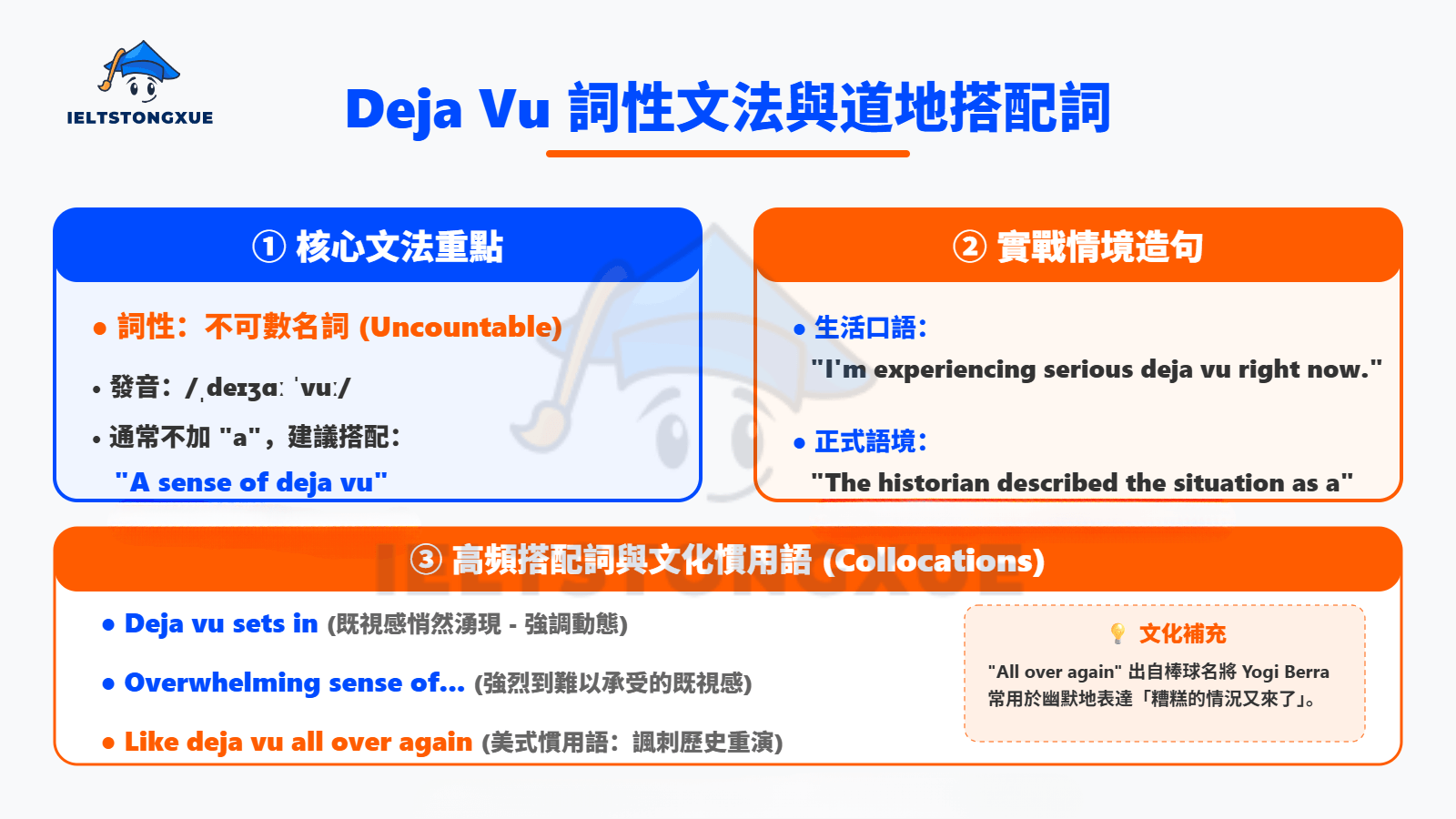
Deja vu 在英文中作為**不可數名詞(Uncountable Noun)**使用。這意味著:
- 通常不直接加不定冠詞 “a” 單獨出現
- 最自然的搭配是 “a sense of deja vu”(一種既視感)或 “a feeling of deja vu”(一種似曾相識的感覺)
- 也可直接說 “I experienced deja vu”(我感受到了既視感)或 “deja vu set in”(既視感悄然而至)
- IPA 音標:/ˌdeɪʒɑː ˈvuː/
三個情境造句範例:
- 情境一(初次到訪某地) Walking into the café for the first time, she was overwhelmed by a sense of deja vu — as if she had sat at that exact table before.(第一次走進這間咖啡廳,她感到一陣強烈的既視感,彷彿曾在那張桌子前坐過。)
- 情境二(對話重複) Haven’t we had this conversation already? I’m experiencing serious deja vu right now.(我們是不是談過這個?我現在有強烈的似曾相識感。)
- 情境三(書面正式語境) The historian described the political situation as a troubling episode of deja vu, echoing the conflicts of the previous decade.(這位歷史學家將當前的政治局勢形容為令人不安的既視感重演,與上一個十年的衝突如出一轍。)
III. 搭配詞與慣用語(Collocations & Idioms)
掌握高頻搭配詞,是讓你的英文從「正確」躍升為「地道」的關鍵。學習 deja vu 意思的同時,更要熟悉這些搭配用法,才能在實際溝通中自然運用:
| 搭配詞與慣用語 | 中文說明 | 例句 |
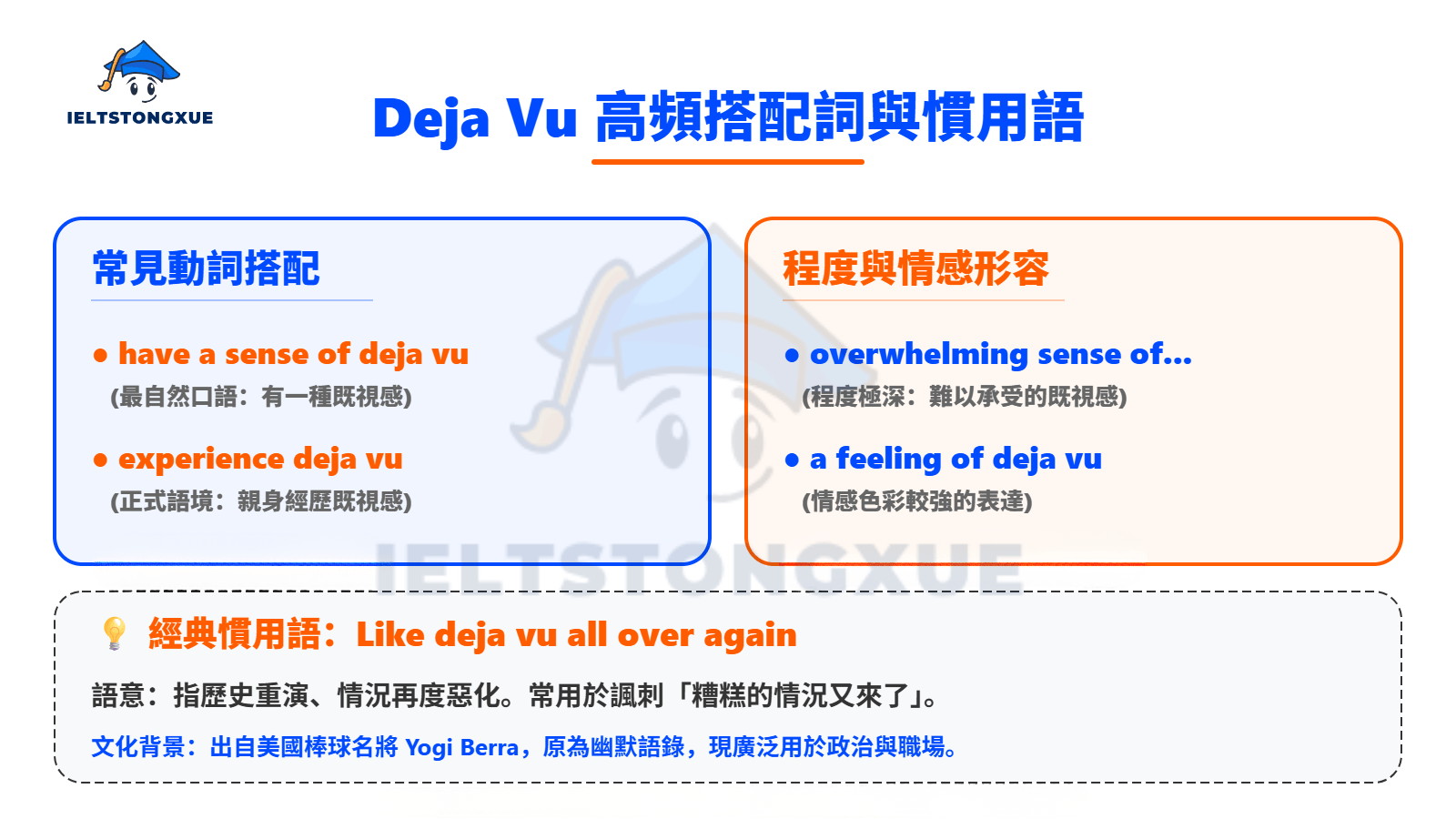
| have a sense of deja vu | 最自然的口語表達,直譯為「有一種既視感」 | I had a strange sense of deja vu when I entered the church.(走進教堂時,我有一種奇異的既視感。) |
| experience deja vu | 正式語境首選,強調「親身經歷」的過程 | Don’t worry if you experience deja vu.(如果你感受到既視感,不要擔心。) |
| a feeling of deja vu | 與 “a sense of” 可互換,情感色彩稍強 | There’s a sad feeling of deja vu about these events.(這些事件讓人感到一種悲涼的似曾相識。) |
| deja vu sets in | 強調「既視感悄然湧現」的動態過程 | As soon as she walked in, deja vu set in.(她一走進去,既視感隨即湧現。) |
| an overwhelming sense of deja vu | 強調程度極深 | The sense of deja vu was overwhelming.(那種既視感強烈得令人難以承受。) |
| an unpleasant / uncanny sense of deja vu | 帶有不舒服或詭異色彩的既視感 | I’m getting an unpleasant sense of deja vu.(我感到一種令人不安的既視感。) |
| like deja vu all over again | 美式慣用語,意指歷史重演、情況再度惡化 | The rise in housing costs is deja vu all over again.(房價再度上漲,一切又回到了原點。) |
文化補充: “like deja vu all over again” 出自美國棒球名人 Yogi Berra 的名言。他以幽默的自我矛盾語錄聞名,這句話原本帶有喜劇效果,但現今已廣泛用於諷刺「又來了」的無奈處境。在評論政治、職場或人際關係時,使用這個慣用語能展現語言的文化厚度。
IV. 日常英文對話實戰:如何用 Deja Vu 表達感受
以下示範如何在真實的日常情境中自然運用 deja vu 意思相關詞彙,幫助你從「懂」到「會用」。
情境:小美(Xiaomei)和雅婷(Yating)第一次一起去台北大安區一間新開的咖啡廳。
| 角色 | 英文對話 | 繁體中文翻譯 |
| Yating | This place just opened last week, right? I’ve never been here before. | 這裡上週才開的對嗎?我從來沒來過。 |
| Xiaomei | Same. But honestly? I’m getting a strong sense of deja vu. The layout, the lighting — it all feels so familiar. | 我也是。但說真的,我有強烈的既視感。這裡的格局、燈光……感覺好熟悉。 |
| Yating | That happens to me all the time. Maybe it’s because a lot of cafés in Taipei share the same minimalist aesthetic. | 我常常這樣。可能是因為台北很多咖啡廳都走一樣的極簡風格。 |
| Xiaomei | Maybe. Or maybe it’s just my brain playing tricks on me again. Either way, it’s a genuinely uncanny feeling. | 也許吧。或者只是我的大腦又在作弄我。不管怎樣,這種感覺真的很詭異。 |
| Yating | You know, there’s actually a scientific explanation for it. Something to do with how the brain processes memory. | 你知道嗎,其實這是有科學解釋的。跟大腦處理記憶的方式有關。 |
| Xiaomei | Really? I always thought deja vu was just one of those things that happened for no reason. | 真的嗎?我一直以為既視感就是無緣無故發生的事。 |
重點單字解析:
- layout(格局、平面配置):例:The layout of this office is very open.(這間辦公室的格局非常開放。)
- minimalist aesthetic(極簡美學):例:She prefers a minimalist aesthetic in her home.(她偏好家中的極簡風格。)
- play tricks on me(作弄我、讓我產生錯覺):例:My eyes were playing tricks on me in the dark.(在黑暗中我的眼睛欺騙了我。)
- uncanny(詭異的、不可思議的):例:There’s an uncanny resemblance between the twins.(這對雙胞胎有種令人不可思議的相似度。)
V. IELTS 雅思口說實戰:如何將 Deja Vu 運用在雅思考試中?
在雅思口說(IELTS Speaking)的評分標準中,詞彙多樣性(Lexical Resource)佔整體分數的25%。考官特別注重考生能否使用超越教科書範疇的「低頻高質量詞彙」(low-frequency, high-quality vocabulary)(低頻高質量詞彙)。
“Deja vu” 兼具心理學深度與日常口語自然性,是體現 deja vu 意思掌握程度、提升 Lexical Resource 分數的理想工具。
1. IELTS Part 1:日常記憶與感受
Q1: Do you have a good memory?(你的記憶力好嗎?)
A: Generally speaking, yes — I’d say my memory is fairly reliable for faces and places. But every now and then, my brain does something strange. I’ll walk into a room I’ve never visited before and get this overwhelming sense of deja vu, as if I’ve lived through that exact moment before.
(整體而言是的,我對人臉和地點的記憶相當可靠。但偶爾大腦會做出奇怪的事。我走進一間從未去過的房間,卻產生強烈的既視感,彷彿曾經歷過那個瞬間。)
Q2: Do you often forget things?(你常忘事嗎?)
A: Not particularly, but it works both ways — sometimes I remember things that didn’t actually happen, or I experience deja vu and feel certain I’ve been somewhere before, when logically I couldn’t have.
(不常,但記憶的運作是雙向的——有時我會記住沒發生過的事,或因既視感確信自己去過某個地方,但理性上根本不可能。)
Q3: Are you good at remembering people’s faces?(你擅長記住別人的臉嗎?)
A: Yes, faces tend to stick with me. In fact, that’s probably one of the reasons I get deja vu so often — my brain picks up on familiar facial features and then mismatches them with new situations.
(是的,臉孔對我來說印象深刻。事實上,這可能是我常產生既視感的原因之一——大腦捕捉到熟悉的面部特徵,卻把它錯誤套用到新的情境上。)
Q4: Do you think a good memory is important in daily life?(你認為在日常生活中,良好的記憶力重要嗎?)
A: Absolutely. But I also think memory is more fallible than we realise. A perfect example is deja vu — it proves that the brain can manufacture a sense of familiarity even when none genuinely exists.
(當然重要。但我也認為記憶比我們意識到的更容易出錯。既視感就是最好的例子——它證明大腦可以在毫無根據的情況下製造一種熟悉感。)
Q5: Did you have a good memory when you were a child?(你小時候記憶力好嗎?)
A: I think so. I remember a lot of small, vivid details from childhood. Interestingly, children actually experience deja vu less frequently than young adults do — the phenomenon tends to peak in your twenties and early thirties.
(我想是的。我記得很多童年時清晰的小細節。有趣的是,兒童產生既視感的頻率其實比年輕人低,這個現象通常在二十多歲至三十歲出頭時最為頻繁。)
Q6: Do you prefer to write things down or remember them?(你偏好把事情寫下來,還是靠記憶?)
A: I prefer writing things down — not because my memory is poor, but because I know how unreliable memory can be. After experiencing deja vu a few times, I realised the brain isn’t always the most trustworthy record-keeper.
(我偏好寫下來,不是因為記憶力差,而是因為我深知記憶有多麼不可靠。有過幾次既視感的經歷後,我意識到大腦並不總是最可靠的記錄者。)
2. IELTS Part 2:描述一次難忘的經歷
Cue Card: Describe a strange experience you had.(描述一次你曾經歷的奇特體驗。)
You should say: what happened, where you were, how you felt, and explain why it was strange.(你應該說明:發生了什麼、你在哪裡、你的感受,並解釋為何奇特。)
Sample answer:
I’d like to talk about something that happened when I was travelling alone in Tainan about two years ago. I had just turned down a narrow alleyway near Anping Old Fort — a place I had never been to in my life — when a wave of deja vu hit me so intensely that I actually stopped walking.
The stone walls, the smell of incense drifting from a nearby temple, the specific way the afternoon light fell across the cobblestones — every detail felt as if I had memorised it long before. My rational mind kept insisting this was impossible, yet the feeling refused to dissolve.
What made it truly strange was how emotionally charged it felt. It wasn’t just visual recognition — it was as if the moment carried an emotional memory I couldn’t trace back to any actual event. Standing in that alleyway, no scientific explanation felt adequate. I stood there for perhaps a full minute, just letting the sensation pass. It was one of the most genuinely unsettling, yet quietly beautiful, experiences I’ve ever had.
(我想講述大約兩年前獨自在台南旅行時發生的事。我剛轉入安平古堡附近一條窄巷——一個我從未去過的地方——一波強烈的既視感瞬間席捲而來,讓我停下了腳步。石牆、附近廟宇飄來的香煙氣味、午後陽光打在石板路上的特定角度——每一個細節都彷彿我早已銘記於心。理性告訴我這不可能,但那種感覺卻無法消散。真正令人困惑的,是這種感覺帶有強烈的情緒色彩。它不只是視覺上的認出——彷彿這個當下承載著某段情感記憶,卻無論如何追溯不回任何真實事件。站在那條小巷裡,任何科學解釋都顯得蒼白。我就那樣站了將近一分鐘,讓那種感覺自然消退。這是我經歷過最真實的不安,同時又最靜謐美麗的體驗之一。)
3. IELTS Part 3:大腦、記憶與科學探討
Q1: Why do you think people experience illusions or false memories?(你認為為什麼人們會產生錯覺或假記憶?)
A: I think the brain is essentially a prediction machine. It matches incoming sensory data with stored patterns to help us navigate the world faster. When there’s a slight misfiring in that system — what some scientists call a “brain lag” — the subconscious stamps a new experience with a “seen before” label before the conscious mind can verify it. That’s the core of deja vu.
(我認為大腦本質上是一台預測機器。它將感知資料與已儲存的模式進行比對,幫助我們更快速地應對世界。當這套系統出現輕微錯誤——科學家稱之為「大腦延遲」——潛意識在意識來不及確認之前,就已為新體驗貼上「曾見過」的標籤。這正是既視感的核心機制。)
Q2: Do you think modern lifestyles affect how people remember things?(你認為現代生活方式影響了人們的記憶方式嗎?)
A: Definitely. Sleep deprivation and chronic stress — both very common today — are known triggers for deja vu. When the brain is overloaded, it becomes more prone to the kind of processing glitches that create false familiarity. In that sense, deja vu might actually be a signal that we need more rest.
(肯定有影響。睡眠不足與長期壓力——如今都極為普遍——已被證實是既視感的誘發因素。當大腦超載時,更容易出現製造「虛假熟悉感」的處理錯誤。從這個角度看,既視感或許其實是大腦提醒我們需要休息的訊號。)
Q3: Some people believe deja vu is a spiritual experience. What do you think?(有些人認為既視感是一種靈性體驗,你怎麼看?)
A: I understand why people feel that way — it’s an experience that genuinely defies easy explanation in the moment. But neuroscience offers fairly convincing explanations, such as the hippocampus misfiring or the brain’s pattern-matching system creating false familiarity. I think it’s a fascinating cognitive phenomenon rather than a supernatural one, though I can see why the two get confused.
(我理解人們為何有這種感受——既視感在當下確實難以用理性解釋。但神經科學提供了相當有說服力的解釋,例如海馬體的錯誤觸發,或大腦模式匹配系統製造虛假熟悉感。我認為這是一種引人入勝的認知現象,而非超自然體驗,儘管我能理解為何兩者常被混淆。)
結論
既視感,這個不到一秒的神秘瞬間,橫跨了語言、記憶與意識的邊界。透過本文的完整梳理,你現在不僅理解了 deja vu 意思的字面定義與法文起源,更掌握了它在英文中的正確詞性、高頻搭配詞,以及從口語到正式書面語的靈活用法。
從神經科學的角度看,既視感是大腦模式匹配系統高速運作下的一個美麗誤差——海馬體的瞬間短路,讓「第一次」錯誤地披上了「再一次」的外衣。而從醫學角度看,偶發的既視感屬於正常的生理現象;唯有在頻率異常或伴隨意識模糊時,才需要進一步的神經科學評估。

