


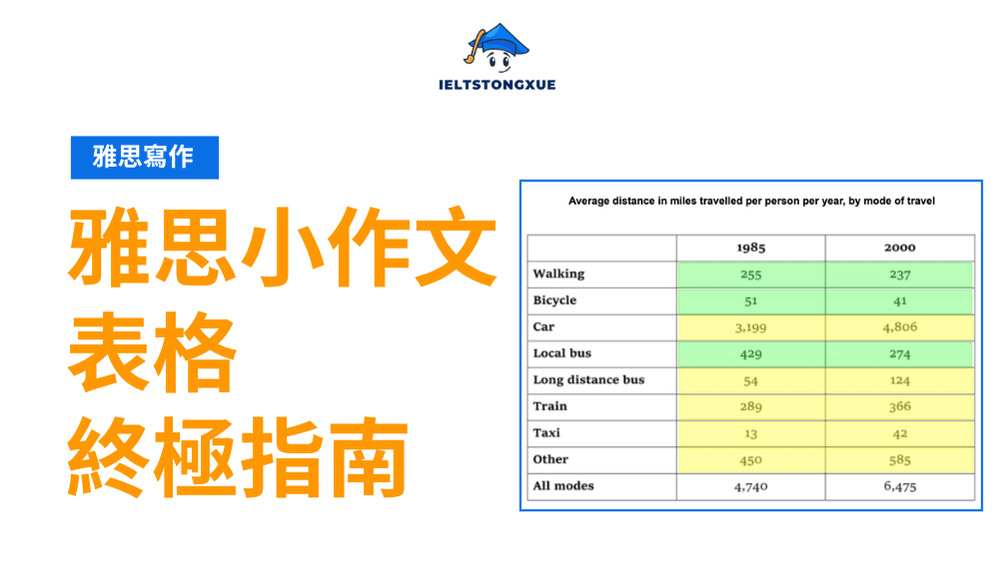
「雅思寫作 Task 1 遇到表格題該怎麼寫?」這是許多考生在備考過程中最常提出的問題。雅思小作文表格題要求考生在20分鐘內從複雜的數據中篩選關鍵資訊、識別主要趨勢,並用精準的學術語言呈現分析結果。與其他圖表類型不同,表格題的挑戰在於數據密集且多維度,考生必須具備快速判斷「哪些數據值得寫、哪些可以略過」的能力。更重要的是,考官評分時最看重的並非描述所有數據,而是你能否展現出「選擇性報告」和「邏輯概括」的分析思維。
許多考生因為不了解評分標準的真實要求而陷入誤區,要麼試圖描述表格中的每一個數字而時間不足,要麼寫出缺乏邏輯的流水帳式文章。事實上,雅思官方明確指出,一篇高分作文的核心在於準確捕捉主要特徵、建立清晰的段落邏輯,以及運用多樣化的詞彙和句型。IELTSTongXue 深入研究官方評分準則與考官期待,將抽象的評分標準轉化為可執行的寫作策略。
本指南將為你完整拆解雅思小作文表格的四大評分維度,提供一套經過驗證的四步寫作系統,並透過五篇7分以上的範文精講,讓你真正掌握在考場上穩定發揮、精準得分的核心技巧。
I. 深度解析四大評分標準與雅思小作文表格題核心要求
理解雅思評分標準不僅是知道考官會從哪些角度評判你的文章,更重要的是透過這些標準建立起正確的寫作思維。當你清楚知道考官期待看到什麼,你的寫作方向就會變得明確,每一個句子都能精準地命中評分要點。對於雅思小作文表格而言,這四大評分標準各有其獨特的要求,我們需要將官方標準「翻譯」成具體可執行的寫作策略。

1. 任務完成度 (Task Achievement)
任務完成度的核心在於「篩選」與「概括」能力,而非「描述所有數據」。考官想看到的是你能否從複雜的表格中識別出最重要的趨勢、最顯著的特徵和最關鍵的對比,然後用精確的語言將這些發現呈現出來。許多考生誤以為描述越多數據就能獲得越高分數,這恰恰是低分作文的典型特徵。真正的高分作文會展現出作者的分析判斷力,能夠在眾多數據中找出真正值得報告的資訊。
三步法則:精準捕捉關鍵數據:要達到高水準的任務完成度,你需要掌握系統化的數據篩選方法。
- 第一步是找出極值,包括表格中的最高值和最低值,這些往往代表最顯著的特徵。
- 第二步是識別趨勢,尋找數據變化幅度最大的項目,無論是增長還是下降。
- 第三步是發現對比,找出不同類別或時間點之間最明顯的差距或相似之處。透過這三個步驟,你就能將一張複雜的表格簡化為幾個核心觀察點。
舉例來說,如果表格顯示五個國家在三年間的碳排放量,關鍵數據可能包括:排放量最高的國家(極值)、增長最快的國家(趨勢)、以及兩個國家間差距最大的年份(對比)。這些數據點才是你應該重點描述的內容。
Overview 的黃金法則:7分的門檻:Overview 段落是整篇文章最重要的部分,它直接決定你是否能達到7分。一個優秀的 Overview 應該遵循「整體趨勢 + 最顯著特徵」的公式。例如,你可以寫:”Overall, while most categories experienced growth over the period, Category A consistently dominated the table with the highest figures throughout.” 這個句子既概括了總體趨勢(大多數類別增長),又指出了最顯著的特徵(Category A 始終最高)。
- ❌ 錯誤的 Overview 範例:”The table shows various numbers for different categories.” 這樣的句子沒有提供任何有價值的概括,僅僅是重述題目。
- ✅ 正確的 Overview 應該像:”Overall, the data reveals a consistent upward trend across all categories, with the most dramatic increase observed in Category B, which tripled over the five-year period.” 這個句子精準地捕捉了主要趨勢和關鍵特徵。
2. 連貫與銜接 (Coherence and Cohesion)
邏輯性是引導讀者理解你分析的關鍵。一篇結構良好的文章能讓考官輕鬆跟隨你的思路,從引言到總覽,再到具體的數據分析,每一個部分都應該自然銜接。許多考生根據感覺隨意劃分段落,這會導致文章缺乏內在邏輯。正確的做法是根據表格的特性和數據的內在關聯來規劃段落結構。
| 針對不同表格類型的分段策略 | 連接詞的功能性使用 |
| 對於動態表格(顯示時間變化的表格),最佳策略是按時間段分段,例如將整個時期分為「初期特徵」和「後期變化」兩個主體段落。對於靜態表格(比較不同項目的表格),可以按類別分組,將相似或相關的項目放在同一段落中討論。若表格同時包含多個維度(如不同國家、不同年份),則可採用混合策略,先按主要維度劃分,再在段落內部處理次要維度的對比。
舉例來說,如果表格展示三個國家在五年間的數據,你可以將第一個主體段落聚焦於「表現最突出的國家及其變化」,第二個主體段落分析「其他國家的趨勢與對比」。這樣的分段既有邏輯性,又能確保內容的完整性。 |
連接詞不僅是句子間的橋樑,更是展現邏輯思維的工具。對比型連接詞如 “in contrast”、”whereas”、”while” 適用於強調差異;因果型連接詞如 “consequently”、”as a result” 可用於說明數據間的關係(雖然在 IELTS Writing Task 1 中要謹慎使用,避免過度推論);補充型連接詞如 “additionally”、”furthermore” 則幫助你添加更多支持細節。選擇正確的連接詞能讓你的文章邏輯更加嚴密,同時也體現出你對語言的精準掌握。 |
3. 詞彙資源 (Lexical Resource)
詞彙的準確性和多樣性是雅思小作文表格評分的重要維度。考官期待看到的不僅是正確的雅思單字使用,更是能夠根據數據變化的程度和性質選擇最恰當表達的能力。單調地重複 “increase” 和 “decrease” 會讓你的文章顯得平淡無奇,而善用同義詞和精確的修飾語則能讓你的描述更加生動且專業。
| 變化程度的詞彙分級 | 靜態表格的專用表達法 |
| 理解詞彙的強度層次能幫助你更精準地描述數據。對於上升趨勢,輕微增長可以用 “rise slightly” 或 “edge up”,中等增長使用 “increase” 或 “grow”,而顯著增長則應該用 “surge”、”soar” 或 “rocket”。同樣的邏輯適用於下降趨勢:輕微下降用 “dip” 或 “decline marginally”,中等下降用 “decrease” 或 “fall”,急劇下降則用 “plummet”、”plunge” 或 “nosedive”。
在描述穩定狀態時,避免總是使用 “remain stable”,可以變化為 “level off”、”plateau”、”stay constant” 或 “maintain a steady level”。這些詞彙的細微差異能夠更精確地反映數據的實際變化情況。 |
對於沒有時間維度的靜態表格,你需要掌握比較和排序的專門詞彙。描述排名時可以使用 “rank first/highest in”、”lead the table with”、”占據 dominate the category”。表達比例關係時,”account for”、”represent”、”constitute” 都是高分詞彙。例如:”Category A accounted for the largest proportion, representing nearly half of the total figure (47%).” 這個句子展示了多樣化的詞彙使用和精確的數據引用。 |
4. 語法多樣性與準確性 (Grammatical Range and Accuracy)
語法的多樣性不是刻意炫技,而是為了更有效地組織和呈現資訊。簡單句能清晰直接地陳述事實,而複雜句則能展現數據間的關係和邏輯連結。一篇高分作文應該是兩者的有機結合,既保證資訊傳達的準確性,又展現出語言運用的靈活性。五種核心高分句型:
- 第一種是分詞結構句型,公式為「主句, -ing/-ed 短語」,例如:”The figure for Category A increased to 500, surpassing all other categories by a significant margin.” 這種句型既簡潔又能有效連接兩個相關動作。
- 第二種是比較句型,公式為「A + 動詞 + 數值/程度 + 比較級 + than B」,例如:”Country X exported 30% more goods than Country Y in 2020.” 這是描述對比關係時最常用的句型。
- 第三種是被動語態句型,特別適合引言改寫,公式為「The table shows… → It can be seen that… / What is shown is…」,例如:”What is presented in the table is the consumption pattern across five regions over a decade.” 這種句型能有效改變句子結構,避免重複。
- 第四種是狀語從句句型,公式為「While/Whereas 從句, 主句」,例如:”While Category A showed a steady decline, Category B experienced remarkable growth, reaching its peak in 2022.” 這種句型非常適合表達對比關係。
- 第五種是名詞性從句句型,公式為「What is noteworthy is that… / It is worth noting that…」,例如:”What is particularly noteworthy is that the gap between the two categories narrowed significantly in the final year.” 這種句型能夠強調重要發現,為你的分析增加深度。
為了更深入理解雅思寫作的評分標準,建議你參考 IELTSTongXue 的文章《雅思寫作分數:從官方標準到 9 分的終極指南》!
II. 雅思小作文表格的四步寫作系統:20分鐘內穩拿高分的祕訣
理論固然重要,但在真實考試的壓力下,你需要的是一套可靠且高效的作戰流程。這套四步寫作系統將抽象的寫作過程轉化為四個具體、有時限的步驟,每一步都有明確的目標和可執行的方法。當你熟練掌握這套系統後,即使在緊張的考場環境中,你也能從容應對任何類型的雅思小作文表格題目。

1. 步驟一:審題與規劃(關鍵4分鐘)
審題規劃階段的質量直接決定你文章的上限。許多考生急於動筆,結果寫到一半才發現遺漏了重要資訊或者段落安排不合理。投資4分鐘在規劃上,能讓你接下來的16分鐘寫作過程更加順暢,這就是「磨刀不誤砍柴工」的智慧。系統化的審題方法能確保你不會錯過任何關鍵資訊,同時為文章建立起清晰的框架。
TUK 法則:審題三要素:TUK 是一個簡單易記的審題口訣,幫助你快速抓住表格的核心資訊。
- T 代表 Topic(主題),明確表格描述的是什麼內容,例如「五個國家的能源消耗」或「不同年齡層的文化活動參與率」。
- U 代表 Unit(單位),確認數據的計量單位,是百分比、絕對數值、還是比例,這會影響你如何描述數據。
- K 代表 Key information(關鍵資訊),包括時間範圍、比較對象、資料來源等,這些都是引言改寫時必須包含的元素。
舉例來說,面對一張顯示「2010、2015和2020年三個城市交通方式分佈」的表格,你的 TUK 分析應該是:
- Topic – 交通方式分佈
- Unit – 百分比
- Key information – 三個城市、三個時間點
這樣的分析為你的引言和整體結構奠定了基礎。
縱橫交錯的數據觀察法:這是一個系統化的分析方法,指導你從不同維度全面掃描表格。縱向觀察是指在同一類別或對象內部尋找時間上的變化趨勢,例如觀察某個國家從2010到2020年的數據是上升、下降還是波動。橫向觀察則是在同一時間點比較不同類別或對象,找出哪個最高、哪個最低、差距有多大。在完成縱橫觀察後,你還需要尋找交叉點和特殊現象。交叉點是指兩條趨勢線的相遇處,例如原本領先的 A 類別被 B 類別超越的時間點。特殊現象包括數據的突然變化、異常的穩定或與整體趨勢相反的個案。這些發現往往是最值得在 Overview 中提及的內容。
2. 步驟二:引言與總覽(靈魂2分鐘)
引言和總覽雖然篇幅不長,但它們是整篇文章的靈魂。引言為讀者建立背景,總覽則展現你的分析能力。這兩部分的質量直接影響考官的第一印象,因此必須做到精準且高效。標準化的句型框架能幫助你在考試初期快速完成這兩個關鍵部分,為後續的主體段落預留更多時間。
引言改寫的三種公式:
- 第一種公式是主被動轉換:”The table shows…” 可以改寫為 “Presented in the table is…” 或 “What is shown in the table is…”。
- 第二種公式是同義詞替換:”shows” 可以替換為 “illustrates”、”compares”、”provides information about” 或 “depicts”。
- 第三種公式是結構重組:將題目中的名詞短語轉化為從句或分詞結構。
- 例如,原題目 “The table shows the number of visitors to three museums between 2010 and 2020″ 可以改寫為:”The table provides a comparison of visitor numbers across three museums over an eleven-year period from 2010 to 2020.” 或者 “Illustrated in the table is the visitation pattern at three different museums spanning from 2010 to 2020.” 這些改寫既避免了抄襲題目,又展現了語言能力。
Overview 的萬用公式:一個有效的 Overview 公式是:「Overall, [主要趨勢/特徵一] while/and [次要趨勢/特徵二]」。主要趨勢通常是整體數據的走向,例如「整體上升」或「領先項目保持不變」。次要趨勢則是最顯著的例外或對比,例如「某一項目逆勢下降」或「差距擴大/縮小」。舉兩個實際範例。
- 對於動態表格:”Overall, all categories demonstrated an upward trajectory during the period, with Category B registering the most substantial growth, nearly doubling its initial figure.”
- 對於靜態表格:”Overall, Country A dominated the table across all metrics, while Country C consistently ranked at the bottom with figures less than half of the leader.” 這些 Overview 都清晰地概括了最重要的發現,為後續的詳細分析建立了框架。
3. 步驟三: 主體段落(高效12分鐘)
主體段落是你展現數據分析能力的舞台。這個階段的核心任務是將規劃階段找到的數據點有邏輯地組織成段落,每個段落都應該有明確的主題,並用具體數據來支撐你的觀察。記住,你不是在羅列數據,而是在用數據講述一個關於變化、對比或排序的故事。
學術段落的黃金結構:一個優秀的主體段落遵循「主題句 → 支持細節 → 數據引用」的結構。主題句應該概括本段的核心發現,例如「Category A experienced the most dramatic transformation over the period」。支持細節則進一步解釋這個發現,例如「starting from a modest base, it underwent consistent expansion」。最後用具體數據來證實你的觀點,例如「rising from 200 in 2010 to 850 in 2020, marking a more than fourfold increase」。讓我們看一個完整的段落範例:「The technology sector witnessed the most remarkable expansion throughout the decade. Beginning at a relatively low figure of 15% in 2010, this category experienced steady growth, reaching 28% by 2015. The upward momentum accelerated in the latter half of the period, with the proportion eventually peaking at 47% in 2020, thereby establishing itself as the dominant category.」這個段落結構清晰,邏輯嚴密,數據引用精準。
選擇性數據引用的技巧:不是所有數據都需要引用,你的任務是選擇那些能最有效支撐你觀點的數據。關鍵數據包括:起點和終點值(展現整體變化)、轉折點(說明趨勢改變)、極值(突出顯著特徵)、以及關鍵對比點(展現差異)。引用數據時,可以使用不同的句型結構來增加變化。例如,你可以用括號插入法:「Category A showed substantial growth (from 30% to 65%)」;或用介詞短語:「Category B increased significantly, with the figure rising from 120 to 340」;或用分詞結構:「Category C experienced a decline, dropping from 450 in 2010 to 280 in 2020」。這些不同的引用方式既能展現數據,又能豐富句式結構。
4. 步驟四: 檢查與優化(最後2分鐘)
檢查階段常被考生忽視,但這2分鐘可能是你避免低級錯誤、確保高分的最後防線。系統化的檢查能幫助你在最後時刻發現並修正那些可能導致失分的問題。這不是一個可有可無的步驟,而是確保你前面18分鐘努力不被浪費的關鍵環節。考場快速檢查清單:
- 第一項檢查是主謂一致和時態正確性,這是最常見的語法錯誤來源。確認每個動詞都與其主語在數上一致,並且時態選擇符合表格的時間特性(動態表格用過去式,靜態表格用一般現在時)。第二項是冠詞和介詞的準確性,特別注意「the」的使用,以及數據引用時介詞的搭配,如「increase to」vs.「increase by」。
- 第三項檢查是詞彙的準確性和拼寫,確認你使用的同義詞確實適合該語境,避免詞彙誤用。第四項是標點符號,特別是逗號的使用,確保複雜句的標點正確,不會造成理解障礙。第五項是檢查 Overview 是否清晰且與主體段落一致,確保你在總覽中提到的主要特徵在主體段落中都有詳細展開。
- 最後,快速掃視全文,確認字數達到要求(至少150字),段落劃分清晰,沒有明顯的塗改痕跡。這個系統化的檢查過程只需2分鐘,但能大幅提升你作文的整體質量。
看更多文章:
III. 雅思小作文表格論文範本 7.0+
理論和方法論的學習必須通過實踐來驗證和內化。接下來的五篇範文涵蓋了雅思小作文表格的主要類型,從動態數據到靜態比較,從簡單結構到複雜表格。透過仔細研讀這些範文,你將看到前面所學的評分標準和寫作系統如何在實際文章中得到體現。每篇範文都經過精心設計,確保達到IELTS7.0分以上的水準,為你提供可以模仿和學習的標杆。
1. 雅思小作文表格: Five types of vehicles registered in Australia in 2010, 2012 and 2014
題目: The table below shows the number of five types of vehicles registered in Australia in 2010, 2012 and 2014.
| Types of vehicles | 2010 | 2012 | 2014 | % change (2010 to 2014) |
| Passenger vehicles | 11,800,000 | 12,700,000 | 13,000,000 | 10.20% |
| Commercial vehicles | 2,300,000 | 2,600,000 | 2,700,000 | 17.40% |
| Motorcycles | 540,000 | 680,000 | 709,000 | 30.80% |
| Heavy trucks | 384,000 | 390,000 | 416,000 | 8.30% |
| Light trucks | 106,000 | 124,000 | 131,000 | 23.50% |
雅思小作文表格範文 (IELTS 7.5分):
The table compares registration figures for five distinct vehicle categories in Australia across three separate years: 2010, 2012, and 2014, also presenting the percentage change over the entire period.
Overall, passenger vehicles maintained overwhelming dominance throughout these years, accounting for the vast majority of registrations. While all vehicle types experienced growth, motorcycles demonstrated the most dramatic percentage increase at 30.8%, despite remaining the category with the smallest absolute numbers.
Passenger vehicles consistently led the market, rising steadily from 11.8 million registrations in 2010 to 13 million by 2014, representing a moderate 10.2% increase. Commercial vehicles, occupying the second position, expanded from 2.3 million to 2.7 million, marking a 17.4% growth rate that exceeded passenger vehicles in relative terms. Heavy trucks showed the most modest expansion, increasing from 384,000 to 416,000 units, equivalent to just 8.3% growth.
The smaller vehicle categories exhibited more substantial percentage gains. Motorcycles, though starting from the lowest base of 540,000, surged to 709,000 registrations, achieving the highest growth rate of 30.8%. Light trucks similarly demonstrated strong momentum, advancing from 106,000 to 131,000 units, corresponding to a 23.5% increase. These figures reveal that while passenger vehicles dominated in absolute terms, the smaller specialized categories experienced more dynamic growth patterns, potentially reflecting changing transportation preferences and economic conditions in Australia during this period.
2. 雅思小作文表格: Participation in cultural activities, by age
題目: The table shows the participation rates in different cultural activities among various age groups.
| Activity | 16–24 | 25–44 | 45–74 | All aged 16+ |
| Any performance* | 35 | 22 | 17 | 22 |
| Undertaking any crafts | 11 | 17 | 22 | 19 |
| Cultural purchases | 11 | 17 | 18 | 16 |
| Any visual arts | 30 | 16 | 11 | 15 |
| Any writing | 17 | 6 | 5 | 7 |
| Computer based | 10 | 9 | 5 | 6 |
| *Note: “Any performance” includes dancing, singing, playing musical instruments, and acting. | ||||
雅思小作文表格範文 (IELTS 7.5分):
The table illustrates the percentage of people engaging in six distinct cultural activities across four age brackets, ranging from 16-24 years old to those aged 16 and above.
Overall, any performance activities attracted the highest participation rate among most age groups, while computer-based cultural activities recorded the lowest engagement across all demographics. A clear inverse relationship emerges between age and participation, with younger cohorts consistently showing greater involvement in most cultural pursuits.
Performance activities, encompassing dancing, singing, playing musical instruments, and acting, proved most popular among 16-24 year-olds at 35%, declining progressively to 17% for the 45-74 age bracket, before rising slightly to 22% for the overall population aged 16 and above. Visual arts participation followed a similar descending pattern, plummeting from 30% among the youngest group to merely 11% among those aged 45-74. Writing activities exhibited the steepest decline, dropping from 17% for young adults to just 5% for the middle-aged demographic.
Conversely, undertaking crafts demonstrated an unusual upward trajectory with age, rising from 11% among 16-24 year-olds to peak at 22% for the 45-74 age group. Cultural purchases maintained relative stability across age brackets, fluctuating between 11% and 18%. Computer-based activities recorded consistently low participation rates across all groups, ranging from 5% to 10%, suggesting this category holds limited appeal regardless of age. These patterns reveal that while younger generations gravitate toward performance and visual arts, older demographics show greater affinity for craft activities, potentially reflecting differing leisure preferences and time availability across life stages.
3. 雅思小作文表格: Household composition in a North American country
題目: The table below gives information about household composition in a North American country in different years.
| Household Composition | Type of Household | 1970 | 2003 |
| Family Household | Married Couple | 61% | 41% |
| Father + Kid | 9% | 10% | |
| Mother + Kid | 10% | 11% | |
| Other Member Sharing | 13% | 14% | |
| Non-Family Household | Single | 4% | 13% |
| Room Sharing | 3% | 11% |
雅思小作文表格範文 (IELTS 8.0分):
The table presents data on household composition patterns in a North American nation, comparing six different household types between 1970 and 2003.
Overall, traditional married couple households experienced substantial decline over the three-decade period, while non-family household arrangements, particularly single-person households, demonstrated remarkable growth. This transformation reflects a fundamental shift in societal living patterns and family structures.
Family households as a whole contracted significantly, with married couples plummeting from 61% in 1970 to 41% in 2003, representing a loss of twenty percentage points. Single-parent households led by fathers remained relatively stable, edging up marginally from 9% to 10%, whereas mother-led single-parent households increased slightly from 10% to 11%. The category of other member-sharing family households showed minimal change, rising by just one percentage point from 13% to 14%.
In stark contrast, non-family households experienced explosive growth during this period. Single-person households more than tripled their share, surging from a mere 4% in 1970 to 13% in 2003, marking the most dramatic transformation among all categories. Room-sharing non-family arrangements exhibited similarly impressive expansion, quadrupling from 3% to 11%. These patterns suggest profound societal changes, including delayed marriage, increased divorce rates, extended periods of independent living, and growing acceptance of non-traditional household arrangements. The data reveals a clear movement away from conventional nuclear family structures toward more diverse and individualized living configurations in North American society.
4. 雅思小作文表格: The amount of tax collected (as % of GDP) in five countries
題目: The table shows the amount of tax collected (as a percentage of GDP) in five countries for four years.
| Country | 1975 | 1985 | 1995 | 2005 |
| Sweden | 46% | 47% | 51% | 70.1% |
| USA | 25.1% | 25.4% | 27.1% | 27.4% |
| Korea | 15.1% | 27% | 26% | 27.3% |
| Japan | 15% | 16% | 23% | 32.1% |
| Turkey | 16.4% | 15% | 24% | 27.4% |
雅思小作文表格範文 (IELTS 8.0分):
The table compares tax revenue as a proportion of Gross Domestic Product across five nations—Sweden, USA, Korea, Japan, and Turkey—over a thirty-year span from 1975 to 2005.
Overall, Sweden consistently maintained the highest tax-to-GDP ratio throughout the entire period, exhibiting a substantial upward trajectory, while the United States remained at the opposite end with the lowest figures and remarkable stability. Most countries demonstrated growth in their tax collection rates, though the magnitude and consistency of increases varied considerably.
Sweden’s tax burden rose dramatically from 46% in 1975 to peak at 70.1% by 2005, representing an increase of more than twenty-four percentage points and establishing it as an outlier with tax rates nearly triple those of some other nations. The United States displayed striking consistency, maintaining figures between 25.1% and 27.4% across all four years, suggesting a fundamentally different fiscal philosophy. Korea experienced the most volatile pattern, surging from 15.1% in 1975 to 27% in 1985, then declining slightly to 26% in 1995 before recovering to 27.3% by 2005.
Japan and Turkey exhibited comparable trajectories, both approximately doubling their tax collection rates over the period. Japan advanced steadily from 15% to 32.1%, while Turkey progressed from 16.4% to 27.4%, though with a notable dip to 15% in 1985. The gap between Sweden and the United States widened substantially over time, expanding from approximately twenty percentage points in 1975 to nearly forty-three percentage points by 2005. These disparities underscore fundamentally divergent approaches to taxation and government revenue generation across developed economies, potentially reflecting differing welfare state models and public service provision philosophies.
5. 雅思小作文表格: Employment patterns for men and women in New Zealand in two separate years
題目: The table below shows employment patterns for men and women in New Zealand in 1993 and 2003.
| Sector | 1993 | 2003 | ||
| % of Female Workforce | % of Male Workforce | % of Female Workforce | % of Male Workforce | |
| Services and transport | 53 | 22 | 36 | 31 |
| Agriculture | 8 | 38 | 6 | 8 |
| Business | 1 | 7 | 22 | 25 |
| Manufacturing | 25 | 16 | 12 | 17 |
| Building | 0 | 12 | 6 | 10 |
| Social services | 13 | 5 | 18 | 9 |
雅思小作文表格範文 (IELTS 8.0分):
The table illustrates the distribution of male and female workers across six economic sectors in New Zealand, comparing workforce composition in 1993 and 2003.
Overall, both genders experienced significant shifts in their employment patterns over the decade, with the services and transport sector witnessing the most dramatic restructuring. Gender disparities in sector representation remained pronounced, though some notable convergence occurred, particularly in business and social services sectors.
The services and transport sector, which initially dominated female employment at 53% in 1993, contracted sharply to 36% by 2003, representing a seventeen-percentage-point decline. Conversely, male participation in this sector increased from 22% to 31%, suggesting a trend toward greater gender balance. The business sector demonstrated remarkable transformation, with female representation surging from a negligible 1% to 22%, while male participation rose from 7% to 25%, indicating substantial economic restructuring and expanded opportunities for women in commercial activities.
Manufacturing employment declined for both genders, with female participation falling from 25% to 12%, and male involvement decreasing from 16% to 17%. Agriculture remained predominantly male-dominated throughout, though male participation declined from 38% to 8%, while female involvement contracted from 8% to 6%. Social services exhibited an inverse gender pattern, with female participation increasing from 13% to 18%, while male representation rose from 5% to 9%. The building sector, traditionally male-dominated, showed women entering the field for the first time, rising from 0% to 6%, while male participation declined slightly from 12% to 10%. These patterns reveal substantial economic transformation in New Zealand during this decade, characterized by service sector restructuring, business expansion, manufacturing decline, and gradual progress toward reducing occupational gender segregation.
IV. 雅思小作文表格的進階思考與常見迷思釐清 (FAQ)
掌握了核心寫作系統和範文分析後,你可能仍有一些更深層次的疑問。這些問題往往涉及寫作中的「灰色地帶」,即官方指南沒有明確規定,但會實際影響你分數的細節。以下問答將幫助你理解那些容易被忽略但至關重要的進階概念,讓你對雅思小作文表格有更全面的掌握。
1. 何謂「數據櫻桃採摘」(Data Cherry-Picking)?它如何影響我的任務完成度分數?
數據櫻桃採摘是指作者選擇性地只呈現對自己論點有利的數據,而刻意忽略或隱藏與之矛盾的資訊。在雅思小作文表格中,這種做法表現為只描述上升的數據而忽略下降的部分,或只關注某幾個類別而完全不提其他項目。這種選擇性報告嚴重違背了 Task 1 的核心要求——客觀且全面地呈現主要特徵。
考官能輕易識別這種寫作策略,因為它會導致你的 Overview 與實際數據不符,或主體段落存在明顯的資訊缺口。這直接影響你的任務完成度(TA)分數,因為你沒有「總結並報告主要特徵」,而是提供了片面的、帶有偏見的描述。正確的做法是平衡地呈現所有重要趨勢,包括那些看似不利或不符合某種模式的數據,這樣才能展現你對數據的全面理解和客觀分析能力。
2. 我是否應該在文章中給出自己的觀點,或嘗試解釋數據背後的原因?
不應該。雅思小作文 Task 1 的本質是客觀報告(Report),而非議論文(Essay)或解釋性分析(Analysis)。你的任務僅限於「總結並報告」表格中呈現的資訊,包括識別趨勢、描述數據和指出關鍵特徵。任何形式的主觀推斷、因果解釋或個人觀點都超出了任務範圍,會被視為偏離主題。
例如,當你看到某國家的失業率上升時,不應該寫「This increase was probably caused by economic recession」或「This suggests poor government policies」。正確的做法是客觀陳述事實:「Unemployment in Country A rose from 5% to 8% between 2010 and 2015.」如果你加入推測性解釋,考官會認為你不理解 Task 1 的要求,這會直接影響你的任務完成度分數。記住,Task 1 考察的是你準確描述和報告資訊的能力,而非分析原因或提出見解的能力。
3. 除了描述上升和下降,還有哪些是考生最常忽略的數據特徵類型?
許多考生過度聚焦於基本的上升和下降趨勢,卻忽略了其他同樣重要的數據特徵。第一種是波動(fluctuation),即數據在一段時間內經歷多次起伏,沒有明確的單一方向。描述波動能展現你對複雜趨勢的觀察力,例如「Category A fluctuated considerably, alternating between peaks and troughs throughout the period.」
第二種是穩定或停滯(stability/plateau),當某個數據在一段時間內保持不變或變化極小時,這本身就是一個值得報告的特徵,例如「Category B remained remarkably stable at around 25% across the entire decade.」第三種是交叉點或超越(crossover),即兩個類別的數據線相交,原本領先的被超越,例如「Category A surpassed Category B in 2015, reversing their previous positions.」
第四種是差距的變化(gap widening/narrowing),關注的不是單個數據的走向,而是兩者之間距離的變化,例如「The gap between urban and rural figures narrowed significantly, shrinking from 30 percentage points to just 10.」第五種是比例關係的轉變,即某個類別在總體中占比的顯著改變。善用這些多元化的描述角度,能讓你的文章更加豐富且深入,展現出超越基礎水平的分析細緻度。
4. 動態表格與靜態表格的「總覽」段落寫法,其核心思維差異為何?
動態表格和靜態表格的總覽段落雖然都遵循「概括主要特徵」的原則,但其關注焦點有本質差異。動態表格(包含時間維度)的總覽應該側重於「時間維度上的趨勢與變化」,你需要回答「整體而言,數據是如何隨時間演變的?」這個問題。因此,動態表格的總覽常用詞彙包括 increase、decrease、fluctuate、remain stable 等描述變化的動詞,例如:”Overall, most categories demonstrated an upward trend over the period, with Category A experiencing the most dramatic surge.”
相反,靜態表格(沒有時間維度,只比較不同項目)的總覽應聚焦於「項目維度上的比較與排名」,你需要回答「哪個最高?哪個最低?差距有多大?」這類問題。靜態表格的總覽常用詞彙包括 dominate、lead、rank highest/lowest、account for the largest proportion 等表示比較和排序的表達,例如:”Overall, Category A dominated the table across all metrics, while Category D consistently recorded the lowest figures.”
理解這個核心差異能幫助你寫出更精準的總覽。動態表格的總覽是對「變化過程」的概括,而靜態表格的總覽是對「現狀格局」的總結。混淆兩者會導致總覽失焦,無法有效地為主體段落建立框架,最終影響連貫性和任務完成度的評分。
結論
雅思小作文表格看似充滿挑戰,但當你掌握了正確的思維方式和系統化的寫作流程後,它完全可以成為你的得分優勢項目。本指南為你揭示了考官評分背後的真實期待,從任務完成度的「篩選與概括」本質,到連貫性的邏輯規劃,從詞彙的精準多樣到語法的靈活運用,每一個評分標準都被轉化為可執行的寫作策略。
四步寫作系統為你提供了在20分鐘時限內穩定發揮的作戰藍圖。4分鐘的審題規劃確保方向正確,2分鐘的引言總覽建立框架,12分鐘的主體段落充實內容,最後2分鐘的檢查優化避免失誤。這套系統的價值不僅在於其高效性,更在於它將抽象的寫作過程具體化,讓你在考場壓力下依然能保持清晰思路。
五篇精選範文展示了理論如何在實踐中呈現,從動態數據的趨勢描述到靜態表格的比較分析,每一篇都是7.0分以上標準的具體體現。透過研讀這些範文,你能看到評分標準如何轉化為實際的句子和段落,這是從理解到應用的關鍵橋樑。

