



當你準備提升英語詞彙量時,是否常覺得單字太多、記不牢、用不起來?這正是多數英語學習者在中高階階段面臨的共同挑戰。要突破這個瓶頸,關鍵在於系統化地學習並靈活運用高頻詞彙。
本文將帶你深入掌握 E 開頭的英文單字,這些單字不僅是日常溝通的常見詞彙,更是雅思、托福、商務英語等測驗中的高頻考點。從 essential、efficient、enhance 等常見詞,到進階表達如 elaborate、emphasize、evaluate,IELTSTongXue 精選的單字與例句將幫助你理解語意差異、掌握用法語境,並在真實溝通中自然運用。
這份指南不僅提供分類清晰的詞彙清單,還附上實用練習與延伸應用,讓學習從「記單字」進化為「活用語言」。立即展開你的詞彙強化之旅,與 IELTSTongXue 一起全面提升英語表達力!
I. E 開頭的英文單字:依詞性與主題深度解析
為了幫助您建立清晰的詞彙架構,本節將系統性地呈現 E 開頭的英文單字。我們依據詞性進行科學分類,讓您能夠從語法功能的角度理解並記憶這些詞彙。這種學習方式不僅提升記憶效率,更能幫助您在實際應用時選擇最恰當的詞彙形式。
1. 總結以「E」開頭的名詞
名詞是構成語言的基礎元素,承載著具體事物與抽象概念。以下精選 100+ 個高頻 E 開頭單字中的名詞,涵蓋人物、地點、抽象概念與具體物品等多元主題,幫助您全面掌握這個字母開頭的核心詞彙:
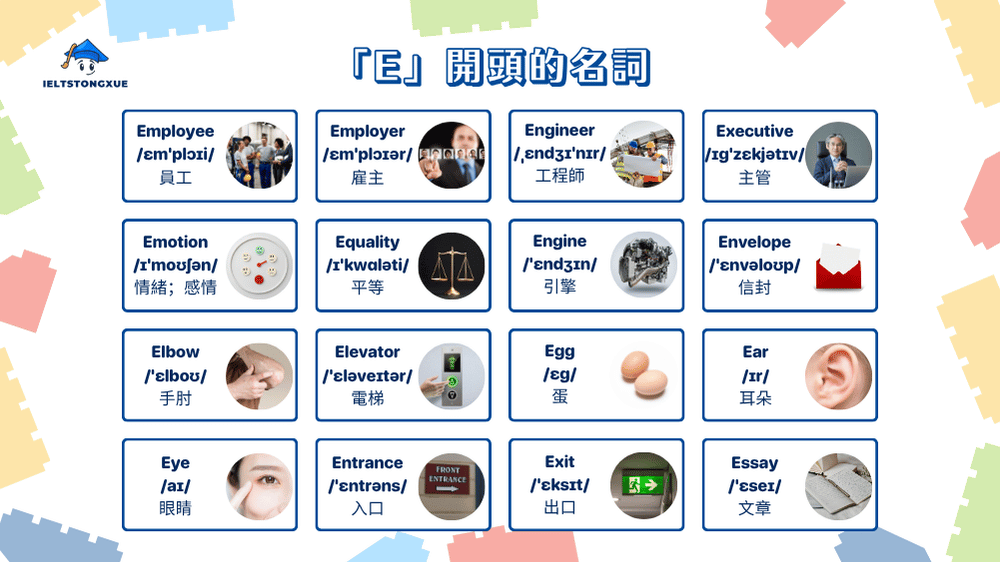
| E 開頭的英文單字 | 中文解釋 | 例句 |
| 人物與身份相關名詞 | ||
| Employee
/ɛmˈplɔɪi/ |
員工;受雇者 | The company values every employee’s contribution.(公司重視每位員工的貢獻。) |
| Employer
/ɛmˈplɔɪər/ |
雇主;老闆 | A responsible employer provides fair compensation.(負責任的雇主提供公平報酬。) |
| Expert
/ˈɛkspɜrt/ |
專家;能手 | The expert provided valuable insights on the topic.(專家就該主題提供寶貴見解。) |
| Editor
/ˈɛdɪtər/ |
編輯;編者 | The editor reviewed the manuscript carefully.(編輯仔細審閱手稿。) |
| Engineer
/ˌɛndʒɪˈnɪr/ |
工程師 | The engineer designed an innovative solution.(工程師設計出創新的解決方案。) |
| Entrepreneur
/ˌɑntrəprəˈnɜr/ |
企業家;創業者 | The entrepreneur launched a successful startup.(企業家創辦一家成功的新創公司。) |
| Educator
/ˈɛdʒukeɪtər/ |
教育工作者 | Educators play a vital role in shaping future generations.(教育工作者在塑造未來世代扮演關鍵角色。) |
| Explorer
/ɪkˈsplɔrər/ |
探險家;探測者 | Early explorers discovered new continents.(早期探險家發現新大陸。) |
| Enemy
/ˈɛnəmi/ |
敵人;仇敵 | They turned enemies into allies through diplomacy.(他們透過外交將敵人變成盟友。) |
| Executive
/ɪgˈzɛkjətɪv/ |
主管;經理 | The executive made strategic decisions for the company.(主管為公司做出策略決策。) |
| 抽象概念與思想名詞 | ||
| Evidence
/ˈɛvɪdəns/ |
證據;證明 | The detective collected evidence at the crime scene.(偵探在犯罪現場蒐集證據。) |
| Education
/ˌɛdʒuˈkeɪʃən/ |
教育;培養 | Quality education opens doors to better opportunities.(優質教育為更好的機會開啟大門。) |
| Experience
/ɪkˈspɪriəns/ |
經驗;體驗 | She gained valuable experience during her internship.(她在實習期間獲得寶貴經驗。) |
| Emotion
/ɪˈmoʊʃən/ |
情緒;感情 | Music can evoke powerful emotions in listeners.(音樂能喚起聽眾強烈的情緒。) |
| Effect
/ɪˈfɛkt/ |
效果;影響 | The new policy had a positive effect on productivity.(新政策對生產力產生正面影響。) |
| Effort
/ˈɛfərt/ |
努力;嘗試 | Your effort will eventually lead to success.(您的努力終將帶來成功。) |
| Ethics
/ˈɛθɪks/ |
倫理;道德規範 | Professional ethics guide our business practices.(專業倫理指引我們的商業行為。) |
| Equality
/ɪˈkwɑləti/ |
平等;相等 | Gender equality remains an important social goal.(性別平等仍是重要的社會目標。) |
| Enthusiasm
/ɪnˈθuziæzəm/ |
熱情;熱忱 | Her enthusiasm for the project inspired the team.(她對計畫的熱情激勵團隊。) |
| Emphasis
/ˈɛmfəsɪs/ |
強調;重點 | The teacher placed emphasis on critical thinking.(教師強調批判性思考。) |
| Efficiency
/ɪˈfɪʃənsi/ |
效率;效能 | Improving efficiency can reduce operational costs.(提升效率能降低營運成本。) |
| Excellence
/ˈɛksələns/ |
卓越;優秀 | The institution is known for academic excellence.(該機構以學術卓越聞名。) |
| Existence
/ɪgˈzɪstəns/ |
存在;生存 | Philosophers debate the meaning of existence.(哲學家辯論存在的意義。) |
| Expectation
/ˌɛkspɛkˈteɪʃən/ |
期待;預期 | The product exceeded customer expectations.(產品超越顧客期待。) |
| Equality
/ɪˈkwɑləti/ |
平等;均等 | Economic equality promotes social stability.(經濟平等促進社會穩定。) |
| 具體事物與物品名詞 | ||
| Equipment
/ɪˈkwɪpmənt/ |
設備;器材 | The laboratory requires specialized equipment for research.(實驗室需要專業設備進行研究。) |
| Engine
/ˈɛndʒɪn/ |
引擎;發動機 | The mechanic repaired the car engine efficiently.(技師有效率地修理汽車引擎。) |
| Envelope
/ˈɛnvəloʊp/ |
信封;包裹物 | Place the documents in a sealed envelope.(將文件放入密封信封中。) |
| Exhibit
/ɪgˈzɪbɪt/ |
展覽品;證物 | The museum displays ancient exhibits from various cultures.(博物館展示來自各種文化的古代展品。) |
| Equipment
/ɪˈkwɪpmənt/ |
裝備;配備 | Hiking requires proper equipment for safety.(登山需要適當裝備以確保安全。) |
| Elevator
/ˈɛləveɪtər/ |
電梯;升降機 | Take the elevator to the tenth floor.(搭電梯到十樓。) |
| Electricity
/ɪˌlɛkˈtrɪsəti/ |
電力;電流 | The storm caused a widespread electricity outage.(暴風雨造成大範圍停電。) |
| Elbow
/ˈɛlboʊ/ |
手肘;肘部 | She injured her elbow during the tennis match.(她在網球比賽中傷到手肘。) |
| Egg
/ɛg/ |
蛋;卵 | Fresh eggs are essential for baking.(新鮮雞蛋對烘焙至關重要。) |
| Ear
/ɪr/ |
耳朵;聽覺 | Loud music can damage your ears.(大聲音樂可能損害您的耳朵。) |
| Edge
/ɛdʒ/ |
邊緣;刀口 | Be careful near the edge of the cliff.(在懸崖邊緣要小心。) |
| Eye
/aɪ/ |
眼睛;視力 | Regular check-ups maintain good eye health.(定期檢查維持良好的眼睛健康。) |
| 地點與空間名詞 | ||
| Entrance
/ˈɛntrəns/ |
入口;進入 | The main entrance is located on the east side.(主要入口位於東側。) |
| Exit
/ˈɛksɪt/ |
出口;太平門 | Please use the emergency exit in case of fire.(火災時請使用緊急出口。) |
| Estate
/ɪˈsteɪt/ |
地產;莊園 | The family owns a large estate in the countryside.(這家人在鄉間擁有大片地產。) |
| Embassy
/ˈɛmbəsi/ |
大使館 | Citizens can seek help at their embassy abroad.(公民在國外可向大使館求助。) |
| Edge
/ɛdʒ/ |
邊界;邊緣 | The house sits on the edge of the forest.(房子位於森林邊緣。) |
| Enclosure
/ɪnˈkloʊʒər/ |
圍場;附件 | The zoo built a new enclosure for the elephants.(動物園為大象建造新圍場。) |
| 時間與時期名詞 | ||
| Era
/ˈɪrə/ |
時代;年代 | The digital era transformed how we communicate.(數位時代改變我們溝通的方式。) |
| Evening
/ˈivnɪŋ/ |
傍晚;晚上 | They enjoyed a peaceful evening by the lake.(他們在湖邊享受寧靜的傍晚。) |
| Epoch
/ˈɛpək/ |
新紀元;時期 | The invention marked a new epoch in technology.(這項發明標誌科技的新紀元。) |
| End
/ɛnd/ |
結束;盡頭 | Success comes at the end of hard work.(成功來自努力的結果。) |
| Eternity
/ɪˈtɜrnəti/ |
永恆;永久 | The couple promised to love each other for eternity.(這對夫婦承諾永恆相愛。) |
| 事件與活動名詞 | ||
| Event
/ɪˈvɛnt/ |
事件;活動 | The charity event raised funds for local schools.(這場慈善活動為當地學校募集資金。) |
| Emergency
/ɪˈmɜrdʒənsi/ |
緊急狀況;急症 | Call this number in case of emergency.(緊急狀況時請撥打此號碼。) |
| Election
/ɪˈlɛkʃən/ |
選舉;當選 | The presidential election will be held next month.(總統選舉將於下個月舉行。) |
| Encounter
/ɪnˈkaʊntər/ |
遭遇;邂逅 | Their first encounter was at a conference.(他們初次相遇是在一場會議。) |
| Explosion
/ɪkˈsploʊʒən/ |
爆炸;激增 | The explosion was heard miles away.(爆炸聲在數英里外都聽得到。) |
| Exhibition
/ˌɛksəˈbɪʃən/ |
展覽;展示 | The art exhibition features contemporary works.(藝術展覽展出當代作品。) |
| Experiment
/ɪkˈspɛrəmənt/ |
實驗;試驗 | Scientists conducted experiments to test the hypothesis.(科學家進行實驗以測試假設。) |
| Excursion
/ɪkˈskɜrʒən/ |
遠足;短程旅行 | The school organized an excursion to the museum.(學校組織博物館參觀之旅。) |
| 學術與專業名詞 | ||
| Examination
/ɪgˌzæməˈneɪʃən/ |
檢查;考試 | Students prepared thoroughly for the final examination.(學生為期末考試做充分準備。) |
| Element
/ˈɛləmənt/ |
元素;要素 | Oxygen is an essential element for human survival.(氧氣是人類生存的必要元素。) |
| Essay
/ˈɛseɪ/ |
文章;論文 | She wrote an insightful essay on climate change.(她撰寫一篇關於氣候變遷的深刻文章。) |
| Equation
/ɪˈkweɪʒən/ |
方程式;等式 | Students learned to solve complex equations.(學生學習解複雜方程式。) |
| Evidence
/ˈɛvɪdəns/ |
證據;論據 | Scientific evidence supports the theory.(科學證據支持該理論。) |
| Evolution
/ˌɛvəˈluʃən/ |
演化;進化 | Darwin’s theory of evolution changed biology.(達爾文的演化論改變生物學。) |
| Encyclopedia
/ɪnˌsaɪkləˈpidiə/ |
百科全書 | The encyclopedia contains comprehensive knowledge.(百科全書包含全面的知識。) |
| Excerpt
/ˈɛksɜrpt/ |
摘錄;節選 | The teacher read an excerpt from the novel.(教師朗讀小說的一段摘錄。) |
| 經濟與商業名詞 | ||
| Economy
/ɪˈkɑnəmi/ |
經濟;節約 | The national economy showed signs of recovery.(國家經濟呈現復甦跡象。) |
| Employment
/ɛmˈplɔɪmənt/ |
就業;雇用 | The government promotes full employment policies.(政府推動充分就業政策。) |
| Enterprise
/ˈɛntərpraɪz/ |
企業;事業 | Small enterprises drive local economic growth.(小型企業推動地方經濟成長。) |
| Exchange
/ɪksˈtʃeɪndʒ/ |
交換;交流 | Cultural exchange programs promote mutual understanding.(文化交流計畫促進相互理解。) |
| Expense
/ɪkˈspɛns/ |
費用;開支 | Travel expenses will be reimbursed by the company.(差旅費用將由公司報銷。) |
| Export
/ˈɛkspɔrt/ |
出口;輸出 | The country’s main export is agricultural products.(該國主要出口農產品。) |
| Entrepreneur
/ˌɑntrəprəˈnɜr/ |
企業家 | Young entrepreneurs are driving innovation.(年輕企業家推動創新。) |
| Estimate
/ˈɛstəmɪt/ |
估計;估價 | The contractor provided a cost estimate.(承包商提供成本估算。) |
| Earnings
/ˈɜrnɪŋz/ |
收入;收益 | The company reported strong quarterly earnings.(公司公布強勁的季度收益。) |
| Equity
/ˈɛkwəti/ |
股權;公平 | Investors hold equity in the company.(投資者持有公司股權。) |
| 環境與自然名詞 | ||
| Environment
/ɪnˈvaɪrənmənt/ |
環境;周遭 | Protecting the environment is everyone’s responsibility.(保護環境是每個人的責任。) |
| Energy
/ˈɛnərdʒi/ |
能量;精力 | Renewable energy sources help reduce carbon emissions.(再生能源有助於減少碳排放。) |
| Earth
/ɜrθ/ |
地球;土地 | Earth is the only planet known to support life.(地球是已知唯一支持生命的星球。) |
| Earthquake
/ˈɜrθkweɪk/ |
地震 | The earthquake caused significant damage.(地震造成重大損害。) |
| Eclipse
/ɪˈklɪps/ |
日食;月食 | Thousands gathered to watch the solar eclipse.(數千人聚集觀看日食。) |
| Ecosystem
/ˈikoʊsɪstəm/ |
生態系統 | Protecting ecosystems ensures biodiversity.(保護生態系統確保生物多樣性。) |
| Erosion
/ɪˈroʊʒən/ |
侵蝕;腐蝕 | Soil erosion threatens agricultural productivity.(土壤侵蝕威脅農業生產力。) |
| 文化與娛樂名詞 | ||
| Entertainment
/ˌɛntərˈteɪnmənt/ |
娛樂;款待 | The festival offers diverse entertainment options.(這個節慶提供多元娛樂選擇。) |
| Enthusiasm
/ɪnˈθuziæzəm/ |
熱忱;熱情 | The audience showed great enthusiasm.(觀眾展現極大熱情。) |
| Epic
/ˈɛpɪk/ |
史詩;壯舉 | Homer’s epics are foundational literary works.(荷馬史詩是文學基礎作品。) |
| Episode
/ˈɛpəsoʊd/ |
集;插曲 | The final episode attracted millions of viewers.(最後一集吸引數百萬觀眾。) |
| 溝通與表達名詞 | ||
| Example
/ɪgˈzæmpəl/ |
例子;範例 | This case serves as an excellent example of teamwork.(這個案例是團隊合作的絕佳範例。) |
| Expression
/ɪkˈsprɛʃən/ |
表達;表情 | Freedom of expression is a fundamental right.(言論自由是基本權利。) |
| Explanation
/ˌɛkspləˈneɪʃən/ |
解釋;說明 | The teacher provided a clear explanation.(教師提供清楚的解釋。) |
| Excuse
/ɪkˈskjus/ |
藉口;理由 | There is no excuse for rudeness.(無禮沒有藉口。) |
| Emphasis
/ˈɛmfəsɪs/ |
強調;重點 | The speaker placed emphasis on teamwork.(演講者強調團隊合作。) |
| 其他重要名詞 | ||
| Exception
/ɪkˈsɛpʃən/ |
例外;異議 | Everyone must follow the rules without exception.(每個人都必須遵守規則,沒有例外。) |
| Error
/ˈɛrər/ |
錯誤;過失 | The system detected an error in the code.(系統偵測到程式碼中的錯誤。) |
| Essence
/ˈɛsəns/ |
本質;精髓 | Patience is the essence of good teaching.(耐心是良好教學的本質。) |
| Extent
/ɪkˈstɛnt/ |
程度;範圍 | The extent of the damage was significant.(損害程度相當嚴重。) |
| Extreme
/ɪkˈstrim/ |
極端;極限 | Athletes push themselves to the extreme.(運動員將自己推向極限。) |
2. 總結以「E」開頭的動詞
動詞在句子中扮演關鍵角色,表達行動、狀態與變化。以下整理 100+ 個常用的 E 開頭的單字動詞,涵蓋日常行為、情感表達與專業動作,讓您能夠更精準地描述各種情境:
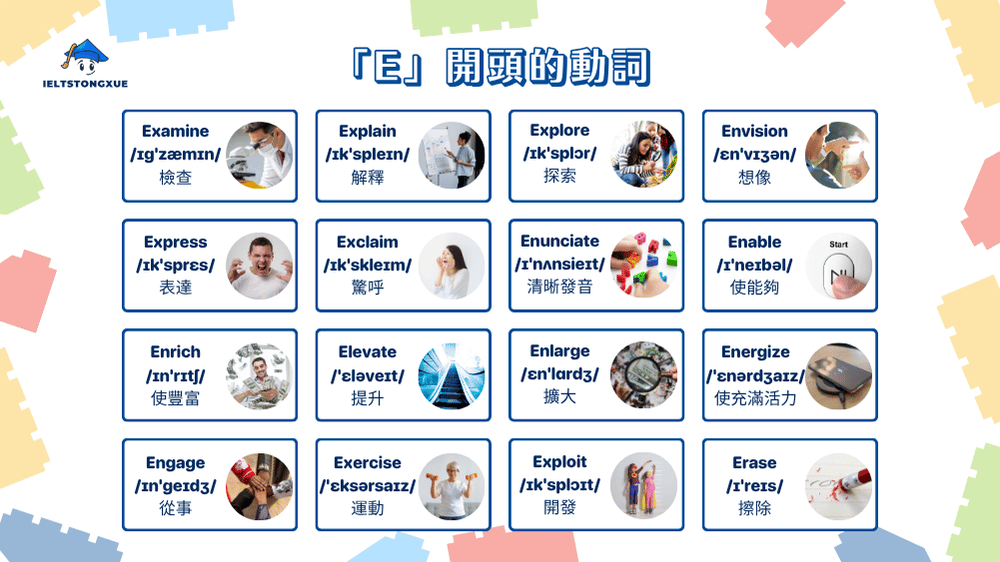
| E 開頭的英文單字 | 中文解釋 | 例句 |
| 思考與認知動詞 | ||
| Examine
/ɪgˈzæmɪn/ |
檢查;審查 | The doctor will examine your condition carefully.(醫生將仔細檢查您的狀況。) |
| Explain
/ɪkˈspleɪn/ |
解釋;說明 | Could you explain the process in simpler terms?(您能用更簡單的詞語解釋這個過程嗎?) |
| Explore
/ɪkˈsplɔr/ |
探索;探究 | Scientists continue to explore new frontiers in space.(科學家持續探索太空的新領域。) |
| Evaluate
/ɪˈvæljueɪt/ |
評估;評價 | The committee will evaluate all proposals fairly.(委員會將公平評估所有提案。) |
| Estimate
/ˈɛstəmeɪt/ |
估計;評估 | Experts estimate the project will take six months.(專家估計計畫將需時六個月。) |
| Expect
/ɪkˈspɛkt/ |
預期;期待 | We expect positive results from this initiative.(我們期待這項計畫帶來正面結果。) |
| Envision
/ɛnˈvɪʒən/ |
想像;展望 | Leaders must envision the future of the organization.(領導者必須展望組織的未來。) |
| Elucidate
/ɪˈlusɪdeɪt/ |
闡明;說明 | The professor elucidated the complex theory.(教授闡明這個複雜理論。) |
| Enlighten
/ɛnˈlaɪtən/ |
啟發;開導 | The lecture enlightened students about ancient cultures.(講座啟發學生認識古代文化。) |
| Envisage
/ɛnˈvɪzɪdʒ/ |
想像;預想 | It is hard to envisage life without technology.(難以想像沒有科技的生活。) |
| 溝通與表達動詞 | ||
| Express
/ɪkˈsprɛs/ |
表達;表示 | She expressed her gratitude for the support.(她表達對支持的感謝。) |
| Emphasize
/ˈɛmfəsaɪz/ |
強調;著重 | The report emphasizes the importance of sustainability.(報告強調永續發展的重要性。) |
| Exclaim
/ɪkˈskleɪm/ |
驚呼;呼喊 | The audience exclaimed in amazement.(觀眾驚嘆地呼喊。) |
| Elaborate
/ɪˈlæbəreɪt/ |
詳細說明;闡述 | Could you elaborate on your proposal?(您能詳細說明您的提案嗎?) |
| Echo
/ˈɛkoʊ/ |
回響;重複 | Her words echoed through the hall.(她的話在大廳迴響。) |
| Enunciate
/ɪˈnʌnsieɪt/ |
清晰發音;闡明 | The speaker enunciated each word clearly.(演講者清晰地發出每個字。) |
| Elucidate
/ɪˈlusɪdeɪt/ |
闡釋;解釋 | The guide elucidated the historical context.(導覽員闡釋歷史背景。) |
| 建立與創造動詞 | ||
| Establish
/ɪˈstæblɪʃ/ |
建立;確立 | The organization aims to establish global partnerships.(該組織旨在建立全球夥伴關係。) |
| Enable
/ɪˈneɪbəl/ |
使能夠;促使 | Technology enables people to work remotely.(科技使人們能夠遠距工作。) |
| Erect
/ɪˈrɛkt/ |
建造;豎立 | Workers erected the building in record time.(工人以創紀錄的時間建造大樓。) |
| Evolve
/ɪˈvɑlv/ |
演化;發展 | Languages evolve over time through usage.(語言隨著使用而逐漸演化。) |
| Engineer
/ˌɛndʒɪˈnɪr/ |
設計;策劃 | They engineered an innovative solution.(他們設計出創新的解決方案。) |
| Embody
/ɛmˈbɑdi/ |
體現;具體表現 | The statue embodies the spirit of freedom.(雕像體現自由精神。) |
| Execute
/ˈɛksɪkjut/ |
執行;實施 | The team executed the plan flawlessly.(團隊完美地執行計畫。) |
| Enact
/ɛˈnækt/ |
制定;頒布 | The government enacted new legislation.(政府制定新法規。) |
| 增強與改善動詞 | ||
| Enhance
/ɪnˈhæns/ |
增強;提高 | Regular practice will enhance your language skills.(定期練習將提升您的語言技能。) |
| Enrich
/ɪnˈrɪtʃ/ |
使豐富;充實 | Reading diverse books will enrich your perspective.(閱讀多元書籍將豐富您的觀點。) |
| Elevate
/ˈɛləveɪt/ |
提升;舉起 | Education elevates individuals and communities.(教育提升個人與社群。) |
| Enlarge
/ɛnˈlɑrdʒ/ |
擴大;放大 | The company plans to enlarge its market share.(公司計畫擴大市場佔有率。) |
| Enforce
/ɛnˈfɔrs/ |
實施;執行 | Police enforce traffic regulations strictly.(警察嚴格執行交通規則。) |
| Energize
/ˈɛnərdʒaɪz/ |
使充滿活力;激勵 | Morning exercise energizes the body and mind.(晨間運動使身心充滿活力。) |
| Empower
/ɛmˈpaʊər/ |
授權;使能夠 | The program empowers women through education.(該計畫透過教育賦予女性力量。) |
| Equip
/ɪˈkwɪp/ |
裝備;配備 | The course equips students with practical skills.(課程為學生配備實用技能。) |
| 鼓勵與支持動詞 | ||
| Encourage
/ɪnˈkɜrɪdʒ/ |
鼓勵;激勵 | Teachers should encourage students to ask questions.(教師應該鼓勵學生提問。) |
| Engage
/ɪnˈgeɪdʒ/ |
從事;吸引 | The speaker engaged the audience with compelling stories.(演講者用引人入勝的故事吸引聽眾。) |
| Embrace
/ɛmˈbreɪs/ |
擁抱;接受 | The company embraced digital transformation.(公司擁抱數位轉型。) |
| Endorse
/ɛnˈdɔrs/ |
支持;背書 | The celebrity endorsed the charitable cause.(名人支持這項慈善事業。) |
| Entertain
/ˌɛntərˈteɪn/ |
娛樂;款待 | The host entertained guests with stories.(主人用故事款待賓客。) |
| Entrust
/ɛnˈtrʌst/ |
委託;信託 | Parents entrust their children to schools.(家長將子女託付給學校。) |
| 確保與保護動詞 | ||
| Ensure
/ɪnˈʃʊr/ |
確保;保證 | We must ensure the safety of all participants.(我們必須確保所有參與者的安全。) |
| Endure
/ɪnˈdʊr/ |
忍受;持久 | Athletes must endure intense training sessions.(運動員必須忍受高強度訓練。) |
| Enforce
/ɛnˈfɔrs/ |
強制執行;實施 | Authorities enforce environmental regulations.(當局執行環境法規。) |
| Enclose
/ɛnˈkloʊz/ |
圍住;附上 | Please enclose the documents with your application.(請將文件附在申請表中。) |
| Encircle
/ɛnˈsɜrkəl/ |
環繞;包圍 | Mountains encircle the valley.(群山環繞山谷。) |
| 使用與應用動詞 | ||
| Employ
/ɛmˈplɔɪ/ |
雇用;運用 | The company will employ innovative strategies.(公司將運用創新策略。) |
| Exercise
/ˈɛksərsaɪz/ |
運動;行使 | Citizens should exercise their voting rights.(公民應行使投票權。) |
| Exploit
/ɪkˈsplɔɪt/ |
開發;利用 | Companies exploit natural resources responsibly.(公司負責任地開發自然資源。) |
| Exert
/ɪgˈzɜrt/ |
施加;運用 | Leaders exert influence through example.(領導者透過榜樣施加影響。) |
| 消除與減少動詞 | ||
| Eliminate
/ɪˈlɪməneɪt/ |
消除;淘汰 | Efforts to eliminate poverty require global cooperation.(消除貧窮的努力需要全球合作。) |
| Erase
/ɪˈreɪs/ |
擦除;抹去 | Time cannot erase precious memories.(時間無法抹去珍貴記憶。) |
| Eradicate
/ɪˈrædɪkeɪt/ |
根除;消滅 | Scientists work to eradicate diseases.(科學家致力於根除疾病。) |
| Evacuate
/ɪˈvækjueɪt/ |
撤離;疏散 | Residents evacuated before the hurricane arrived.(颶風到來前居民撤離。) |
| Evade
/ɪˈveɪd/ |
逃避;規避 | Honest citizens do not evade taxes.(誠實的公民不逃稅。) |
| Exempt
/ɪgˈzɛmpt/ |
免除;豁免 | Students were exempted from the final exam.(學生免除期末考試。) |
| Exclude
/ɪkˈsklud/ |
排除;排斥 | The policy excludes certain categories.(該政策排除某些類別。) |
| Expel
/ɪkˈspɛl/ |
驅逐;開除 | The school expelled students for misconduct.(學校因不當行為開除學生。) |
| 展示與顯露動詞 | ||
| Exhibit
/ɪgˈzɪbɪt/ |
展示;顯露 | The artist will exhibit her latest works next month.(藝術家下個月將展示她的最新作品。) |
| Expose
/ɪkˈspoʊz/ |
暴露;揭露 | The investigation exposed serious violations.(調查揭露嚴重違規情事。) |
| Exemplify
/ɪgˈzɛmpləfaɪ/ |
例證;是⋯的典範 | Her work exemplifies dedication and skill.(她的工作是奉獻與技能的典範。) |
| Erupt
/ɪˈrʌpt/ |
爆發;噴出 | The volcano erupted after decades of dormancy.(火山在數十年的休眠後爆發。) |
| Emanate
/ˈɛməneɪt/ |
散發;發出 | Confidence emanated from the speaker.(演講者散發自信。) |
| Emit
/ɪˈmɪt/ |
發出;排放 | Factories emit greenhouse gases.(工廠排放溫室氣體。) |
| 擴展與延伸動詞 | ||
| Expand
/ɪkˈspænd/ |
擴展;膨脹 | The business plans to expand into Asian markets.(企業計畫擴展至亞洲市場。) |
| Extend
/ɪkˈstɛnd/ |
延伸;延長 | The library will extend its opening hours.(圖書館將延長開放時間。) |
| Exceed
/ɪkˈsid/ |
超過;勝過 | The results exceeded our expectations significantly.(結果大幅超越我們的期望。) |
| Excel
/ɪkˈsɛl/ |
擅長;優於 | She excels in mathematics and science.(她擅長數學和科學。) |
| Escalate
/ˈɛskəleɪt/ |
逐步升級;惡化 | The conflict escalated into violence.(衝突升級為暴力。) |
| 交換與互動動詞 | ||
| Exchange
/ɪksˈtʃeɪndʒ/ |
交換;兌換 | Students exchanged ideas during the workshop.(學生在工作坊期間交換想法。) |
| Encounter
/ɪnˈkaʊntər/ |
遭遇;遇到 | Travelers often encounter unexpected situations.(旅行者經常遭遇意外狀況。) |
| Embrace
/ɛmˈbreɪs/ |
擁抱;接納 | The community embraced diversity.(社群接納多元性。) |
| Entangle
/ɛnˈtæŋgəl/ |
使糾纏;使捲入 | Avoid becoming entangled in disputes.(避免捲入爭端。) |
| 選擇與決定動詞 | ||
| Elect
/ɪˈlɛkt/ |
選舉;選擇 | Citizens will elect their representatives next year.(公民明年將選舉他們的代表。) |
| Endorse
/ɛnˈdɔrs/ |
認可;支持 | The board endorsed the new policy.(董事會認可新政策。) |
| Enlist
/ɛnˈlɪst/ |
徵募;爭取 | The army enlisted new recruits.(軍隊徵募新兵。) |
| 賺取與獲得動詞 | ||
| Earn
/ɜrn/ |
賺取;贏得 | Hard work helps you earn respect from others.(努力工作幫助您贏得他人尊重。) |
| Earn
/ɜrn/ |
獲得;掙得 | She earned a scholarship through excellent grades.(她透過優異成績獲得獎學金。) |
| 出現與浮現動詞 | ||
| Emerge
/ɪˈmɜrdʒ/ |
浮現;出現 | New opportunities emerge during challenging times.(困難時期會浮現新機會。) |
| Erupt
/ɪˈrʌpt/ |
突然發生;爆發 | Conflict erupted between rival groups.(對立團體間爆發衝突。) |
| Emanate
/ˈɛməneɪt/ |
發源;散發 | Strange sounds emanated from the basement.(地下室傳出奇怪聲音。) |
| 啟蒙與教育動詞 | ||
| Educate
/ˈɛdʒukeɪt/ |
教育;培養 | Schools educate future generations.(學校教育未來世代。) |
| Enlighten
/ɛnˈlaɪtən/ |
啟發;教導 | The documentary enlightened viewers about climate change.(紀錄片啟發觀眾認識氣候變遷。) |
| Edify
/ˈɛdɪfaɪ/ |
啟迪;教化 | Great literature edifies readers.(偉大文學啟迪讀者。) |
| 進入與參與動詞 | ||
| Enter
/ˈɛntər/ |
進入;參加 | Participants entered the competition enthusiastically.(參賽者熱情地參加比賽。) |
| Enroll
/ɛnˈroʊl/ |
註冊;登記 | Students enrolled in the advanced course.(學生註冊進階課程。) |
| Embark
/ɛmˈbɑrk/ |
開始;從事 | They embarked on a new business venture.(他們開始新的商業冒險。) |
| Entail
/ɛnˈteɪl/ |
需要;使必需 | The project entails significant investment.(該計畫需要大量投資。) |
| 其他重要動詞 | ||
| Ebb
/ɛb/ |
退潮;衰退 | His enthusiasm began to ebb over time.(他的熱情隨時間逐漸消退。) |
| Eavesdrop
/ˈivzdrɑp/ |
偷聽;竊聽 | It is rude to eavesdrop on private conversations.(偷聽私人對話很不禮貌。) |
| Economize
/ɪˈkɑnəmaɪz/ |
節約;節省 | Families must economize during difficult times.(困難時期家庭必須節約。) |
| Etch
/ɛtʃ/ |
蝕刻;銘記 | The experience was etched in her memory.(這段經歷銘刻在她記憶中。) |
| Evoke
/ɪˈvoʊk/ |
喚起;引起 | The music evoked memories of childhood.(音樂喚起童年回憶。) |
| Exaggerate
/ɪgˈzædʒəreɪt/ |
誇大;誇張 | Do not exaggerate the facts.(不要誇大事實。) |
| Excel
/ɪkˈsɛl/ |
優於;擅長 | Athletes excel through dedication and training.(運動員透過奉獻和訓練表現優異。) |
| Excavate
/ˈɛkskəveɪt/ |
挖掘;發掘 | Archaeologists excavated ancient ruins.(考古學家挖掘古代遺址。) |
3. 總結以「E」開頭的形容詞
形容詞賦予語言豐富的描述能力,讓表達更加生動精確。以下收錄50個實用的 E 開頭英文單字形容詞,幫助您精準描述各種特質、狀態與程度:
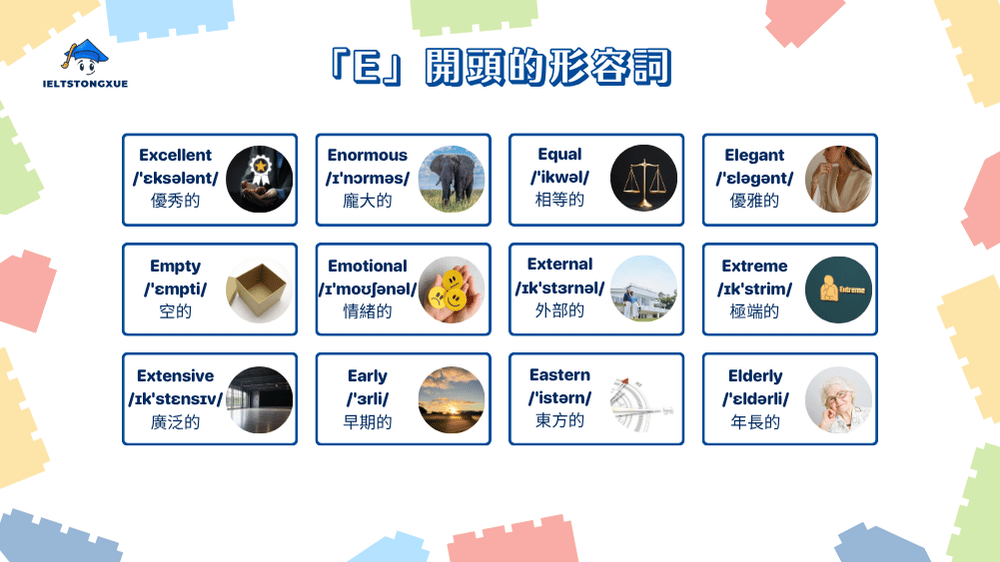
| E 開頭的英文單字 | 中文解釋 | 例句 |
| Efficient
/ɪˈfɪʃənt/ |
有效率的;能幹的 | An efficient system saves both time and resources.
(高效率的系統節省時間與資源。) |
| Effective
/ɪˈfɛktɪv/ |
有效的;生效的 | Communication is the most effective tool for collaboration.
(溝通是協作最有效的工具。) |
| Essential
/ɪˈsɛnʃəl/ |
必要的;本質的 | Sleep is essential for maintaining good health.
(睡眠對維持健康至關重要。) |
| Excellent
/ˈɛksələnt/ |
優秀的;傑出的 | She delivered an excellent presentation yesterday.
(她昨天進行一場優秀的簡報。) |
| Enormous
/ɪˈnɔrməs/ |
巨大的;龐大的 | The project requires an enormous amount of effort.
(這個計畫需要大量努力。) |
| Equal
/ˈikwəl/ |
相等的;平等的 | All team members deserve equal opportunities.
(所有團隊成員都應獲得平等機會。) |
| Elegant
/ˈɛləgənt/ |
優雅的;精緻的 | The architect designed an elegant building structure.
(建築師設計一座優雅的建築結構。) |
| Empty
/ˈɛmpti/ |
空的;空虛的 | The theater was nearly empty during the afternoon show.
(下午場次時劇院幾乎是空的。) |
| Entire
/ɪnˈtaɪr/ |
全部的;完整的 | She read the entire book in one weekend.
(她在一個週末讀完整本書。) |
| Environmental
/ɪnˌvaɪrənˈmɛntəl/ |
環境的;周遭的 | Environmental protection requires immediate action.
(環境保護需要立即行動。) |
| Emotional
/ɪˈmoʊʃənəl/ |
情緒的;情感的 | The film triggered an emotional response from viewers.
(這部電影引發觀眾的情感反應。) |
| Economic
/ˌɛkəˈnɑmɪk/ |
經濟的;經濟學的 | Economic growth benefits the entire society.
(經濟成長使整個社會受益。) |
| Educational
/ˌɛdʒuˈkeɪʃənəl/ |
教育的;有教育意義的 | The museum offers educational programs for children.
(博物館為兒童提供教育計畫。) |
| Electronic
/ɪˌlɛkˈtrɑnɪk/ |
電子的;電子學的 | Electronic devices have become part of daily life.
(電子裝置已成為日常生活的一部分。) |
| Eligible
/ˈɛlɪdʒəbəl/ |
合格的;適任的 | Only eligible candidates will be invited for interviews.
(僅有合格候選人將受邀面試。) |
| Evident
/ˈɛvɪdənt/ |
明顯的;明白的 | The benefits of exercise are evident to everyone.
(運動的好處對每個人都很明顯。) |
| Explicit
/ɪkˈsplɪsɪt/ |
明確的;清楚的 | The contract contains explicit terms and conditions.
(合約包含明確的條款與條件。) |
| External
/ɪkˈstɜrnəl/ |
外部的;外在的 | External factors influenced the final decision.
(外部因素影響最終決定。) |
| Extreme
/ɪkˈstrim/ |
極端的;極度的 | Extreme weather conditions disrupted transportation.
(極端天氣狀況擾亂交通運輸。) |
| Enthusiastic
/ɪnˌθuziˈæstɪk/ |
熱情的;熱心的 | The team showed an enthusiastic attitude toward the project.
(團隊對計畫展現熱情態度。) |
| Ethical
/ˈɛθɪkəl/ |
道德的;倫理的 | Companies should follow ethical business practices.
(公司應遵循道德商業行為。) |
| Exceptional
/ɪkˈsɛpʃənəl/ |
例外的;卓越的 | Her exceptional talent earned her recognition.
(她卓越的才華為她贏得認可。) |
| Existing
/ɪgˈzɪstɪŋ/ |
現有的;現存的 | We need to improve existing infrastructure systems.
(我們需要改善現有基礎設施系統。) |
| Extensive
/ɪkˈstɛnsɪv/ |
廣泛的;大量的 | The research involved extensive data collection.
(這項研究涉及廣泛的資料蒐集。) |
| Extraordinary
/ɪkˈstrɔrdənɛri/ |
非凡的;特別的 | The team achieved extraordinary results this quarter.
(團隊本季達成非凡成果。) |
| Eager
/ˈigər/ |
渴望的;熱切的 | Students are eager to learn new skills.
(學生渴望學習新技能。) |
| Early
/ˈɜrli/ |
早期的;提早的 | Early intervention can prevent serious problems.
(早期介入可預防嚴重問題。) |
| Earnest
/ˈɜrnɪst/ |
認真的;誠摯的 | She made an earnest effort to improve her performance.
(她認真努力改善表現。) |
| Eastern
/ˈistərn/ |
東方的;向東的 | Eastern philosophy emphasizes harmony and balance.
(東方哲學強調和諧與平衡。) |
| elderly
/ˈɛldərli/ |
年長的;上了年紀的 | The program provides support for elderly citizens.
(該計畫為年長公民提供支援。) |
4. 總結以「E」開頭的其他詞類
語言的豐富性不僅體現在主要詞類上,副詞與慣用語更是提升表達精確度與文化深度的關鍵元素。副詞能精確修飾動作與狀態,而慣用語則展現語言的文化底蘊與使用智慧。
4.1. 副詞 (Adverbs):精確修飾動作與狀態
副詞在句子中扮演修飾者的角色,為動詞、形容詞或其他副詞增添精確的程度、方式或時間資訊。以下精選的 E 開頭副詞將幫助您表達得更加細膩準確:
| E 開頭的英文單字 | 中文解釋 | 例句 |
| Especially
/ɪˈspɛʃəli/ |
特別地;尤其 | This method works especially well for beginners.
(這個方法對初學者特別有效。) |
| Eventually
/ɪˈvɛntʃuəli/ |
最終;終於 | Hard work will eventually lead to success.
(努力工作終將帶來成功。) |
| Equally
/ˈikwəli/ |
相等地;同樣地 | All opinions should be equally valued.
(所有意見都應被同等重視。) |
| Exactly
/ɪgˈzæktli/ |
確切地;正是 | That is exactly what I meant to say.
(那正是我想說的意思。) |
| Extremely
/ɪkˈstrimli/ |
極端地;非常 | The task proved to be extremely challenging.
(這項任務證明非常具挑戰性。) |
| Efficiently
/ɪˈfɪʃəntli/ |
有效率地;能幹地 | The team completed the project efficiently.
(團隊有效率地完成計畫。) |
| Effectively
/ɪˈfɛktɪvli/ |
有效地;實際上 | The strategy worked effectively in practice.
(策略在實際執行中有效運作。) |
| Eagerly
/ˈigərli/ |
渴望地;熱切地 | Children eagerly awaited the holiday season.
(孩子們熱切期待假期到來。) |
| Easily
/ˈizəli/ |
容易地;輕易地 | She can easily solve complex problems.
(她能輕易解決複雜問題。) |
| Entirely
/ɪnˈtaɪrli/ |
完全地;徹底地 | The decision was entirely based on facts.
(這個決定完全基於事實。) |
4.2. 慣用語與片語 (Idioms & Phrases):提升口語與寫作的道地感
慣用語是語言文化的精髓,承載著豐富的歷史與智慧。學習 E 開頭的慣用語不僅能讓您的英語聽起來更自然道地,更能深入理解英語文化的思維方式:
| 英文 | 中文解釋 | 例句 |
| each and every | 每一個(強調) | Each and every participant contributed valuable ideas.
(每一位參與者都貢獻寶貴想法。) |
| easier said than done | 說來容易做來難 | Changing habits is easier said than done.
(改變習慣說來容易做來難。) |
| early bird | 早起的人;及早行動者 | The early bird catches the best opportunities.
(早起的鳥兒有蟲吃。) |
| earn one’s keep | 賺取生活費;證明價值 | He works hard to earn his keep in the company.
(他努力工作以在公司證明自己的價值。) |
| easy come, easy go | 來得容易去得快 | Money from gambling follows the rule of easy come, easy go.
(賭博的錢來得容易去得快。) |
| eat one’s words | 收回前言;承認錯誤 | He had to eat his words after the results proved him wrong.
(結果證明他錯誤後,他不得不收回前言。) |
| elbow room | 足夠的空間;活動餘地 | Creative projects need elbow room for innovation.
(創意計畫需要創新的活動空間。) |
| end of the line | 終點;盡頭 | After years of service, it was the end of the line for the old system.
(服務多年後,舊系統走到盡頭。) |
| every cloud has a silver lining | 黑暗中總有一線光明 | Remember, every cloud has a silver lining during tough times.
(記住,困難時期黑暗中總有一線光明。) |
| every now and then | 偶爾;有時 | Every now and then, taking breaks improves productivity.
(偶爾休息一下能提升生產力。) |
要記住以字母 E 開頭的英文單字,你可以透過下方的 Quizlet 應用程式來複習單字:
II. E 開頭英文單字應用練習與測驗
理論學習與實際應用之間存在關鍵差距,唯有透過系統性的練習才能真正將詞彙內化為語言能力。本節設計了多樣化的練習題型,幫助您從不同角度鞏固對 E 開頭單字的掌握。
1. 練習1: 詞義配對與中文翻譯
這項練習將測試您對 E 開頭的英文單字基本語義的掌握程度。請仔細閱讀單字與釋義,運用邏輯推理找出正確配對:
| E 開頭的英文單字列表 | 中文解釋選項 |
| enhance | A. 特別地;尤其 |
| efficient | B. 證據;證明 |
| evidence | C. 有效率的 |
| explore | D. 探索;探究 |
| emotional | E. 增強;提高 |
| eliminate | F. 情緒的;情感的 |
| entire | G. 消除;淘汰 |
| especially | H. 全部的;完整的 |
參考答案: 1-E, 2-C, 3-B, 4-D, 5-F, 6-G, 7-H, 8-A
完成詞義配對之後,讓我們進入更進階的練習,考驗您在實際語境中選擇並運用正確詞彙的能力。
2. 練習2: 詞性判斷與填空應用
這項練習將挑戰您對詞性的理解以及在真實語境中運用詞彙的能力。請根據句子結構與語義,從提供的詞彙庫中選擇最恰當的 E 開頭單字填入空格,並判斷該詞彙的詞性:
詞彙庫: examine, excellent, effectively, enable, essential, evidence, encourage, entirely
- Regular health check-ups __________ doctors to detect diseases early.
- Water is __________ for all living organisms to survive.
- The lawyer presented strong __________ to support his case.
- Teachers should __________ students to think critically.
- The new software manages data more __________ than before.
參考答案:
- enable(動詞)
- essential(形容詞)
- evidence(名詞)
- encourage(動詞)
- effectively(副詞)
透過這些練習,您不僅檢驗了學習成果,更重要的是培養了在實際情境中靈活運用詞彙的能力。持續練習將幫助您將這些詞彙轉化為自然流暢的語言表達。
結語
語言學習是一個持續累積與深化的過程,今天您所掌握的這些 E 開頭單字,正是構建完整英語詞彙系統的重要基石。我建議您將這些詞彙融入日常練習中:在寫作時刻意運用新學的詞彙,在閱讀時留意它們的實際用法,在口語練習時嘗試自然地表達。隨著時間推移,這些詞彙將從「學過的單字」轉變為「能夠靈活運用的工具」。您的英語能力必將達到全新的高度,為您開啟更廣闊的國際視野與機會。謹祝您學業有成,不斷提升自我,並透過 IELTSTongXue 的全面知識資源持續進步!

