

端午節英文怎麼說?標準說法是 Dragon Boat Festival,台灣官方音譯為 Duanwu Festival,香港則稱 Tuen Ng Festival。三種說法各有適用場合,掌握差異才能在不同語境中精準表達。端午節落在農曆五月初五,是與中秋節、農曆新年並列的華人三大傳統節慶之一,擁有超過兩千年歷史。
然而,許多學習者在面對外國朋友時,往往只會說出節慶名稱,卻無法進一步介紹粽子的英文、龍舟賽的動詞搭配,或驅邪習俗的道地片語——更遑論在雅思口語考場上流暢論述傳統文化。語言的深度,決定了你能否真正跨越文化的隔閡。
本文由 IELTSTongXue 整理,提供一套從基礎到進階的完整端午節英文攻略,涵蓋節慶稱呼的場合差異、端午節粽子英文與習俗詞彙、文化敘事模板、端午節快樂英文祝賀語,以及雅思口語 Part 1、Part 2、Part 3 的高分範例回答。無論你是準備英語考試的學生、需要向外國同事解釋假期的職場人士,還是希望提升跨文化溝通能力的語言學習者,這篇指南都能讓你開口就展現自信與深度。
I. 端午節英文怎麼說?各種場合的稱呼與 Dragon Boat Festival 具體例句
端午節英文不只有一種說法。根據場合、對象與語境,你可以選擇不同的表達方式。無論是向外國同事解釋假期,還是在學術報告中引用文化背景,掌握這些細微差異能讓你的英文表達更加精準與自然。
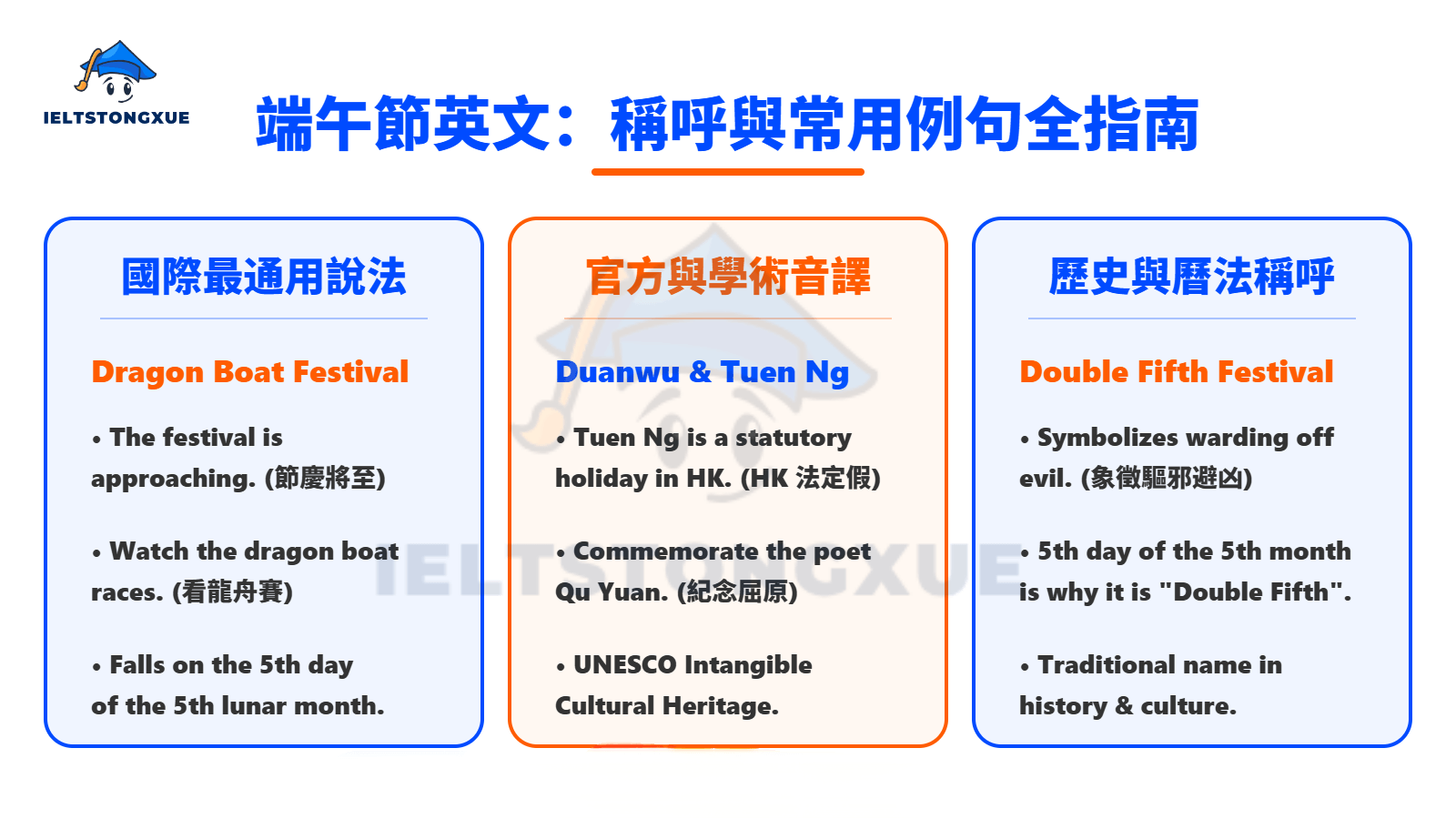
1. 國際最通用說法:Dragon Boat Festival(附具體英文句型)
Dragon Boat Festival 是全球最廣泛使用的端午節英文說法,外國人一聽就能理解節慶的核心意象。以下例句適用於日常對話與職場溝通:
- The Dragon Boat Festival is approaching.(端午節快到了。)
- Are you going to watch the dragon boat races this weekend?(你這週末要去看龍舟比賽嗎?)
- We get a public holiday for the Dragon Boat Festival in Taiwan.(台灣端午節放假。)
- The Dragon Boat Festival falls on the fifth day of the fifth lunar month.(端午節在農曆五月初五。)
- Dragon Boat Festival, also known as Double Fifth Festival, is an important festival in our history.(端午節,也被叫做雙五節,在我們的歷史中是一個重要的節日。)
2. 台港澳官方與學術音譯:Duanwu & Tuen Ng Festival(附具體英文句型)
在正式文件或學術語境中,台灣官方採用 Duanwu Festival,香港官方則使用 Tuen Ng Festival。這兩種端午節英文說法能展現你對在地文化的精確掌握:
- Tuen Ng Festival is a statutory holiday in Hong Kong.(端午節是香港的法定假日。)
- We celebrate the Duanwu Festival to commemorate the patriotic poet Qu Yuan.(我們慶祝端午節以紀念愛國詩人屈原。)
- The Duanwu Festival has been officially recognized by UNESCO as an Intangible Cultural Heritage.(端午節已被聯合國教科文組織列為非物質文化遺產。)
3. 歷史與曆法稱呼:Double Fifth Festival(附具體英文句型)
Double Fifth Festival 是從農曆曆法衍生的學術稱呼,常見於歷史文獻與文化研究中。其中 double 指兩個五,fifth 為序數,合指農曆五月初五。使用這個名稱,能讓你的端午節英文介紹更具學術深度:
- It is also known as the Double Fifth Festival because it falls on the 5th day of the 5th lunar month.(它又稱雙五節,因為落在農曆五月初五。)
- The Double Fifth carries deep symbolic meaning related to warding off evil and celebrating summer.(雙五節承載著驅邪避凶與慶祝夏季的深層象徵意義。)
- In Minnan culture, the festival is traditionally called the Fifth Month Festival.(在閩南文化中,這個節日傳統上稱為「五月節」。)
II. 端午核心詞彙大全:端午節粽子英文、習俗片語(Phrases)與實用俚語(Idioms)
掌握端午節英文的節慶名稱只是起點。要真正用英文「活用」端午節,你需要熟悉從端午節粽子英文到龍舟競渡、從驅邪習俗到高階成語的完整詞彙庫。本章節按主題分類,讓你在任何場合都能流暢表達。
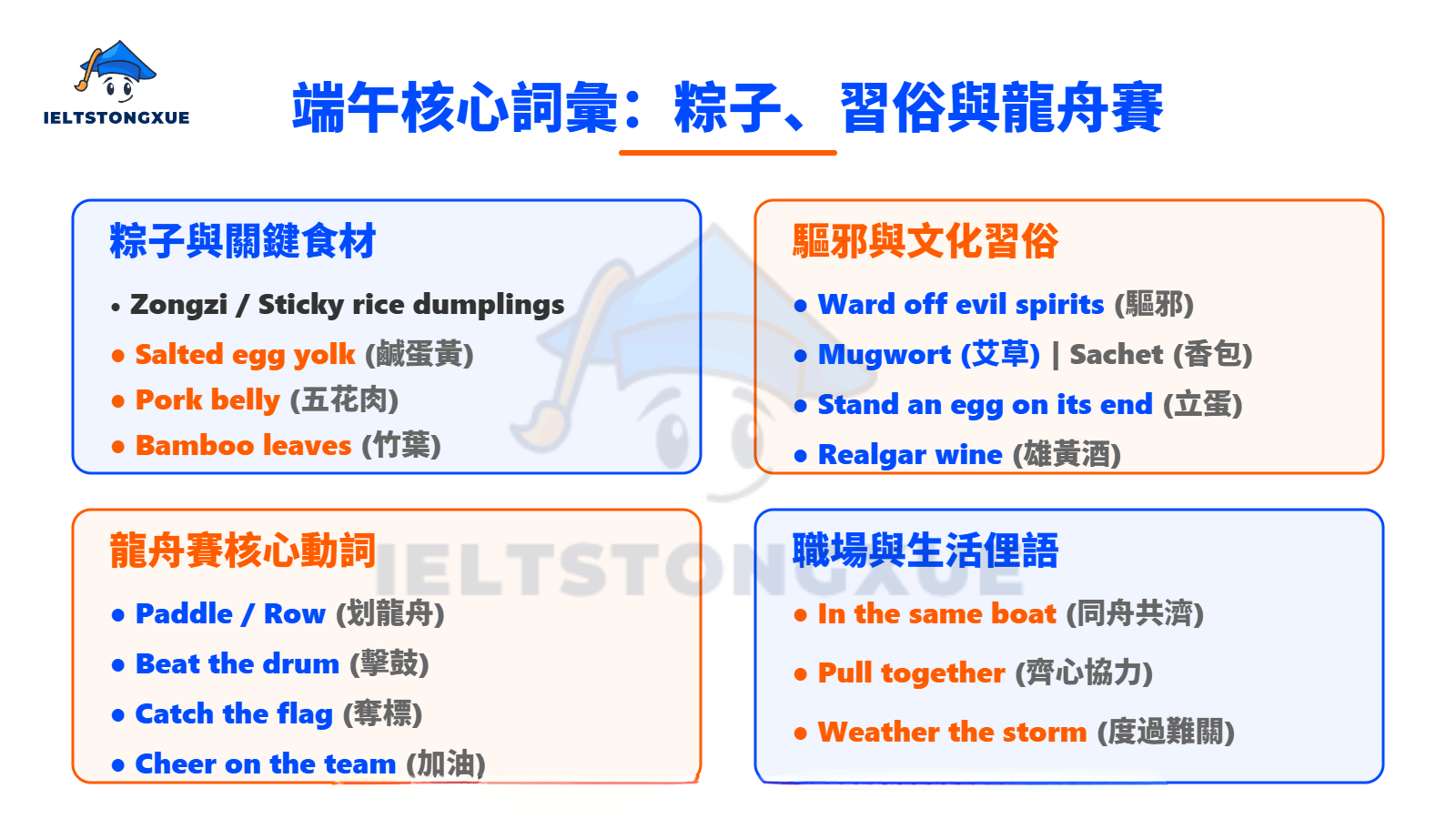
1. 飲食篇:端午節粽子英文(Zongzi)、南北部粽與豐富內餡單字
端午節粽子英文的標準說法是 Zongzi(粽子,音譯)或 sticky rice dumplings(糯米糰,描述性說法)。sticky 描述糯米的黏性口感,dumpling 廣泛指各種包有餡料的食物。向外國朋友介紹時,兩種說法可搭配使用:
- We eat Zongzi, which are sticky rice dumplings wrapped in bamboo leaves.(我們吃粽子,也就是用竹葉包裹的糯米糰。)
- Glutinous rice is stuffed with different fillings such as egg yolk, pork and mushroom, then wrapped in bamboo leaves and cooked in boiling water.(糯米填入蛋黃、豬肉、香菇等不同餡料,再以竹葉包覆,放入滾水中蒸煮。)
傳說屈原投汨羅江後,民眾為了保護他的遺體不被魚群侵擾,將包有餡料的糯米糰投入江中,這便是吃粽子習俗的起源。以下表格涵蓋台灣南北部粽的常見內餡與口感描述:
| 中文名稱 | 英文說法 |
| 粽子 | Zongzi / sticky rice dumplings |
| 竹葉 | bamboo leaves |
| 糯米 | glutinous rice / sticky rice |
| 五花肉 | pork belly |
| 鹹蛋黃 | salted egg yolk |
| 香菇 | shiitake mushrooms |
| 蝦米 | dried shrimp |
| 栗子 | chestnuts |
| 花生 | peanuts |
| 紅豆泥 | red bean paste |
| 鹼粽 | lye water rice dumpling |
描述粽子口感時,你可以使用以下片語:wrapped in bamboo leaves(以竹葉包裹)、chewy and fragrant(有嚼勁且香氣濃郁)、steamed to perfection(蒸得恰到好處)。
2. 節慶活動篇:Dragon Boat Festival 龍舟賽的動名詞搭配
學端午節英文不只要記名詞,更要掌握動詞搭配。在英文中,race 特指有起點、終點的比速競賽,因此 dragon boat race 最為精確。以下是龍舟賽的核心動名詞組合:
- row / paddle a dragon boat(划龍舟)——paddle 更常見於口語
- beat the drum(擊鼓)——龍舟隊的鼓手負責統一划槳節奏
- catch / grab the flag(奪標)——龍舟賽終點的決勝動作
- cheer on the team(為隊伍加油)——觀眾的參與方式
- compete in a dragon boat race(參加龍舟賽)——正式描述競賽參與
- line up at the starting line(在起跑線排列整齊)——比賽前的準備動作
- cross the finish line(衝過終點線)——完成比賽
在句子中,你可以這樣運用:
- Dragon boat racing is the most popular activity on Dragon Boat Festival.(划龍舟是端午節最受歡迎的活動。)
- After Qu Yuan jumped into the river, people paddled out on boats to search for his body.(屈原投江後,人們划船出去尋找他的遺體。)
- Teams from across the city compete in dragon boat races, paddling in perfect unison to the beat of the drum.(來自全市的隊伍參加龍舟競賽,在鼓聲的節拍中整齊劃一地划行。)
3. 驅邪避凶篇:艾草、香包與「立蛋」的道地英文片語
端午節的慶祝活動不止吃粽子與看龍舟。The celebration is a time for protection from evil and disease for the rest of the year.(端午節的慶祝活動是為了在餘下的一年中防止邪惡與疾病的侵擾。)以下詞彙涵蓋台港地區常見的驅邪文化,是完整端午節英文介紹不可或缺的部分:
| 中文習俗 | 英文說法 | 例句 |
| 艾草 | mugwort / moxa / wormwood | Hanging mugwort at the door is believed to repel evil spirits.(在門口掛艾草,據信能驅除邪靈。) |
| 菖蒲 | calamus / sweet flag | People hang calamus and Chinese mugwort on doors to avoid bad luck and diseases.(人們在門上掛菖蒲和艾草以驅除厄運和疾病。) |
| 香包 | fragrant sachet / perfume pouch / perfumed medicine bag | The fragrant sachets are said to protect kids from evil spirits and prevent diseases.(香包據說能保護孩子遠離邪靈和疾病。) |
| 雄黃酒 | realgar wine / realgar alcohol | Realgar wine is a Chinese alcoholic drink believed to drive away evil spirits.(雄黃酒是一種中國酒飲,被認為能驅除邪靈。) |
| 立蛋 | stand an egg on its end / egg balancing / egg standing | It is said that if people can stand an egg at noon, they will have good luck the whole year.(傳說在正午能立起蛋的人,整年都會有好運。) |
| 鍾馗畫像 | portrait of Chung Kuei | Displaying a portrait of Chung Kuei is believed to ward off evil.(張貼鍾馗畫像被認為能驅邪。) |
使用這些詞彙時,ward off 是最道地的片語,遠比 keep away evil 更自然。Hanging moxa on the front door is to keep the bad spirit away.(在前門掛艾草是為了趕走邪氣。)
4. 文化故事篇:白蛇傳與端午節的淵源
除了屈原的故事,端午節在民間文化中還與另一個著名的傳說緊密相連——Legend of the White Snake(白蛇傳)。在這個故事中,女主角白素貞被丈夫的師父法海強迫在端午節喝下雄黃酒,結果顯露出其真正的蛇的形態,令丈夫受到驚嚇。這一情節解釋了端午節飲雄黃酒習俗的另一層文化意涵:人們相信雄黃能驅除一切妖邪,包括偽裝成人形的妖怪。
- Dragon Boat Festival commemorates the death of the poet Qu Yuan, but its folk culture extends far beyond this single story.(端午節紀念詩人屈原之死,但其民俗文化遠不止於這一個故事。)
- I love the female main character in Legend of the White Snake. She is so brave!(我喜歡白蛇傳中的女主角,她好勇敢!)
5. 進階表達:與「龍」或「團隊精神」相關的英文俚語(Idioms)
以下成語不只適用於日常對話,更能在雅思寫作或口語中展現語言深度,是提升端午節英文表達層次的利器:
- In the same boat(同舟共濟;處於相同困境):字面上指同乘一船,引申為面臨相同處境。”During the pandemic, we were all in the same boat.”(疫情期間,我們同舟共濟。)
- Pull together(齊心協力;共同努力):龍舟競賽的核心精神,也適用於團隊合作情境。”To win the race, the team must pull together.”(要贏得比賽,團隊必須齊心協力。)
- Weather the storm(度過難關;經受風浪):呼應端午節戰勝困境的歷史主題。”With persistence, we can weather any storm.”(只要堅持,我們能度過任何難關。)
- Go against the current(逆流而上;不隨波逐流):暗喻屈原堅守原則的精神。”It takes courage to go against the current.”(逆流而上需要勇氣。)
- Row your own boat(掌控自己的人生;自力更生):意指獨立自主,把握自己的方向,與划龍舟的意象相呼應。
III. 文化敘事:如何寫出一篇完美的端午節英文介紹?
詞彙是材料,敘事是架構。學完端午節英文的單字與片語後,你需要學會如何把這些元素組合成流暢、有說服力的端午節英文介紹。以下提供兩種層次的模板:一種適合社交場合的快速破冰,另一種適合深度文化分享。
1. 30 秒快速破冰:適合社交場合的簡潔介紹模板
當外國朋友問起端午節,你可以直接使用以下約 50 字的 Elevator Pitch,開口就能留下深刻印象:
「The Dragon Boat Festival, or Duanwu Festival, is a traditional Chinese holiday celebrated on the fifth day of the fifth lunar month. We eat sticky rice dumplings called Zongzi, watch exciting dragon boat races, and hang mugwort at the door to bring good health. It’s one of the most vibrant festivals of the year.」
(端午節,又稱端午,是在農曆五月初五慶祝的傳統華人節日。我們吃稱為粽子的糯米糰、觀看精彩的龍舟比賽,並在門口掛艾草以祈求健康。這是一年中最熱鬧的節日之一。)
如果想補充更多細節,你可以加上:
- This holiday also serves as a time for protection from evil and disease for the rest of the year.(這個節日同時也是祈求全年避免邪惡與疾病侵擾的時刻。)
2. 深入淺出歷史淵源:用英文講述愛國詩人屈原(Qu Yuan)的故事
在較正式的場合或雅思口語 Part 2,你需要一段有故事性的敘述。以下是端午節英文介紹的完整歷史敘事範本:
「The Dragon Boat Festival traces its origins to the story of Qu Yuan, a patriotic poet and government official of the Chu State during the Warring States period, around 300 BCE. He was a good and respected man, but because of the misdeeds of jealous rivals, he eventually fell into disfavor in the emperor’s court.」
(端午節的起源可追溯至屈原的故事,他是約公元前 300 年戰國時代楚國的愛國詩人與政府官員。他是一位善良而受人尊崇的人,卻因嫉妒對手的惡行,最終在朝廷中失寵。)
「Unable to regain the respect of the emperor, in his sorrow Qu Yuan threw himself into the Miluo River in 277 BCE as an act of protest and despair. Because of their admiration for Qu Yuan, the local people rushed into their boats to search for him while throwing rice into the waters to appease the river dragons.」
(無法重獲皇帝的尊重,憂鬱的屈原於公元前 277 年投身汨羅江,以此表達抗議與絕望。由於民眾對屈原的深切愛戴,他們紛紛划船搜尋,並向江中投入糯米以平息江中的龍。)
「Over centuries, these acts of mourning evolved into the Dragon Boat Festival we celebrate today — the races re-enacting the rescue, and the Zongzi honoring his memory. It is a festival that celebrates both cultural identity and the enduring power of moral courage.」
(數百年來,這些哀悼之舉演變為今日的端午節——龍舟競渡重現了當年的搜救,粽子則承載著對屈原的永恆紀念。這是一個同時慶祝文化認同與道德勇氣永恆力量的節日。)
IV. 實用社交對話:如何說「端午節快樂英文」與外國朋友互動
節慶語言的核心在於互動。掌握地道的端午節快樂英文祝賀語,以及如何邀請外國朋友體驗粽子,能讓你的端午節英文應用更加自然而有溫度。
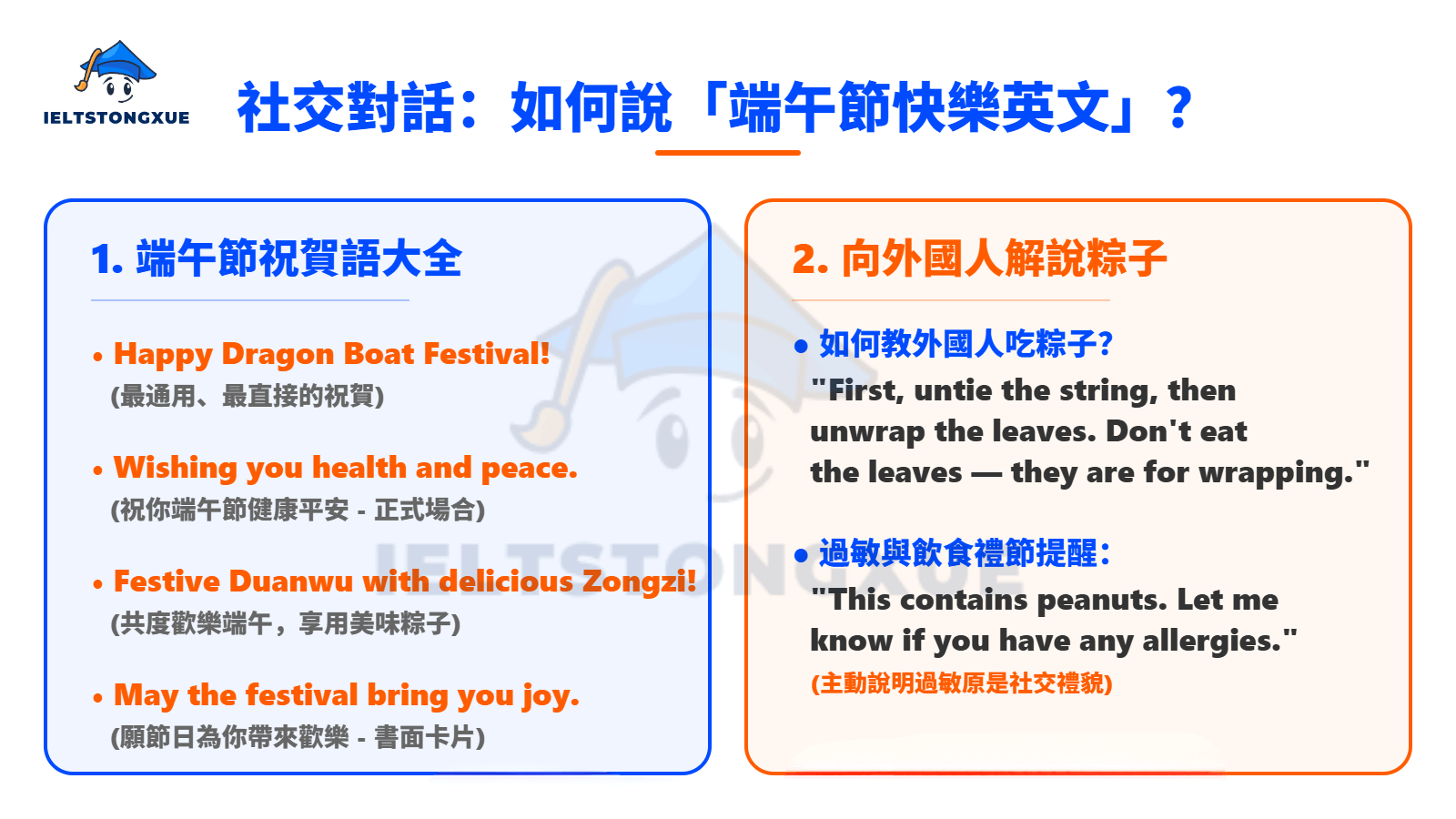
1. 節慶祝賀語大全:端午節快樂英文的不同表達法
端午節快樂英文的標準說法是 Happy Dragon Boat Festival!,但你也可以根據對象與語境選擇更細緻的表達:
- Happy Dragon Boat Festival!(端午節快樂!)——最通用、最直接的祝賀語
- Happy Duanwu Festival!(端午節快樂!)——台灣風格,適合有文化背景知識的對象
- Wishing you health and peace on Tuen Ng Festival.(祝你端午節健康平安。)——適合香港正式場合
- May the Dragon Boat Festival bring you joy and good health.(願端午節為你帶來歡樂與健康。)——書面祝賀,適合卡片或訊息
- Wishing you a festive Duanwu with family and delicious Zongzi!(祝你與家人共度歡樂端午,享用美味粽子!)——輕鬆溫馨,適合朋友間
2. 飲食解說與邀約:向外國人說明粽子吃法與禁忌
向外國朋友介紹端午節粽子英文時,以下情境對話能幫助你自然邀約,同時預防誤解:
甲:Would you like to try some Zongzi? I made them myself this morning.(你想試試粽子嗎?我今早剛做的。)
乙:Sure! How do I eat it?(好啊!怎麼吃?)
甲:First, untie the string, then carefully unwrap the bamboo leaves. Don’t eat the bamboo leaves — they’re just for wrapping. The sticky rice inside is the part you eat.(先解開繩子,再小心打開竹葉。竹葉不能吃——它只是包裝用的。裡面的糯米才是食用部分。)
在邀請外國朋友之前,請主動說明過敏原資訊,這是尊重對方的重要禮節:
- This Zongzi contains peanuts. Please let me know if you have any nut allergies.(這個粽子含有花生,如果你對堅果過敏,請告知我。)
- The filling includes pork belly and salted egg yolk. Is that okay for you?(內餡包含五花肉和鹹蛋黃,你可以接受嗎?)
V. 考場實戰:端午節英文在雅思口語(IELTS Speaking)的高分應用
對台灣與香港大多數考生而言,「傳統節慶」是雅思口語中最常見的主題之一,卻也是最容易流於表淺的陷阱。如果你能運用本文所學的端午節英文詞彙與文化敘事架構,在考場中有條理地展開論述,就能在考官面前展現真正的語言能力,而非背誦套路答案。
1. Part 1 基礎問答:關於 Dragon Boat Festival 的常見考題
以下提供六道雅思口語 Part 1 常見考題及高分範例回答,每題後附完整繁體中文翻譯。
Q1: Do you like the Dragon Boat Festival?(你喜歡端午節嗎?)
Sample Answer:
Yes, I genuinely enjoy the Dragon Boat Festival. For me, it’s one of those rare occasions where the whole family gathers to make Zongzi together — wrapping glutinous rice with pork belly and salted egg yolk in bamboo leaves. Beyond the food, I love the competitive atmosphere of the races. Watching teams paddle in unison to the beat of the drum is incredibly energizing. It reminds me that some traditions, even ancient ones, have a way of pulling people together across generations.
(是的,我非常喜歡端午節。對我來說,這是全家聚在一起包粽子的難得時刻。除了美食之外,我也喜歡賽事的競技氛圍。看著各隊隨著鼓聲整齊劃一地划行,那種能量令人振奮。它提醒我,有些傳統即便歷史悠久,依然有著凝聚跨代人心的力量。)
Q2: How do you usually celebrate the Dragon Boat Festival?(你通常如何慶祝端午節?)
Sample Answer:
We usually start the day by preparing Zongzi as a family. My grandmother always leads the process — she soaks the glutinous rice overnight and wraps each dumpling with great precision. In the afternoon, we head out to watch the dragon boat races by the river. In the evening, we hang mugwort and calamus by the front door as tradition dictates.
(我們通常以全家一起準備粽子來開始這天。我的祖母一直是主導者——她前一晚浸泡糯米,並精確地包好每個粽子。下午,我們前往河邊觀看龍舟賽。傍晚,按照傳統,我們在前門掛上艾草和菖蒲。)
Q3: What is your favorite food during the Dragon Boat Festival?(你在端午節最喜歡吃什麼?)
Sample Answer:
Without a doubt, it’s the traditional Zongzi with salted egg yolk and pork belly. The combination of the chewy sticky rice and the rich, savory filling is hard to beat. I also love the southern Taiwanese style, where the rice is pre-cooked before wrapping — it has a distinctly smooth texture that sets it apart.
(毫無疑問,是傳統的鹹蛋黃五花肉粽子。有嚼勁的糯米與濃郁鹹香的餡料相結合,難以匹敵。我也很喜歡台灣南部風格的粽子——它有一種特別光滑細緻的口感。)
Q4: Have you ever watched a dragon boat race?(你曾經看過龍舟賽嗎?)
Sample Answer:
Yes, several times. The atmosphere is electric — dozens of teams line up at the starting line, the crowd cheers, and the sound of the drums is almost deafening. What strikes me most is the teamwork involved. Every paddler must synchronize perfectly with the rhythm of the drummer, or the boat loses speed. It’s a true demonstration of pulling together.
(是的,看過好幾次了。現場氣氛十分熱烈——數十支隊伍在起跑線上排列整齊,觀眾歡呼雀躍,鼓聲幾乎震耳欲聾。最令我印象深刻的是其中的團隊合作。每位划槳手都必須與鼓手的節奏完美同步,否則船速就會減慢。這是齊心協力的真實展現。)
Q5: Did you celebrate the Dragon Boat Festival when you were a child?(你小時候有慶祝端午節嗎?)
Sample Answer:
Absolutely. I used to make my own fragrant sachet at the Dragon Boat Festival when I was little. My mother would prepare the herbs and I would help sew the pouch. I also remember trying to stand an egg on its end at noon every year — I never quite managed it, but the whole family would gather around and cheer me on. Those memories are very vivid.
(當然有。我小時候在端午節都會自己做香包。我的母親會準備藥草,我則幫忙縫製小袋子。我也記得每年正午都會嘗試立蛋——我從來沒能成功,但全家人會聚在一起為我加油。那些記憶非常鮮明。)
Q6: Do you think the Dragon Boat Festival is important?(你認為端午節重要嗎?)
Sample Answer:
Yes, I think it is. It connects people to their cultural roots in a way that few modern activities can match. When you eat Zongzi or watch a dragon boat race, you’re participating in traditions that are over two thousand years old. That sense of continuity is genuinely precious, especially for younger generations who are growing up in a digital world.
(是的,我認為它很重要。它以現代活動難以匹敵的方式,將人們與自身的文化根源相連。當你吃粽子或觀看龍舟賽時,你正在參與超過兩千年歷史的傳統。那種延續感是真正珍貴的,尤其對於在數位世界中成長的年輕世代而言。)
2. Part 2 描述題:請做一段端午節英文介紹(Describe a traditional festival)
Cue Card:
Describe a traditional festival in your country. You should say:
- what it is
- when and how people celebrate it
- what it means to you
- and explain why it is important to keep this tradition alive
Sample Answer:
I’d like to talk about the Dragon Boat Festival, which falls on the fifth day of the fifth lunar month — typically in June. It is one of the oldest and most culturally significant festivals in Taiwan and Hong Kong, alongside Chinese New Year and the Mid-Autumn Festival.
The festival originates from the story of Qu Yuan, a patriotic poet from ancient China who threw himself into the Miluo River as an act of political protest. To honor his memory, people began racing dragon boats and tossing sticky rice dumplings into the water — traditions that have evolved into what we celebrate today.
In practical terms, the day usually begins with the family gathering to prepare or buy Zongzi — sticky rice dumplings wrapped in bamboo leaves and filled with pork belly, salted egg yolk, and mushrooms. In the afternoon, communities gather along rivers to watch or participate in dragon boat races, where teams of paddlers row in perfect unison to the beat of a drum. Many families also hang mugwort and calamus by the door to ward off evil spirits.
For me personally, the festival carries a sense of continuity. When I unwrap a Zongzi, I’m connected to a story that is over two thousand years old. It reminds me that cultural identity isn’t just something you read about — it’s something you taste, hear, and feel.
(我想介紹端午節,它在農曆五月初五——通常在六月——慶祝,是台灣與香港最古老、最具文化意義的節日之一,與農曆新年和中秋節並列。之舉。為了紀念他,人們開始賽龍舟、向水中投這個節日源於屈原的故事,他是古代中國一位愛國詩人,以投身汨羅江作為政治抗議粽子——這些習俗演變為今日的端午節慶。在實際生活中,這天通常從家人齊聚包粽子或購買粽子開始。下午,社區居民聚集河畔觀賞或參與龍舟賽,各隊划手隨著鼓聲整齊划行。許多家庭也會在門口掛上艾草和菖蒲以驅除邪靈。對我個人而言,這個節日帶有一種文化傳承感。當我打開粽子葉,我與一個超過兩千年的故事相連。它提醒我,文化認同不只是閱讀而來——它是你品嚐、聆聽、親身感受的存在。)
3. Part 3 深入討論:傳統節慶在現代社會的意義
以下三道雅思口語 Part 3 考題提供簡潔而有深度的回答,符合雅思口語每題約 30 至 60 秒的論述要求。
Q1: Why is it important to keep traditional festivals like the Dragon Boat Festival alive?(為何保留像端午節這樣的傳統節慶很重要?)
Sample Answer:
Traditional festivals serve as anchor points for cultural identity. Without them, younger generations lose their connection to history and shared values. The Dragon Boat Festival, for example, transmits lessons about loyalty and moral courage through storytelling and ritual. Beyond culture, these festivals also strengthen family bonds and community ties, which are increasingly rare in fast-paced urban life. Losing them would be an irreversible cultural loss.
(傳統節慶是文化認同的錨點。若失去這些節慶,年輕世代將與歷史和共同價值觀脫節。以端午節為例,它透過故事與儀式傳遞忠誠與道德勇氣的精神。此外,這些節慶也能強化家庭紐帶與社區聯繫——這些在快節奏的城市生活中愈發稀缺。失去它們將是不可挽回的文化損失。)
Q2: Do you think young people are losing interest in traditional festivals?(你認為年輕人是否對傳統節慶失去興趣?)
Sample Answer:
To some extent, yes. Many young people see traditional festivals as just a day off rather than a meaningful cultural event. However, I think the festivals themselves are evolving. Dragon boat racing, for instance, has become an international competitive sport, attracting young participants worldwide. Social media also helps — people share Zongzi recipes and festival photos online, which keeps the culture visible and relevant to younger audiences.
(在某種程度上,是的。許多年輕人將傳統節慶視為純粹的假日,而非有意義的文化活動。然而,我認為節慶本身正在演變。以龍舟賽為例,它已成為一項國際競技運動,吸引全球年輕參與者。社群媒體也發揮了作用——人們在網路上分享粽子食譜和節慶照片,讓文化對年輕一代保持可見度與相關性。)
Q3: How have the celebrations of the Dragon Boat Festival changed over time?(端午節的慶祝方式如何隨時間改變?)
Sample Answer:
The core elements remain — eating Zongzi, racing dragon boats, and wearing fragrant sachets. But the scale and format have shifted significantly. What was once a local community ritual has grown into a major international sporting event, with competitions held across Asia, Europe, and North America. On the food side, traditional Zongzi fillings have also expanded to include creative modern variations like seafood and dessert flavors, reflecting how living traditions can adapt without losing their soul.
(核心元素依舊——吃粽子、賽龍舟、戴香包。但規模與形式已有顯著改變。原本是地方社區儀式的活動,如今已發展為在亞洲、歐洲及北美舉辦的重大國際體育賽事。在飲食方面,傳統粽子餡料也擴展至海鮮甚至甜點等創意現代口味,體現了活的傳統如何在不失其精髓的情況下與時俱進。)
VI. 常見疑惑與進階交流(FAQ):深入探討 Dragon Boat Festival
以下四個進階問答能幫助你建立更完整的跨文化視野,進一步豐富你的端午節英文表達能力。在英語導覽、學術討論或高階對話中,這些內容能展現真正的文化素養。
1. 端午節與其他東亞粽子節慶在英文表達上有何差異?
雖然東亞多個文化都有包粽子的習俗,但其英文名稱與文化內涵截然不同。
- 台灣與香港的端午節對應 Dragon Boat Festival 或 Duanwu Festival。
- 韓國的「江陵端午祭」英文為 Gangneung Danoje Festival,其內容以歌舞祭典為主,與划龍舟關聯不大,已於 2005 年被聯合國教科文組織列為非物質文化遺產。
- 日本的五月五日即 Children’s Day(兒童節),內容以鯉魚旗及祈願男孩健康為主,與屈原故事無關。
- 在英語表達中,準確使用各自的專有名稱,能避免文化混淆。
2. 是否可以將端午節直接稱呼為「華人的感恩節」?
不建議如此類比。Thanksgiving(感恩節)的核心主題是感謝豐收與家人團聚,而端午節的重心在於紀念屈原的犧牲精神以及驅邪避凶的民俗信仰,兩者的文化底層邏輯截然不同。過度簡化的類比雖然能讓外國人快速理解,但往往犧牲了文化的精確性。更好的做法是直接說:
- It’s a memorial festival with deep roots in Chinese poetry and folk religion, quite distinct from Western harvest holidays.(這是一個深植於中國詩歌與民間宗教的紀念節日,與西方豐收假日截然不同。)
3. 將端午節龍舟賽與西方賽艇(Regatta)進行比較,是否更容易理解?
這是一個有效但需謹慎使用的教學策略。向西方人介紹龍舟賽時,可以借用 regatta(水上賽事)的概念作為初步框架:
- Think of it like a regatta, but instead of rowing in silence, the entire team synchronizes to a drummer at the front.(把它想成水上賽事,但與安靜划行不同,整隊以船頭鼓手的節拍同步划行。)
牛津劍橋賽艇賽(The Boat Race)可作為輔助說明,但需強調龍舟賽不只是競技,更是對屈原故事的集體重現,具有深厚的文化意涵。
4. 除了划龍舟與吃粽子,還有哪些值得在英語導覽中介紹的特色習俗?
端午節的習俗可分為三大類,適合在英語導覽中有系統地介紹。
- 飲食類: 除了 Zongzi,南台灣有以鹼水製成的 lye water rice dumpling(鹼粽),部分地區還有飲用 realgar wine(雄黃酒)的傳統。需提醒外國朋友,雄黃酒含有微量毒性物質,現代多已作為文化儀式而非實際飲用。
- 避邪類: 在門口懸掛 mugwort(艾草)與 calamus(菖蒲)、為孩童配戴 fragrant sachets(香包)、張貼 portrait of Chung Kuei(鍾馗畫像)等,都是具有豐富民俗意涵的習俗,能引發外國訪客強烈的文化好奇心。
- 競賽類: 除了 dragon boat races(龍舟賽),「午時立蛋」即 standing an egg on its end at noon(正午立蛋)是台港地區廣受歡迎的民俗活動。據說在正午時分,雞蛋能直立於平面上,象徵好運與技巧。這個習俗在英語說明中往往令外國人驚喜不已,是引發跨文化對話的絕佳話題。
結論
端午節是一個層次豐富的節慶——它既是歷史的紀念,也是族群的凝聚,更是日常語言學習的絕佳素材。從 Dragon Boat Festival 的標準說法,到雅思口語 Part 2 的完整論述,你現在擁有了完整的端午節英文工具箱。語言學習的真正進步,來自於將詞彙與真實文化情境結合的那一刻。這個端午節,試著用英文向身邊的外國朋友分享一個關於屈原的故事——你會發現,語言是最好的文化橋樑。

