



吵架英文怎麼說?在英語中,「吵架」並沒有唯一的對應單字。Argue、quarrel、fight、dispute 各自代表不同程度的衝突——從有邏輯根據的爭辯,到情緒失控的激烈對峙,每個詞的語氣與適用場合都截然不同。許多人以為「吵架」只是一個簡單的生活詞彙,卻不知道它在英語中是一套層次分明的表達系統,直接影響你在職場、考試與人際溝通中給人的印象。
想像這樣一個場景:你和朋友鬧得不愉快,對方還在冷戰,你想開口說「我們把事情說開吧」,卻只擠得出一句 “I’m sorry”——這樣的語言空白,在真實溝通中會讓你錯失化解衝突的最佳時機。從日常的 bicker(拌嘴)到英式口語的 have a row(大吵一架),再到雅思口說必備的 constructive argument(建設性討論),掌握這些詞彙的差異,才能在任何情境下精準表達自己。
本文由 IELTSTongXue 整理,從六大核心單字的語氣比較出發,涵蓋道地片語、職場溝通技巧、情緒發洩短句、吵架和好英文金句,以及雅思口說三個 Part 的完整模擬範例,是你一次搞懂吵架英文的全方位指南。
I. 吵架的英文怎麼說?六大核心單字與語氣比較表
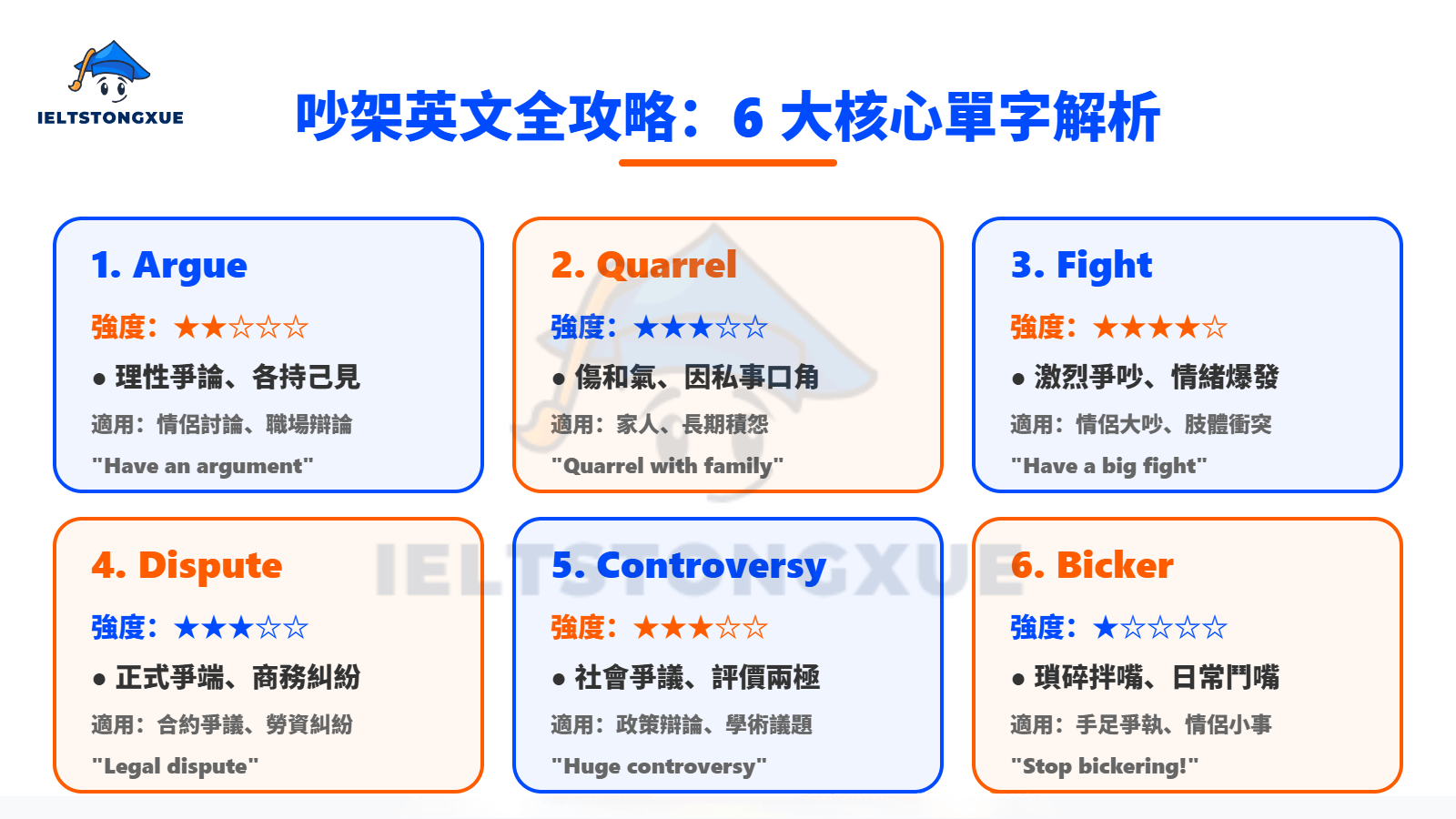
「吵架的英文」並非只有一種說法。英語依照衝突的嚴重程度、情緒強度與適用場合,提供了一系列不同的詞彙。掌握這些差異,你才能在正確的語境下選用正確的字,避免在職場說出太過口語的表達,或在日常對話中使用過於正式的詞彙而顯得格格不入。這是學好吵架英文最重要的第一步。
| 單字 | 英標(KK) | 嚴重程度 | 核心語意 | 適用情境 |
| Argue / Argument | /ˈɑːrɡjuː/ /ˈɑːrɡjumənt/ | ★★☆☆☆ | 有理由的爭論,各持己見 | 情侶討論、朋友意見相左、職場辯論 |
| Quarrel | /ˈkwɒrəl/ | ★★★☆☆ | 因私事或瑣事起的口角,傷和氣 | 家人之間、親密朋友、長期積怨 |
| Fight | /faɪt/ | ★★★★☆ | 激烈爭吵,含肢體衝突可能 | 情侶大吵、嚴重家庭衝突 |
| Dispute | /dɪˈspjuːt/ | ★★★☆☆ | 正式的爭端,多見於商業或法律語境 | 勞資糾紛、合約爭議、國土爭端 |
| Controversy | /ˈkɒntrəvɜːrsi/ | ★★★☆☆ | 評價兩極的社會性爭議 | 政策辯論、倫理議題、公眾輿論 |
| Bicker / Squabble | /ˈbɪkər/ /ˈskwɒbəl/ | ★☆☆☆☆ | 瑣碎的拌嘴、無傷大雅的鬥嘴 | 兄弟姊妹、情侶日常小摩擦 |
1. Argue / Argument(講理的爭辯 / 各持己見)
Argue 是最中性也最常見的吵架英文詞彙之一。它強調雙方各有立場、以理服人的過程,而非純粹的情緒發洩。這個字可以作動詞,也可以用名詞形式 argument。除了「爭吵」之外,argument 也有「論點、理由」的意思,是英文中使用頻率極高的多義詞。搭配介系詞時,通常用 argue with someone(與某人爭)或 argue about / over something(為某事而爭)。
- It’s normal to argue with friends once in a while.(偶爾和朋友吵架是很正常的。)
- I don’t think your argument is persuasive enough.(我不覺得你的論點足夠有說服力。)
- My husband and I had a big argument today regarding how we spend our money.(我和先生今天對於該如何用錢大吵了一架。)
2. Quarrel(傷和氣的口角 / 長期不和)
Quarrel 語氣較正式,在文學與書面語中尤其常見。與 argue 不同的是,quarrel 更偏向「無理取鬧、情緒性的吵架」,不一定有清晰的邏輯立場。它通常指因私人矛盾或積怨所引發的爭執,往往帶有情感上的傷害。Quarrel 本身也可以當動詞使用。
- I don’t want to get involved in my parents’ quarrel again. They will make up with each other a few days later anyway.(我不想再度捲入我父母的爭吵中。反正他們幾天之後就會和好了。)
- What are they quarreling about?(他們在為什麼事情吵架?)
3. Fight(激烈的爭吵 / 甚至肢體衝突)
在所有吵架英文詞彙中,fight 代表情緒最激動的狀態。它可以指言語上的激烈衝突,也可以指肢體衝突,具體意思需依語境判斷。值得注意的是,fight 也可以用於正面語境,例如 fighting spirit(拼鬥精神),表示奮鬥與努力。「have a big fight」是描述情侶或家人大吵的常用搭配。Fight 的過去式與過去分詞為不規則變化,須寫成 fought。
- Their fights are always about money.(他們的爭吵總是跟錢有關。)
- I always feel bad after a fight with my family.(我每次和家人爭執過後都會感覺很糟。)
- Stop fighting over trivial matters! Grow up and be mature!(不要再為瑣事爭吵了!長大、成熟一點吧!)
4. Dispute(正式的爭端 / 商業或法律糾紛)
Dispute 和 argument 很像,都帶有「爭論、爭吵」的含意,但 dispute 更常出現在正式場合,例如勞資意見分歧、國土糾紛、合約爭議等。它既可作名詞,也可作動詞。
- They should settle the dispute over the contracts as soon as possible, or it may affect their business.(他們應該要盡快解決合約糾紛,否則這可能會影響到他們的生意。)
- Taiwan, China, and Japan have disputed over the Diaoyutai Islands for years.(台灣、中國和日本好幾年來都因釣魚臺列嶼而存在領土紛爭。)
5. Controversy(評價兩極的社會性爭議)
Controversy 專門用來強調「評價兩極」的爭議,通常出現在社會議題、政策辯論或倫理討論中。它的形容詞形式是 controversial(有爭議性的),在雅思口說 Part 3 和學術寫作中都非常實用。
- Whether to legalize euthanasia has always been a huge controversy.(是否要合法化安樂死一直以來都存在著很大的爭議。)
- Whether to legalize euthanasia has always been controversial.(是否要合法化安樂死一直以來都很有爭議性。)
6. Bicker / Squabble(瑣碎的鬥嘴 / 拌嘴)
Bicker 和 squabble 都指無傷大雅的小爭執,往往因為一些微不足道的小事而起——兄弟姊妹搶電視遙控器、情侶為了晚餐要吃什麼而鬥嘴。這類衝突通常不留下長期積怨,卻是日常生活中最常出現的吵架英文場景。
- The kids were bickering over who got the last piece of cake.(孩子們為了誰能得到最後一塊蛋糕而拌嘴。)
- My roommate and I always squabble about whose turn it is to clean.(我和室友總是為了輪到誰打掃而吵個不停。)
II. 其他「和人吵架英文」的道地片語表達
除了上述核心單字,英語中還有一套豐富的慣用語,用來描述衝突的不同面向。掌握這些片語,你的和人吵架英文表達就能從「能說清楚」提升到「真的像母語者」。以下補充幾個從日常生活到職場都實用的延伸說法。
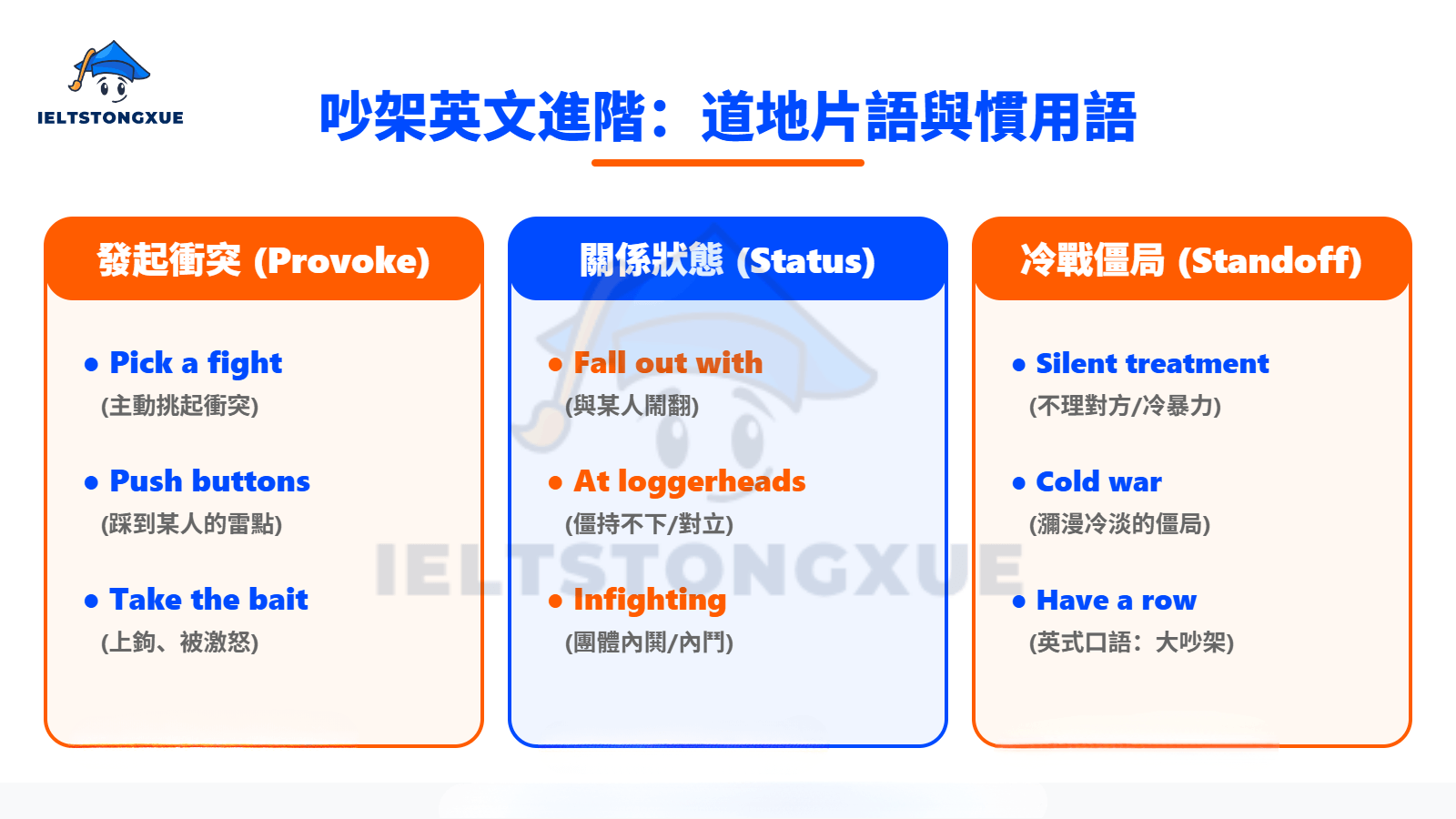
1. 尋釁找碴:Pick a fight / Push someone’s buttons
| 片語 | 中文解釋 | 範例句 |
| Pick a fight(主動挑起衝突) | 主動挑起衝突;刻意尋釁並試圖引發爭端 | We just met my ex-girlfriend in a shop, and my current girlfriend tried to pick a fight with her. I was in a bit of a panic.(我們剛好在一間店裡遇到我的前女友,結果我現任女友一直想要找她吵架,搞得我很緊張。) |
| Push someone’s buttons(踩到某人的雷點) | 踩到某人的雷點;觸碰對方敏感神經,導致情緒爆發 | She knows exactly how to push his buttons.(她很清楚如何惹他抓狂。) |
| Take the bait(上鉤、被激怒) | 上鉤、被激怒;因挑釁而被引發情緒反應 | She was lured in by taking the bait, even though she didn’t want to fight.(雖然她本來沒有想吵架,但還是忍不住被激怒了。) |
2. 關係破裂:Fall out (with someone) / At loggerheads
| 片語 | 中文解釋 | 範例句 |
| Fall out with someone(與某人鬧翻) | 指因爭執而導致關係破裂,通常用於原本親近的人 | I fell out with my best friend over something really trivial.(我為了一件非常小的事和我最好的朋友鬧翻了。) |
| At loggerheads(僵持不下 / 水火不容) | 形容雙方意見完全對立,毫無交集 | The two departments have been at loggerheads over the budget for months.(這兩個部門為了預算問題對峙了好幾個月。) |
| Infighting(內鬨、內鬥) | 這是一個專門描述組織或群體內部矛盾的名詞,非常實用 | Stop infighting. It’s only making things worse for everyone.(不要再內鬨了。這只會讓所有人的處境更糟糕。) |
3. 無聲抗議:Silent treatment / Cold war
這兩個表達對台灣與香港的讀者來說特別貼切。「冷戰」在中文世界極為常見,在英文中也有精準的對應說法。
| 片語 | 中文解釋 | 範例句 |
| Give someone the silent treatment(不理對方 / 冷戰) | 用沉默作為懲罰或抗議手段 | After the argument, she gave him the silent treatment for two days.(吵架之後,她對他冷戰了兩天。) |
| Cold war(冷戰) | 在日常英文中,它也被用來形容兩個人或兩個群體之間的冷淡僵局 | There’s a cold war going on between them ever since that incident.(自從那件事發生後,他們之間就一直處於冷戰狀態。) |
| Have a row(大吵一架) | Row 讀作 /raʊ/,是英式英文中非常道地的說法,意思等同於 have a big argument,在英國日常口語中使用頻率極高 | She had a terrible row with her flatmate last night and barely slept.(她昨晚和室友大吵了一架,幾乎沒有睡著。) |
III. 台港職場生存術:如何專業且優雅地處理意見分歧(Disagreement)
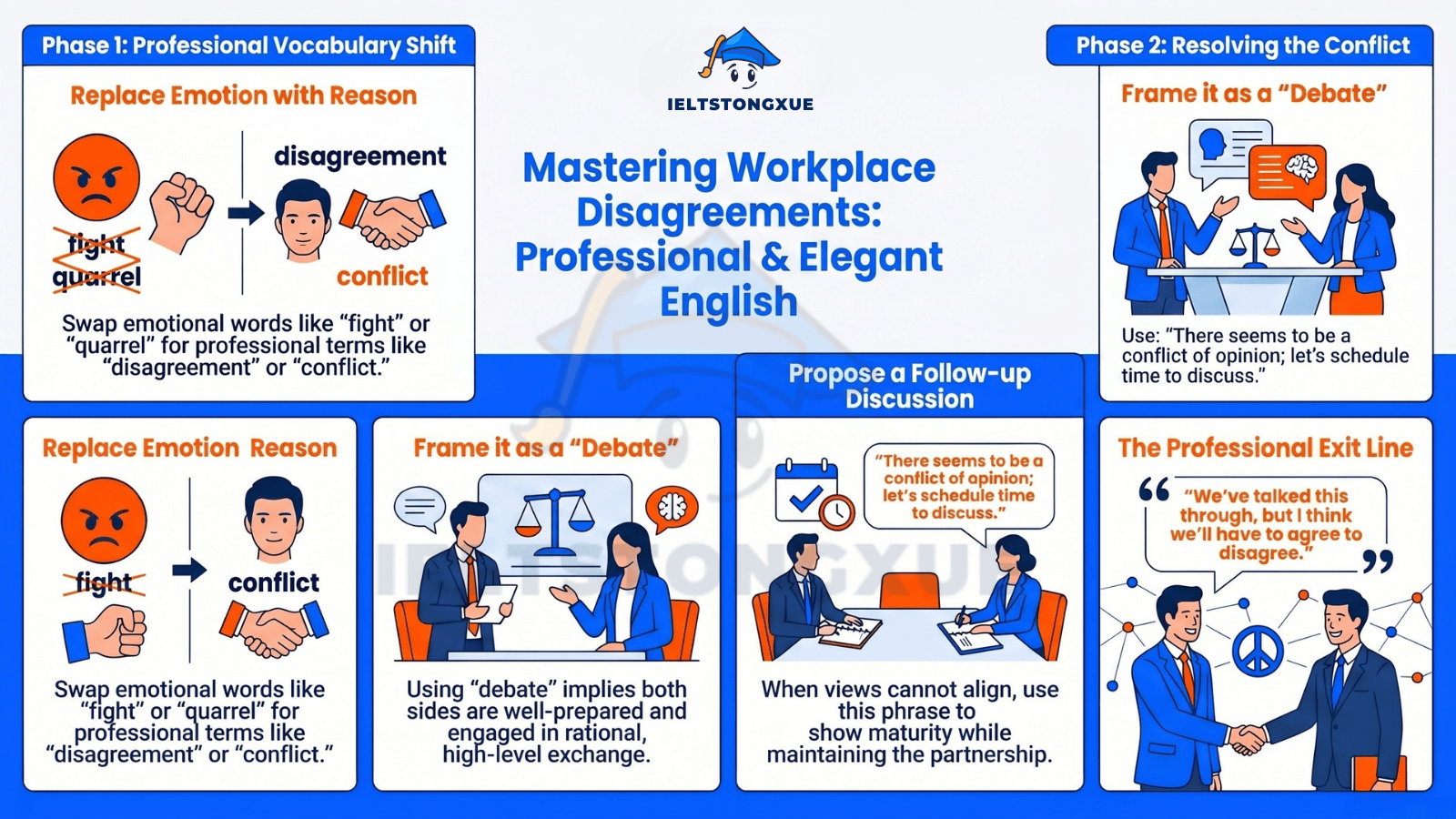
學習吵架英文,不代表只在私人場合才用得上。台灣與香港的職場文化普遍重視「以和為貴」。在這樣的環境中,直接使用 fight 或 quarrel 來描述工作上的分歧,不僅失禮,更可能傷害你的專業形象。
真正的高手,懂得把情緒衝突轉化為理性討論。在職場溝通中,你應該以 dispute、conflict 或 disagreement 取代情緒化的字眼。除此之外,debate(正式辯論、討論)也是職場英文中常見的表達方式,它帶有「雙方準備充分、理性交流」的意涵,適合用於正式會議情境。
- There seems to be a conflict of opinion on this matter. Could we schedule a time to discuss it further?(我們在這個問題上似乎存在意見分歧。能否安排時間進一步討論?)
- The subject of this policy has been hotly debated over the past few weeks, but we haven’t reached a conclusion yet.(這項政策的議題在過去幾週內被熱烈討論,但我們尚未得出結論。)
當雙方立場實在難以調和時,「agree to disagree」是職場英文中最成熟的表達之一。它代表雙方尊重彼此的不同意見,同時維護合作關係:We’ve talked this through, but I think we’ll have to agree to disagree on this one.(我們已經充分討論過了,但我認為在這個問題上我們只能各持己見了。)
IV.「吵架英文口語」必備:情境句型與情緒發洩短句
學習吵架英文口語,不代表鼓勵衝突,而是讓你在真實情境中能夠清晰表達自己的感受與底線。以下句型依情緒強度分級整理,幫助你在需要的時刻找到最合適的表達方式。
1. 警告與制止:Drop it! / Get off my back!
當你不想繼續這個話題,或已經被對方煩到極限,這些句子能直接傳達你的立場:
| 英文短句 | 中文語意 | 語氣標註 |
| Drop it! | 別再說了! | 不耐煩、強烈警告 |
| Leave me alone! | 讓我一個人靜靜! | 需要空間、情緒激動 |
| Get off my back! | 別再煩我了! | 不滿、強烈抗議 |
| Back off! | 退後一步!給我點空間! | 強烈、帶有警示意味 |
| Mind your own business! | 管好你自己的事! | 直接、防禦性強 |
| That’s none of your concern. | 這不關你的事。 | 正式、冷靜但強硬 |
| It’s not your business. | 這和你無關。 | 口語、直接 |
“You’re always criticizing me!” “Drop it, okay? I really don’t want to talk about this right now.”(「你總是在批評我!」「別再說了,好嗎?我現在真的不想談這件事。」)
2. 表達不滿與失望:I’ve had enough! / That’s the last straw!
當情緒已累積到臨界點,你需要明確讓對方知道你的忍耐已到極限:
| 英文短句 | 中文語意 | 語氣標註 |
| I’ve had enough! | 我已經受夠了! | 忍無可忍、爆發前夕 |
| That’s the last straw! | 這是最後一根稻草! | 宣告底線被突破 |
| I can’t take this anymore. | 我再也無法忍受了。 | 沉重、疲憊感 |
| You’ve crossed the line. | 你越界了。 | 冷靜但嚴肅的警告 |
| This is unacceptable. | 這完全無法接受。 | 正式、有力 |
| I’m fed up. | 我受夠了。 | 強烈不滿,略帶疲憊 |
| I’m done. | 我不想再談了。 | 乾脆、宣告退出對話 |
| We really need to talk. We can’t keep repeating this. | 我們真的要好好談一談,而不是繼續重複這樣的模式。 | 理性、試圖解決問題 |
“That’s the last straw. Every time I trust you, you let me down.”(「這是壓垮我的最後一根稻草。每次我信任你,你都讓我失望。」)
V. 破冰與修復關係:「吵架和好英文」的萬用金句
吵架是衝突,但吵架和好英文才是考驗真正溝通能力的時刻。從開口道歉,到釐清誤會,再到正式言歸於好,修復關係是一個循序漸進的過程。以下是 IELTSTongXue 為你整理的完整步驟:
Step 1:開口道歉(Apologize)
誠懇的道歉是修復關係的第一步。比起單純說「I’m sorry.」(對不起。),更有力的道歉需要承認具體的行為,並表達改變的意願。
- I’m sorry for the way I spoke to you. That was out of line.(我為我說話的方式道歉。我當時太過分了。)
- I owe you an apology. I should have listened to you more carefully.(我欠你一個道歉。我本應更認真地聆聽你說的話。)
- Sorry about it. I didn’t mean what I said.(對不起。我說的話並不是真心的。)
Step 2:釐清誤會(Clear the air)
「Clear the air」是英文中描述「消除誤會、把話說開」的核心片語。在雙方情緒都稍微平靜之後,主動提出對話,是成熟的表現。
- Can we sit down and clear the air? I don’t want this to come between us.(我們能坐下來把事情說開嗎?我不希望這件事影響我們的關係。)
- It’s really not good for us. Let’s calm down and just talk.(這樣對我們兩個人都不好,還是先冷靜下來好好談談吧。)
Step 3:達成共識,言歸於好(Make up / Bury the hatchet)
- Make up:和好,重修舊好:We always make up with each other quickly after a couples fight.(我們每次爭吵過後都會很快和好。)
- Bury the hatchet:放下過去的恩怨,重新開始。這個片語源自美洲原住民的和平儀式,意象生動有力:It’s time to bury the hatchet and move forward together.(是時候放下過去的恩怨,一起向前走了。)
VI. 吵架英文在 IELTS 雅思口說的實戰應用
前面學到的吵架英文詞彙和片語,在雅思口說(IELTS Speaking)中同樣大有用武之地。能夠靈活運用 argue、compromise、conflict、controversy 這類詞彙,是考官眼中詞彙豐富度(Lexical Resource)的直接體現。以下由 IELTSTongXue 提供完整的實戰模擬,涵蓋三個 Part 的典型題型。
1. IELTS Part 1: Daily Disagreements(日常爭執)
Part 1 考官問的是你的個人日常,回答需自然、口語,約 2 至 4 句即可。
Q1: Do you often argue with your friends or family?
Not particularly. My friends and I tend to bicker over small things — like which restaurant to go to — but nothing serious. With my family, I’ve had the occasional argument about life decisions, but we always try to talk things through calmly.
(不太常。我和朋友之間偶爾會為一些小事拌嘴,例如去哪家餐廳吃飯,但都不是嚴重的事。和家人之間,我偶爾會為了人生規劃爭論,但我們都會盡量冷靜地溝通。)
Q2: How do you usually feel after an argument?
Honestly, I usually feel pretty drained and a bit guilty, even if I was in the right. I find it hard to just move on without clearing the air first, so I tend to reach out and apologize if I said anything too harsh.
(說實話,我通常感到精疲力竭,也有點自責,即使我是對的那一方。我很難在沒有把話說開的情況下繼續前進,所以如果我說了什麼太過分的話,我傾向於主動聯繫對方並道歉。)
Q3: Did you argue with your siblings when you were a child?
Yes, absolutely. My brother and I would squabble constantly — over the TV remote, snacks, you name it. It was the classic kind of siblings fight that kids have. We always made up quickly, though. It never lasted more than a day.
(是的,當然有。我和哥哥會不斷拌嘴——為了電視遙控器、零食,什麼都吵。這就是孩子之間典型的手足爭吵。不過我們總是很快就和好了。從來不會超過一天。)
Q4: Do you think it’s healthy to argue sometimes?
I do, actually. A healthy argument allows people to express their feelings and work through misunderstandings. The problem isn’t the conflict itself — it’s how people handle it. If both sides stay respectful, arguing can actually strengthen a relationship.
(我認為是的。健康的爭論讓人們能夠表達感受、解開誤會。問題不在於衝突本身,而在於人們如何處理它。如果雙方都保持尊重,爭論實際上可以加深一段關係。)
Q5: Have you ever stopped talking to someone after an argument?
Once, yes. I fell out with a close friend over a misunderstanding that spiraled out of control. We gave each other the silent treatment for almost two weeks. Eventually, I reached out, and we buried the hatchet. I’m glad we did — it was a waste of time to stay angry.
(有過一次。我和一位親密朋友因一場失控的誤會而鬧翻了。我們互相冷戰了將近兩個星期。最終,我主動聯繫了他,我們化解了積怨。我很慶幸這樣做了——持續生悶氣只是浪費時間。)
Q6: Is it common for people your age to argue on social media?
Very much so. People often pick fights online because there’s a certain distance — they say things they’d never say face to face. It creates a lot of controversy over quite trivial issues. I personally try to stay out of those online disputes. They rarely lead anywhere productive.
(非常普遍。人們在網上經常挑釁找碴,因為有一定的距離感——他們會說一些在現實中絕對不會說的話。這在相當瑣碎的議題上製造了很多爭議。我個人盡量避開這些網路爭端,它們很少能帶來任何有建設性的結果。)
2. IELTS Part 2: Describe a time you argued with someone
Cue Card(題目卡): Describe a time when you had an argument or disagreement with someone. You should say:
- Who you argued with
- What the argument was about
- How it was resolved
- And explain how you felt about it afterwards
Model Answer(1 分鐘回答範例):
I’d like to talk about a disagreement I had with my closest friend, Xiaowang, about two years ago in Taipei. We were planning a trip together, and things started to fall out when we couldn’t agree on the budget. I wanted to keep it simple and affordable, but he had something much more extravagant in mind. At one point, tensions rose and we both said things we didn’t really mean — it turned into a genuine fight.
After a couple of days of silent treatment from both sides, I decided to reach out. I asked if we could clear the air, and we met at a coffee shop in Da’an District. We talked everything through calmly, and eventually made up. We even compromised on a mid-range travel plan that worked for both of us.
Looking back, I’m actually glad it happened. It taught me that healthy relationships aren’t about avoiding conflict — they’re about how you resolve it.
(我想說的是我和我最好的朋友小旺大約兩年前在台北的一次爭執。我們當時在計劃一起旅行,結果因為預算問題產生了摩擦。我想簡單省錢,但他心目中的計劃要豪華得多。緊張情緒升級後,我們都說了一些不太好聽的話,演變成了一場真正的吵架。
雙方冷戰了幾天後,我決定主動聯繫。我提議把事情說開,我們在大安區的一家咖啡廳見了面。我們冷靜地談清楚了一切,最終和好了。我們甚至各退一步,商定了一個雙方都能接受的中等預算旅行計劃。
回頭看,我其實很慶幸這件事發生了。它讓我明白,健康的關係不在於避免衝突,而在於你如何解決衝突。)
3. IELTS Part 3: Society & Debate(社會與辯論概念)
Part 3 考的是你對社會議題的分析能力。回答需有觀點、有邏輯,但無需過長,兩至三句一個論點即可。
Q1: Why is it important for colleagues to resolve disputes in the workplace?
Unresolved disputes damage team productivity and morale. When people are at loggerheads, communication breaks down and the work environment turns hostile. Organizations that encourage constructive argument and timely compromise tend to perform better and retain talent longer.
(未解決的爭端損害團隊生產力和士氣。當同事對峙僵持時,溝通中斷,工作環境變得充滿敵意。鼓勵建設性討論和及時妥協的組織,往往表現更好,也更能留住人才。)
Q2: Do you think conflict between people is always negative?
Not necessarily. Conflict can be a driver of change when managed well. A healthy argument pushes people to reconsider assumptions and find better solutions. The key is whether both sides can move from fighting to genuine debate — that shift in approach makes all the difference.
(不一定。當衝突被妥善處理時,它可以成為改變的動力。健康的爭論促使人們重新審視假設,找到更好的解決方案。關鍵在於雙方是否能從吵架轉向真正的辯論,這種方式上的轉變至關重要。)
Q3: How can social media affect the way people argue or express disagreement?
Social media amplifies controversy and often turns minor disagreements into public disputes. The anonymity involved encourages people to pick fights they would avoid in person. That said, it also gives marginalized voices a platform to raise concerns, which can spark meaningful debate on important issues.
(社交媒體放大了爭議,常常將小小的意見分歧升級為公開的爭端。匿名性讓人們更容易挑釁,去做他們在現實中不會做的事。不過,它也給了邊緣化的聲音一個表達平台,這有時能激發對重要議題的有意義的辯論。)
結論
語言是溝通的橋樑,而吵架英文正是這座橋樑上最難走、卻也最值得練習的一段路。從本文的學習旅程回頭看:argue 與 quarrel 的語氣差異、bicker 和 squabble 的生活場景、fall out 與 at loggerheads 的關係描述,到最終用 clear the air 和 bury the hatchet 修復一段珍貴的情誼——每一個詞彙背後,都是真實人際互動的縮影。
真正的英語能力,從來不是只在教室裡才用得上的技能。當你和外籍朋友產生誤會、在職場上需要優雅地表達異議、或是在雅思口說考場上被問到衝突與和解的話題,今天學到的詞彙與句型,就是你最可靠的底氣。語言學習沒有捷徑,但有方法——先從「說得準確」開始,再追求「說得自然」。

