



「拒絕英文」怎麼說才不失禮?這是許多台灣與香港英語學習者在職場、社交與考試中反覆面對的難題。答案不只是一個「No」。英文中表達拒絕的詞彙多達六種以上,包括 refuse、decline、reject、deny、turn down 與 disavow,每一個詞的語氣、文法結構與適用場合都不盡相同。選對詞,你是專業有禮的溝通者;選錯詞,你可能在不知不覺間冒犯了對方。
事實上,許多英語學習者在說「不」時最大的障礙,並非詞彙量不足,而是不知道如何在「直接」與「有禮」之間取得平衡。在台灣與香港的職場文化中,拒絕往往帶有更重的社交壓力——面子、和諧、階層關係,都讓一句婉拒變得格外複雜。這也是為什麼,掌握一套有結構的拒絕英文公式,遠比死背句型更有效。
本篇文章由 IELTSTongXue 整理,從六大核心單字的語氣對比、三步驟婉拒公式、職場Email模板,到雅思口說 Part 1、Part 2、Part 3 的完整範例答案,一次涵蓋你在工作、生活與考試中可能遭遇的所有「說不」情境。無論你是準備雅思的考生、外商職場的工作者,還是希望提升英語溝通自信的學習者,這份攻略都能讓你從此優雅、果斷地說出那個「不」。
I. 拒絕的英文怎麼說?六大核心單字解析
很多人學了多年英文,遇到需要說「不」的場合,腦中還是只有一個字:「No」。事實上,拒絕英文的表達方式遠比你想像的豐富,選錯詞,輕則顯得失禮,重則破壞關係或專業形象。
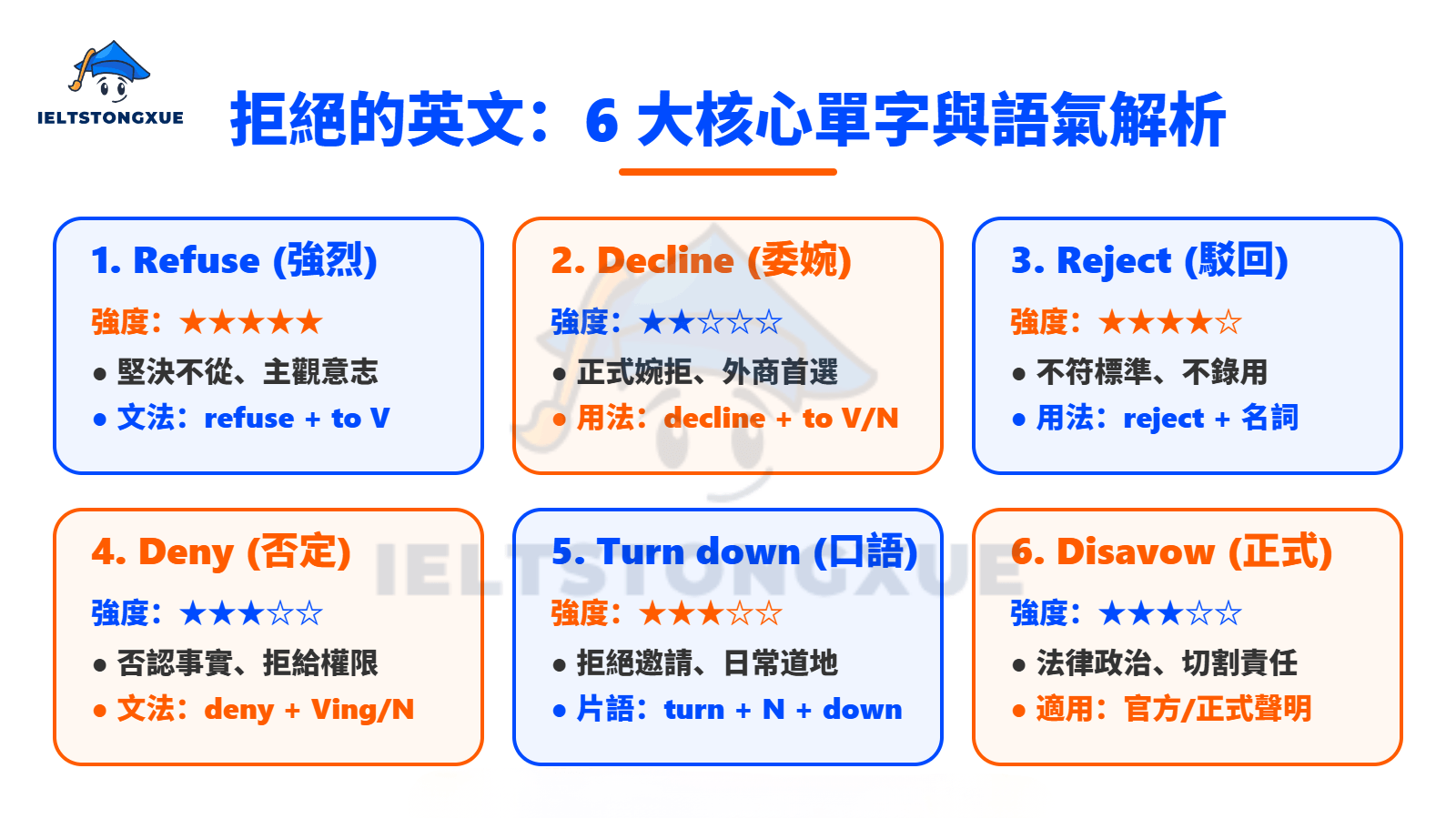
根據劍橋字典與各大英語教學資源的整理,以下六個核心詞彙,是你掌握拒絕的英文必須建立的詞彙基礎。
| 單字 | 詞性 | 語氣強度 | 核心含義 | 適用場合 |
| Refuse | 動詞 | ★★★★★(強烈) | 堅決不服從、不接受 | 拒絕規定、拒絕不合理要求 |
| Decline | 動詞 | ★★☆☆☆(委婉) | 有禮貌地婉拒 | 商務Email、正式邀約 |
| Reject | 動詞 | ★★★★☆(明確) | 駁回、不錄用、退件 | 提案審核、招聘決定 |
| Deny | 動詞 | ★★★☆☆(否定) | 否認事實或拒絕給予 | 否認指控、拒絕申請 |
| Turn down | 片語動詞 | ★★★☆☆(日常) | 拒絕邀請或提案 | 口語、商務均適用 |
| Disavow | 動詞 | ★★★☆☆(正式) | 正式否認關聯或責任 | 法律、政治、正式聲明 |
1. Refuse:強烈且直接的拒絕
劍橋字典定義:To say that you will not do or accept something.(表示你不願意做或接受某事。)
Refuse 語氣最強,傳達的是一種「堅決不從」的態度,通常帶有主觀意志的色彩。根據英語島雜誌的說明,refuse 強調的是說話者的個人立場,與事物本身的對錯或條件無關——「只要我不喜歡,即使你再好,我還是要拒絕。」此外,refuse 作名詞時有「垃圾、廢棄物」的意思,是這幾個拒絕詞彙中使用頻率最高的一個。
文法結構:refuse + to V(後接不定詞)
例句:
- The contractor refused to sign the agreement without reviewing the terms.(承包商在未審閱條款前,拒絕簽署協議。)
- My friend refuses to lend me money for a concert ticket.(我的朋友拒絕借錢給我買演唱會門票。)
2. Decline:最適合台港職場的「婉拒」
劍橋字典定義:To refuse something, especially politely.(拒絕某事,尤指以禮貌的方式。)
Decline 是這幾個詞中語氣最柔和、最正式的。它不帶對抗性,傳達的是「我選擇不」而非「我不服從」。在台灣與香港的外商職場環境中,禮貌拒絕英文的首選,正是 decline。英語島雜誌特別指出,decline 的語氣比 refuse 和 reject 更委婉、溫和、客氣,無論何種原因都可以使用。
文法結構:decline + to V 或 decline + 名詞
例句:
- She declined the offer politely and thanked them for the opportunity.(她禮貌地婉拒了邀約,並感謝對方給予機會。)
- The princess is believed to have declined various proposals of marriage.(據說公主已婉拒了各式各樣的求婚。)
3. Reject:帶有「駁回、不錄用」之意
劍橋字典定義:To refuse to accept, use, or believe something or someone.(拒絕接受、使用或相信某事或某人。)
Reject 的語感比 refuse 稍微客觀,常用於制度性或結果導向的情境,例如提案被駁回、面試未錄取,或瑕疵品退貨。根據英語島雜誌的解釋,reject 強調的是「不符合標準」而非「主觀不願意」——決定者只是依照條件給予接受或拒絕的判斷。Reject 作名詞使用時有「報廢品」的意思。
文法結構:reject + 名詞
例句:
- The manager rejected our new project proposal.(經理否決了我們的新企劃提案。)
- The factory rejected the shipment after finding defects in 15% of the units.(工廠在發現百分之十五的貨品有瑕疵後,退回了整批出貨。)
4. Deny:否認事實或拒絕給予權限
劍橋字典定義:To say that something is not true, or to refuse to give or allow something.(表示某事不屬實,或拒絕給予、允許某事。)
Deny 與前三者的文法結構不同——它後接名詞或動名詞(Ving),而非不定詞(to V)。Deny 有兩個核心用途:否認某件事的真實性,或拒絕給予某種權限。
文法結構:deny + 名詞 / deny + V-ing
例句:
- The company denied any involvement in the data breach.(公司否認與資料外洩事件有任何關聯。)
- His visa application was denied by the immigration authority.(他的簽證申請遭移民局拒絕。)
5. Turn down:口語通用的「拒絕」片語
Turn down 是英語日常溝通中最道地的拒絕說法之一,適用於口語與書面,語氣介於 decline 與 refuse 之間,可用於拒絕邀約、工作機會或提案。
文法結構:turn down + 名詞 / turn + 名詞 + down
例句:
- She turned down the job offer because the salary didn’t meet her expectations.(她拒絕了那份工作邀約,因為薪資未達她的期望。)
- He turned the proposal down without giving a reason.(他未給出任何理由便拒絕了提案。)
6. Disavow:正式否認關聯或責任
Disavow 較少出現在日常對話,主要用於法律、政治或正式聲明,表示正式否認與某事或某人的關聯。
例句:
- The organization disavowed any connection to the controversial statement.(該組織正式否認與那份爭議聲明有任何關聯。)
- The politician disavowed any ties to the scandal during the press conference.(該政治人物在記者會上正式否認與該醜聞有任何關聯。)
II. 禮貌地拒絕英文的三步驟公式
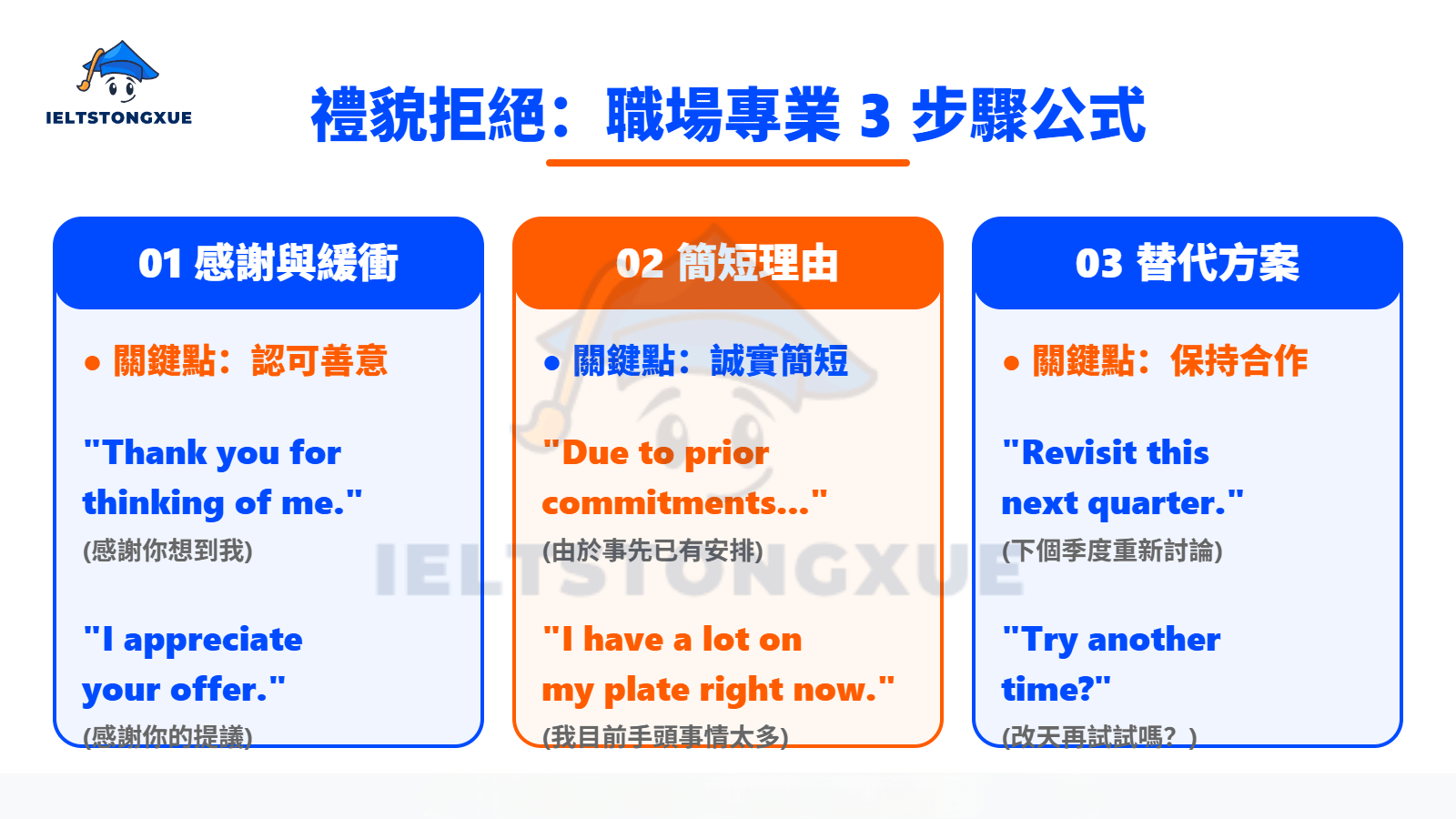
學會詞彙只是第一步。真正的挑戰,是如何把「不」說得讓對方接受,甚至感謝你的坦誠。外商職場的溝通邏輯,建立在一套清晰的結構之上——只要掌握以下三個步驟,禮貌地拒絕英文就不再令你感到焦慮。
Step 1:感謝與緩衝(Acknowledgement)
先認可對方的付出或善意,這個動作能瞬間降低被拒絕的衝擊感。常用表達如下:
- Thank you for thinking of me.(感謝你想到我。)
- I really appreciate your offer.(我非常感謝你的提議。)
- That’s very kind of you.(你真是太好了。)
- Thank you for asking / inviting me.(感謝你的詢問╱邀請。)
Step 2:給出簡短理由(Reason)
理由不必冗長,簡短、誠實且清楚即可。根據 ZIM Academy 的建議,過度解釋反而顯得心虛,甚至引起對方的懷疑。常用句型如下:
- Unfortunately, due to prior commitments…(很遺憾,由於事先有其他承諾……)
- Given our current workload, we are unable to…(考量到我們目前的工作量,我們無法……)
- I’m afraid I have to say no — I’m just buried in work right now.(恐怕我必須說不,我現在實在工作纏身。)
- I’m having a lot on my plate right now.(我目前手頭上的事情太多了。)
Step 3:提供替代方案(Alternative)
這一步是區分「普通拒絕」與「專業拒絕」的關鍵。提出替代方案,表示你仍然在乎這段關係或合作可能。常用表達如下:
- Perhaps we could revisit this next quarter.(也許我們可以在下個季度重新討論。)
- I’d be happy to recommend a colleague who specializes in this area.(我很樂意推薦一位專長於此領域的同事。)
- Would you like to try another time?(你願意改個時間再試試嗎?)
這三步驟的組合,讓每一次的委婉拒絕英文都顯得有溫度、有誠意,而不是一句冷冰冰的「No」。
III. 實用拒絕英文句型總整理:我拒絕英文可以怎麼說?
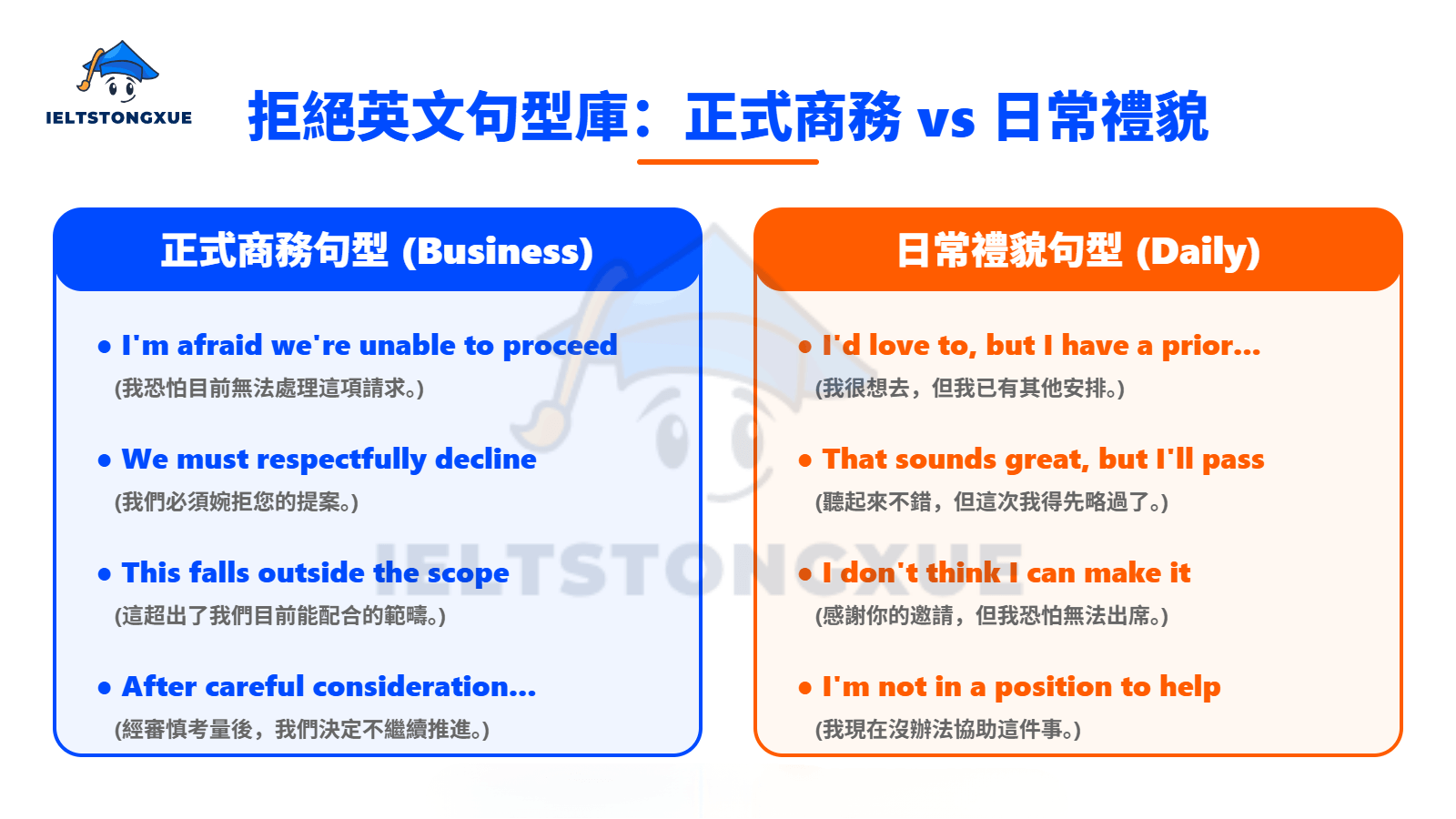
掌握公式之後,你需要的是可以直接套用的句型庫。「我拒絕」的拒絕英文表達遠不止 “I refuse”,以下分為「正式商務句型」與「日常禮貌句型」兩類,幫助你在不同情境下找到最合適的表達方式。
正式商務句型
- I’m afraid we’re unable to proceed with this request at the moment.(我恐怕目前無法處理這項請求。)
- We must respectfully decline your proposal.(我們必須婉拒您的提案。)
- Unfortunately, this falls outside the scope of what we can accommodate.(很遺憾,這超出了我們目前能配合的範疇。)
- After careful consideration, we’ve decided not to move forward with this.(經審慎考量後,我們決定不繼續推進。)
- I appreciate the offer, but I must decline on this occasion.(感謝您的提議,但這次我必須婉拒。)
- I’m awfully sorry I have to refuse such an offer, but…(對於必須拒絕這樣的提議,我深感抱歉,但是……)
- That’s very kind of you; unfortunately, I can’t…(您真是太好了,但很遺憾,我無法……)
日常禮貌句型
- I’d love to, but I have a prior commitment.(我很想去,但我已有其他安排。)
- That sounds great, but I’m going to have to pass this time.(聽起來不錯,但這次我得先略過了。)
- I appreciate you asking, but I don’t think I can make it.(感謝你的邀請,但我恐怕無法出席。)
- I wish I could, but this is really not my type of thing.(但願我可以,但這真的不是我在行的。)
- I’m not in a position to help with that right now.(我現在沒辦法協助這件事。)
- I’ll have to sit this one out.(這次我得先旁觀了。)
- I’m afraid this is not a good time.(恐怕現在沒辦法。)
IV. 其他婉轉拒絕英文的口語說法與片語
正式場合用 decline,那日常生活呢?當朋友約你週末出遊、同事邀你參加聚餐,你需要的是道地、自然,又不顯失禮的婉轉拒絕英文片語。
以下三個慣用語,是英語母語者最常掛在嘴邊的說法:
片語一:Take a rain check(改天再約)
這是拒絕邀約時最溫暖的說法之一。”Rain check” 原指因下雨延期的球賽門票,引申為「保留這個邀約、改天再用」的意思。
對話範例:
| 英文對話 | 中文翻譯 |
| A: We’re all heading to the night market tonight. Join us? | A:我們今晚要去夜市,一起嗎? |
| B: I’d love to, but I’m swamped with a deadline. Can I take a rain check? | B:我很想去,但我有個截止日快到了。可以改天嗎? |
| A: Of course! Next time then. | A:當然!下次見。 |
片語二:It’s not my cup of tea(不是我的菜)
這個片語用來婉拒某種活動或偏好,語氣輕鬆,完全沒有冒犯意味。
對話範例:
| 英文對話 | 中文翻譯 |
| A: Want to join us for karaoke on Friday? | A:週五要不要來唱卡拉OK? |
| B: Thanks for the invite! Honestly, karaoke isn’t really my cup of tea. | B:謝謝邀請!老實說,唱卡拉OK不太是我的菜。 |
| A: No worries, maybe next time! | A:沒關係,下次再說吧! |
片語三:I’ll pass on this one(這次先略過)
語氣直接但不失禮,適合在熟悉的朋友或同事之間使用,傳達「我選擇不參與這次」的意思。
對話範例:
| 英文對話 | 中文翻譯 |
| A: We’re trying that new hotpot place. Coming? | A:我們要去試試那家新火鍋店,要來嗎? |
| B: I’ll pass on this one — I had a hotpot just yesterday! | B:這次我先略過,我昨天才剛吃火鍋! |
| A: Fair enough! | A:也對! |
補充:回應對方的拒絕
當角色對調,換你是邀約方,對方拒絕了你,你應該如何禮貌回應?以下是英語母語者常用的「沒關係」說法:
- Don’t worry about it.(別擔心。)
- No worries.(沒關係。)
- No problem.(沒問題。)
- Never mind.(不要緊。)
- That’s okay, there’s always next time!(沒關係,總會有下次的!)
V. 職場實戰:委婉拒絕降價與推辭不合理要求
對於台灣與香港的貿易及商務人員而言,最令人頭痛的拒絕英文場景之一,莫過於客戶要求降價。既不想失去訂單,又不能輕易讓步——這時候,委婉拒絕降價英文的表達方式,直接影響你的談判結果。
核心原則只有一個:將拒絕的焦點轉移到「價值」,而非「價格」。
情境一:客戶要求打折
客戶說:We were hoping you could offer us a 15% discount on this order.(我們希望您能針對這筆訂單提供百分之十五的折扣。)
專業回應:
Thank you for your continued business. Our pricing reflects the quality of materials and the level of service we provide. Offering a discount at this stage would compromise our ability to maintain those standards. However, I’d be happy to explore options such as extended payment terms or a volume-based arrangement for future orders.
(感謝您長期的合作。我們的定價反映了所使用材料的品質與服務水準。在此階段提供折扣,將影響我們維持這些標準的能力。不過,我很樂意探討其他方案,例如延長付款期限,或針對未來訂單制定批量優惠。)
情境二:主管要求你接手不在職責範圍內的工作
實戰對話:
| 英文對話 | 中文翻譯 |
| Manager: Can you take over the Johnson account while Kevin is away? | 主管:Kevin不在的期間,你能接手 Johnson 的客戶嗎? |
| You: I understand the urgency, and I want to support the team. My current projects are at a critical stage this week — could we discuss either adjusting my existing priorities or having someone assist? | 你:我理解情況緊急,也希望能支援團隊。但本週我現有的專案正處於關鍵階段,我們能否討論調整我目前的工作優先順序,或安排其他人協助? |
情境三:已答應後需反悔時
- 有時候,你已經說了「好」,之後才因突發狀況而無法履行——這種情況英文稱為 backing out of something(退出某件已承諾的事)。這時請按以下三步驟處理:
- 第一步,誠懇致歉並說明原因:I know I promised to go, but something really important has come up. I’m really sorry.(我知道我答應了要去,但突然有急事發生。我真的很抱歉。)
- 第二步,提出替代方案:I’m free next week, though. Maybe we can reschedule?(不過我下週有空。也許我們可以重新安排?)
- 第三步,表達善意收尾:I hope you can understand. I hope everything goes well.(我希望你能理解。祝一切順利。)
VI. 求職必看:如何優雅拒絕工作機會與面試邀約?
收到面試邀約或工作錄取,卻因為種種原因無法接受,是求職過程中很常見的情況。許多人為了避免尷尬,選擇直接已讀不回——這是最不專業的處理方式。一封得體的拒絕面試email英文,不僅保護你的職業聲譽,更可能在未來為你開啟另一扇門。
1. 情境一:拒絕面試邀約(禮貌拒絕面試英文)
可直接套用的Email模板:
Subject: Re: Interview Invitation – [Your Name] / [Position Title]
Dear [Hiring Manager’s Name],
Thank you sincerely for inviting me to interview for the [Position Title] role at [Company Name]. After careful consideration, I have decided to withdraw from the process at this time, as I am pursuing a direction that more closely aligns with my current career goals.
I have great respect for [Company Name] and the work you do. I hope we may have the opportunity to connect in the future.
Thank you again for your time and consideration.
Warm regards, [Your Name]
2. 情境二:拿到多個 Offer,如何優雅拒絕工作機會英文
可直接套用的Email模板:
Subject: Re: Offer Letter – [Your Name]
Dear [Hiring Manager’s Name],
I am truly grateful for the offer to join [Company Name] as [Position Title]. This was a difficult decision, as I have been genuinely impressed by the team and the opportunities the role presents.
After much deliberation, I have decided to accept another position that aligns more closely with my long-term professional development goals.
I hold [Company Name] in high regard and hope to stay in touch. Thank you for the time and effort you invested throughout the recruitment process.
Best regards, [Your Name]
VII. 雅思口說實戰(IELTS Speaking):如何運用禮貌拒絕英文拿高分?
在雅思口說考試中,「婉拒」不只是一個生活技能,更是展示詞彙廣度與句型多樣性的絕佳機會。以下三個題型,示範如何將禮貌拒絕英文自然融入高分答案。
1. Part 1:日常問答(Hobby / Invitation)
Part 1 的回答以自然、流暢為主,長度約三十至六十秒(約七十至一百二十字),不需要過度展開。
Q1:Do you enjoy going to loud parties?
Honestly, loud parties are not really my cup of tea. I tend to decline invitations to large gatherings because I find them quite draining. I prefer smaller get-togethers where I can have real conversations.
(老實說,嘈雜的派對並不太是我的喜好。我傾向於婉拒大型聚會的邀請,因為我覺得很耗神。我更喜歡小型聚會,可以真正進行對話。)
Q2:Have you ever had to turn down a friend’s invitation?
Yes, quite a few times actually. Whenever I’m swamped with work, I usually take a rain check on social plans. I always make sure to explain my reason and suggest catching up another time, so the friendship stays intact.
(是的,其實不少次。每當我工作繁忙時,我通常會對社交計畫說「改天再約」。我一定會解釋原因,並建議另找時間敘舊,這樣友誼就不會受影響。)
Q3:Do people in your country find it hard to say no?
I think so. In Taiwanese culture, maintaining harmony is highly valued, so people often feel uncomfortable refusing others directly. Many would rather say “maybe” or avoid the question, which sometimes causes bigger misunderstandings down the line.
(我認為是的。在台灣文化中,維持和諧非常受重視,所以人們常常不太敢直接拒絕別人。許多人寧可說「也許吧」或迴避問題,這有時反而造成更大的誤解。)
Q4:Is it important to know how to decline politely in English?
Absolutely. Knowing how to decline politely in English is a practical life skill, especially in international workplaces. If you can turn something down without damaging a relationship, you come across as both professional and emotionally intelligent.
(絕對是的。懂得如何用英文禮貌地拒絕,是一項實用的生活技能,在國際職場尤其重要。如果你能在不破壞關係的情況下拒絕某件事,別人會覺得你既專業又具備高情商。)
Q5:How do you usually respond when someone refuses your invitation?
I try to be understanding. I usually say something like “No worries, there’s always next time!” I think it’s important not to take it personally — people have their own commitments and boundaries, and a graceful response keeps the relationship positive.
(我會盡量保持理解。我通常會說「沒關係,以後還有機會!」我認為重要的是不要往心裡去,每個人都有自己的安排與界限,優雅的回應能讓關係保持正向。)
Q6:Would you say it’s easier to refuse someone in English or in your native language?
That’s an interesting question. In some ways, English actually makes refusals easier, because there are so many softening phrases — like “I’m afraid” or “I’d love to, but…” — that cushion the blow. In Mandarin or Cantonese, the social pressure can feel heavier because the culture emphasizes not wanting to lose face.
(這是個有趣的問題。某種程度上,英文其實讓拒絕變得更容易,因為有很多緩衝用語,例如「I’m afraid」或「I’d love to, but…」,能削弱衝擊感。而在普通話或廣東話的環境中,社交壓力感覺更重,因為文化上非常強調面子。)
2. Part 2:長篇描述(Describe a time you said no)
考官卡片題: Describe a time when you had to refuse someone’s request. You should say: who made the request, what the request was, why you refused, and how you felt afterwards.
高分範例答案:
I’d like to talk about a time when I had to turn down a close friend’s request for a loan. He was going through a rough patch financially and asked if I could lend him a significant sum — around NT$50,000, which is roughly 1,600 US dollars.
I genuinely wanted to help, so I didn’t reject him outright. First, I acknowledged how difficult his situation must have been and told him I was glad he trusted me enough to ask. Then I explained, honestly, that lending that amount would put my own finances under strain, especially with my rent and monthly commitments. Finally, I offered an alternative — I connected him with a non-profit credit counselling service in Taipei that I’d heard was effective.
Refusing a friend is never easy, particularly in Taiwanese culture where maintaining harmony matters deeply. I felt a degree of guilt initially. But I also knew that protecting both my finances and our friendship required me to be honest rather than agreeable. In the end, he appreciated my transparency, and our friendship remained intact.
(我想分享一次必須拒絕好友借款請求的經歷。他當時財務陷入困境,詢問我能否借他一筆錢,約新台幣五萬元,相當於一千六百美元左右。
我真的很想幫忙,所以沒有直接拒絕他。首先,我認可了他處境的艱難,告訴他我很高興他信任我、願意開口。接著,我坦誠說明,借出那筆金額會讓我自己的財務承壓,尤其是租金和每月固定支出。最後,我提供了一個替代方案,將他介紹給台北一個口碑不錯的非營利信用諮詢機構。
拒絕朋友從來都不容易,在台灣文化中尤其如此,因為維持和諧非常受重視。起初我確實感到一些愧疚。但我也清楚,保護我們雙方的財務與友誼,需要的是誠實而非一味順從。最終,他感謝了我的坦誠,我們的友誼也依然完好。)
3. Part 3:深度討論(Social Issues / Workplace)
Part 3 的答案應簡潔有力,每題約六十至九十秒(約一百至一百五十字)。避免過長或過度鋪陳,重點在於觀點清晰、詞彙多樣。
Q1:Is it difficult for people to say no in the workplace?
In many workplaces across Taiwan and Hong Kong, refusing a superior is considered socially sensitive. The cultural emphasis on hierarchy means employees often accept unreasonable requests rather than risk appearing uncooperative. However, professionals who can decline requests clearly and offer alternatives are increasingly valued, even in traditionally hierarchical environments. The key is turning something down professionally rather than rejecting it outright.
(在台灣與香港的許多職場中,拒絕上司在社交上被認為是敏感的。強調階層的文化意味著員工往往接受不合理的要求,以免顯得不配合。然而,能夠清楚地拒絕並提出替代方案的專業人士,在傳統階層架構中越來越受到重視。關鍵在於以專業方式婉拒,而非直接駁回。)
Q2:Do you think younger generations find it easier to refuse others compared to older generations?
I believe so. Younger generations, particularly those exposed to Western corporate culture or international education, tend to set boundaries more confidently. They’re more comfortable saying “I’m afraid I can’t take this on” without feeling it damages relationships. Older generations, shaped by Confucian values around respect and deference, often find refusal more emotionally costly.
(我認為是的。年輕一代,尤其是接觸過西方企業文化或國際教育的人,往往更有自信地設定界限。他們更能輕鬆地說「恐怕我無法接下這件事」,而不覺得這會損害關係。受儒家尊重與服從價值觀影響的年長一代,通常在情感上覺得拒絕的代價更高。)
Q3:What are the consequences of not being able to say no at work?
The most immediate consequence is burnout. When employees cannot decline excessive workloads, their productivity drops and their mental health suffers. From a management perspective, a team that never pushes back is also less innovative — people stop proposing alternatives or flagging problems. Teaching staff how to refuse unreasonable demands professionally is, in fact, a leadership priority in high-performing organisations.
(最直接的後果是職業倦怠。當員工無法拒絕過多的工作量,生產力就會下降,心理健康也會受損。從管理角度來看,一個從不反映意見的團隊也較缺乏創新力,因為員工不再提出替代方案或指出問題所在。教導員工如何以專業方式拒絕不合理的要求,其實是高績效組織的領導核心之一。)
結論
學會拒絕英文,是你英語溝通能力躍升的關鍵一步。說「不」從來就不是一件容易的事,但真正的難點往往不在於勇氣,而在於工具——你是否擁有足夠精準的詞彙、足夠有結構的句型,以及足夠清楚的場合判斷力,讓每一次的拒絕都顯得專業、有溫度,而非冒失或失禮。
從本文所整理的六大核心詞彙來看,refuse、decline、reject、deny、turn down 與 disavow,每一個都有其獨特的語氣與適用語境。Decline 適合正式婉拒,refuse 傳達堅定立場,reject 用於制度性判斷,deny 著重於否認,turn down 則是最日常通用的口語說法。在實際運用中,掌握「感謝緩衝→簡短理由→替代方案」的三步驟公式,能讓你的每一次拒絕都兼顧誠意與效率。

